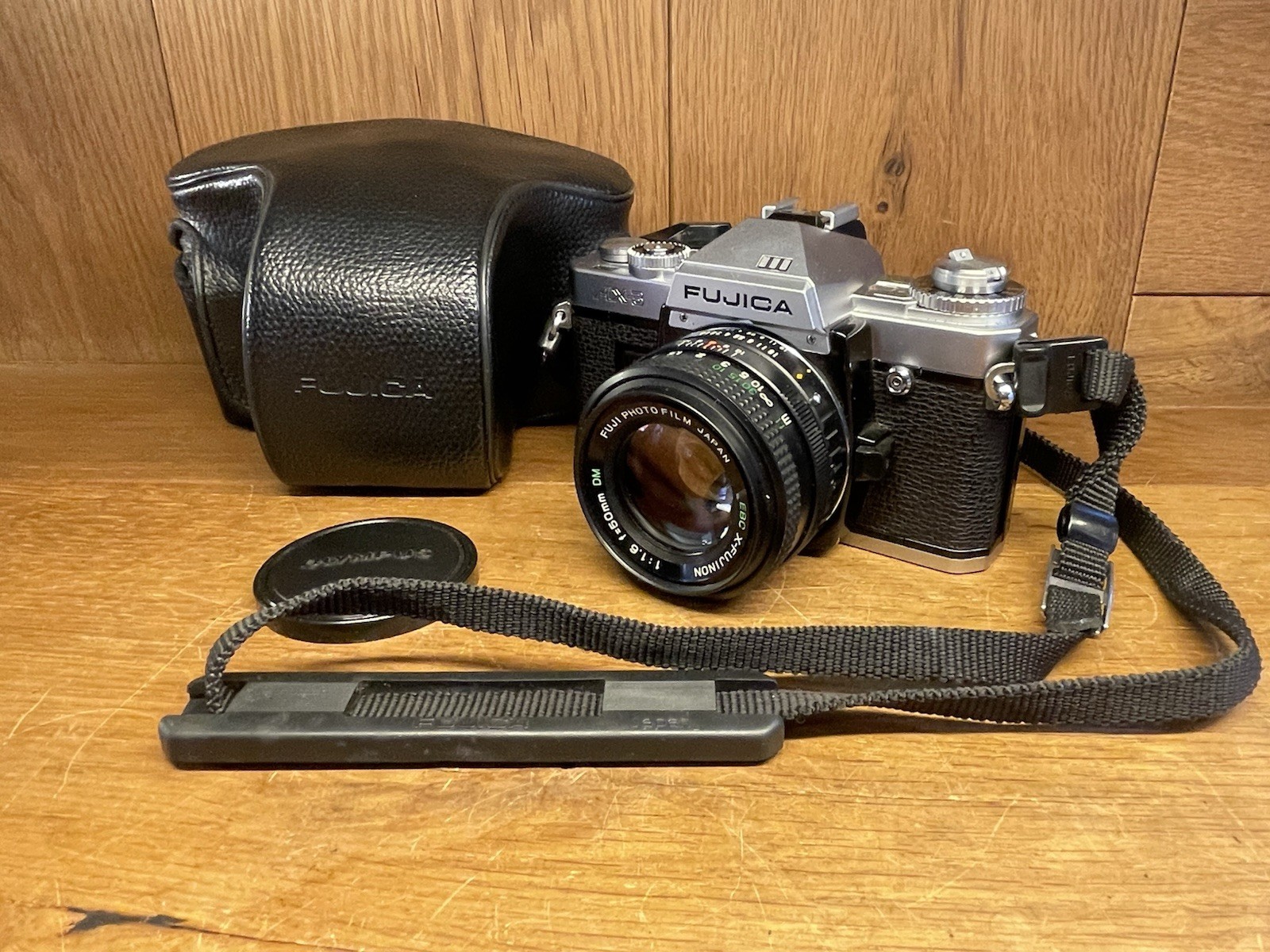
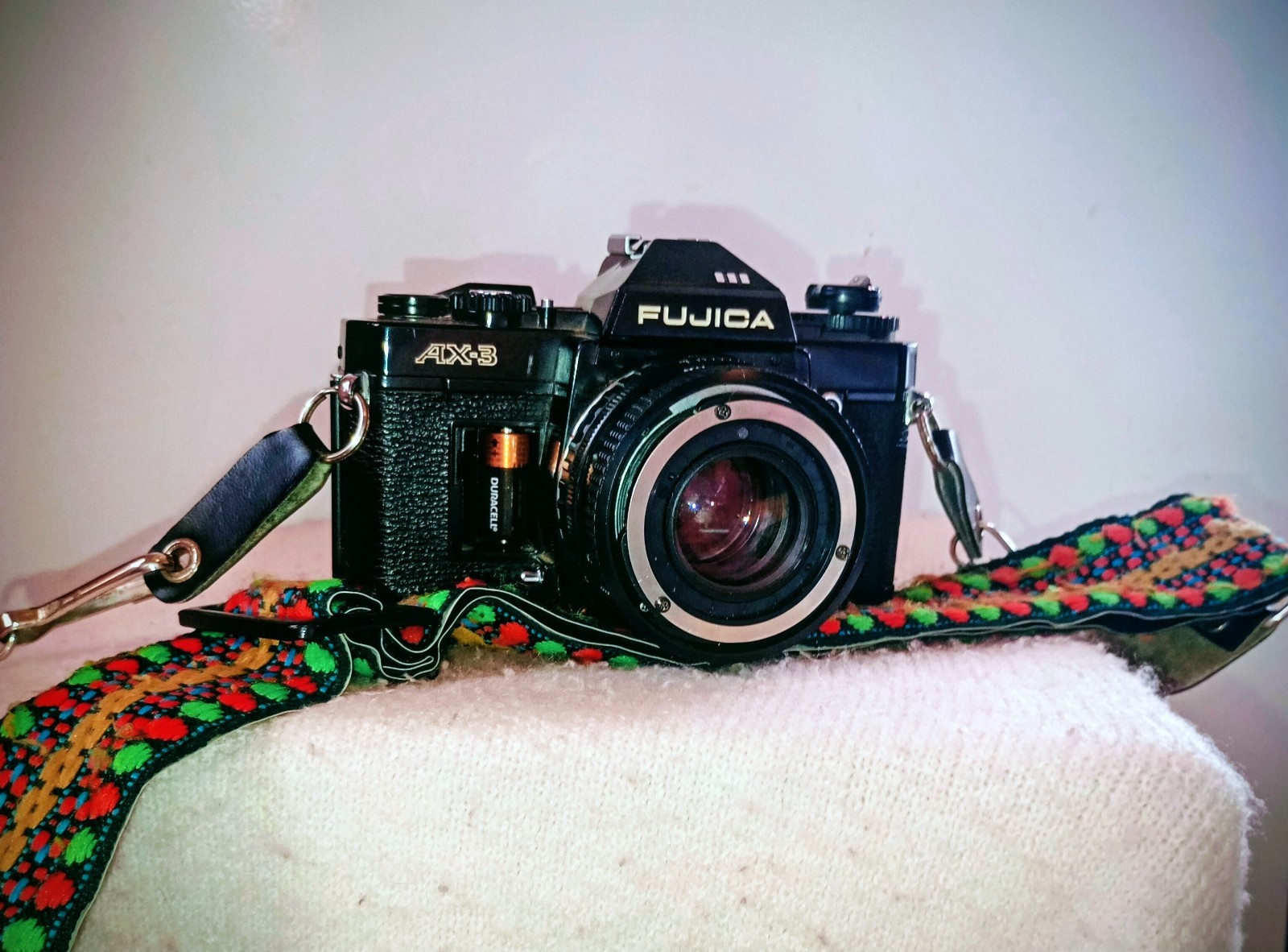
FUJICA AX-3
Step into the early 1980s, and the Fujica AX-3 emerges as Fujifilm’s confident answer to the rising tide of electronic SLRs. Not quite a beginner’s tool, nor a pro’s backup, this 35mm aperture-priority SLR carved its place for photographers who wanted automation with a safety net—smart metering, solid build, and a mechanical heartbeat that keeps ticking even when the batteries die. Built around Fujica’s modern X-mount and powered by integrated circuitry, the AX-3 was Fujifilm’s quiet declaration that they belonged in the same arena as Canon, Nikon, and Pentax.
Overview
Launched in 1980, the AX-3 slotted neatly into Fujifilm’s SLR hierarchy—a step above the entry-level AX-1, yet below the rugged, fully mechanical ST-series. It wasn’t trying to be everything at once. Instead, it offered a focused experience: aperture-priority automation for effortless shooting, with manual override when you wanted full control. This was Fujica embracing electronics without surrendering to them, using silicon photodiode metering and an electrically timed shutter to deliver consistent exposures—while still letting you shoot at 1/125 sec without a battery in sight.
At its core, the AX-3 is a precision instrument. The vertically traveling metal-blade focal-plane shutter cycles from 1 to 1/1000 second, plus Bulb, synced to flash at 1/125 sec. Through-the-lens (TTL) center-weighted metering ensures reliable readings, and the Fujica X-mount—introduced in 1979—replaced the outdated M42 screw mount with a faster, electrically coupled bayonet system. That meant quicker lens swaps and seamless communication between Fujinon-X glass and camera body. For enthusiasts balancing automation and craftsmanship, the AX-3 wasn’t just capable—it felt like a partner.
It held its ground against tough competition: the Canon AE-1 Program, Nikon FE, and Pentax ME Super. Yet by 1985, Fujifilm was shifting focus toward autofocus and digital innovation, and the AX-3 quietly exited production, leaving behind a legacy of thoughtful engineering.
Specifications
| Specification | Value |
| Type | 35mm Single-Lens Reflex (SLR) |
| Film Format | 35mm (135 cartridge) |
| Years Produced | 1980–1985 |
| Lens Mount | Fujica X-mount (bayonet) |
| Shutter | Vertical-travel, metal-blade focal-plane shutter; speeds 1 – 1/1000 sec, B (Bulb), X-sync at 1/125 sec |
| Metering | TTL center-weighted silicon photodiode (SPD) metering |
| Exposure Modes | Aperture-priority automatic exposure, stop-down metering for manual exposure |
| Viewfinder | Fixed pentaprism, eye-level, with split-image rangefinder and microprism collar; 0.92x magnification, 94% coverage |
| Dimensions | 140 mm (W) × 93 mm (H) × 54 mm (D); approx. 570 g (body only, no battery or lens) |
Key Features
- Aperture-Priority AE with Manual Override: Set your aperture, and the camera picks the shutter speed. Need full control? Stop-down metering opens the door to manual exposure.
- Fujica X-Mount Compatibility: A modern bayonet system that locks Fujinon-X lenses securely in place, enabling automatic diaphragm control and seamless meter coupling.
- Mechanical Backup at 1/125 sec: When batteries fail, the shutter still fires at flash sync speed—no dead camera, no missed shots.
- Center-Weighted TTL Metering: The silicon photodiode reads light through the lens, prioritizing the center of the frame for balanced exposures in most lighting.
- Self-Timer and Depth-of-Field Preview: A front-mounted lever activates the self-timer; a button on the lens mount stops the lens down so you can preview focus depth.
Historical Context
The early 1980s were a turning point for SLRs. Electronics were no longer a luxury—they were becoming essential. Fujifilm, long respected for film and optics, saw the shift and responded with the AX-3: a camera that embraced automation without abandoning mechanical integrity. The 1979 debut of the X-mount signaled a clean break from the M42 era, aligning Fujica with the modern bayonet standards set by Canon’s FD, Nikon’s F, and Pentax’s K mounts.
But the market was crowded. The Canon AE-1 had already won hearts with its sleek design and user-friendly automation; the 1981 AE-1 Program added full program mode, raising the bar. The AX-3 didn’t follow that path. Instead, it stuck with aperture-priority—no program mode, no shutter-priority—relying on solid build and consistent SPD metering to stand out. It faced off against the Nikon FE, a favorite among purists for its all-mechanical reliability, and the Pentax ME Super, which offered dual priority modes in a compact body. The AX-3 didn’t win on features, but it earned respect for its balance: smart electronics, mechanical fail-safes, and Fujinon glass that could rival any brand.
Despite Fujifilm’s optical excellence, Fujica never achieved the market dominance of Canon or Nikon. The AX-3, well-built and logically designed, often flew under the radar. Yet today, it stands as a testament to Fujifilm’s analog ambition—a final, refined statement before the digital wave reshaped everything.
Collectibility & Value
Now, the Fujica AX-3 is a sleeper hit among vintage camera collectors. It’s not a household name, but those in the know appreciate its clean design, reliable mechanics, and especially its Fujinon-X lenses—renowned for sharpness, color rendition, and build. Outside Japan, the AX-3 is relatively rare, giving it quiet appeal in Western collector circles.
Prices typically range from $50 to $120 for a working body, spiking when paired with a Fujinon lens or original accessories. Units with the original strap, manual, and clean cosmetics can fetch over $200—especially if labeled “mint” or “like new.” But condition is everything. Watch for degraded light seals (a common source of light leaks), sluggish shutter speeds below 1 second, and SPD meter sensors that have dimmed with age. The camera runs on two SR44 silver-oxide batteries (or LR44 alkalines), but non-silver-oxide types may throw off meter accuracy due to voltage differences.
Repairs are tricky. Service manuals are scarce, parts even scarcer, and few technicians specialize in X-mount gear. That makes the AX-3 a camera for patient owners—those who value its engineering and are ready to maintain it with care. A clean viewfinder, unmarked finish, and responsive meter? That’s the holy grail.
Similar Cameras
- Canon AE-1 Program (1981): Shutter-priority SLR with program mode; widely produced and supported.
- Nikon FE (1978): Mechanically controlled, aperture-priority capable SLR with excellent build quality.
- Pentax ME Super (1979): Compact aperture- and shutter-priority SLR with TTL metering.
- Minolta XG-7 (1980): Aperture-priority SLR with LED readout and compact design.
- Olympus OM-2 (1975): Advanced aperture-priority OM-series SLR with off-the-film metering.
Repair & Maintenance
Power comes from two SR44 silver-oxide batteries in the base plate—essential for metering and electronic shutter control. While the camera can fire at 1/125 sec without power, full functionality demands fresh cells. Stick to silver-oxide: alkaline LR44s may work, but their lower voltage can skew shutter timing and meter readings.
Over time, the foam light seals crumble. Replacing them is a must during servicing to prevent light leaks. The shutter, though durable, can develop inconsistencies—especially in the 1–8 sec range—requiring professional calibration. And the SPD meter sensor? It’s known to weaken with age. If the needle drags or doesn’t move, the sensor may need replacement or recalibration.
Repair isn’t for beginners. Service documentation is limited, and spare parts are hard to find. Few techs specialize in Fujica X-mount systems, so preventive care is key. Use it regularly, remove batteries when storing, and keep it in a dry, stable environment. Treat it right, and the AX-3 will keep delivering frames for years.
eBay Listings


As an eBay Partner, we earn from qualifying purchases. This helps support our independent vintage technology research.
Service Manuals, Schematics & Catalogs
- Catalog (1966) — archive.org
Related Models
- Fujica AX-5 (1980-1985)
- Fujica ST605 (1976-1980)
- Fujica ST605N (1978-1981)
- Fujica ST701 (1971-1975)
- Fujica ST801 (1973-1978)
- Alpa 6 (1948-1953)
- Agfa Agfaflex
- Agfa Ambiflex
- Agfa Easy
- Agfa Futura Af zoom