FED 5
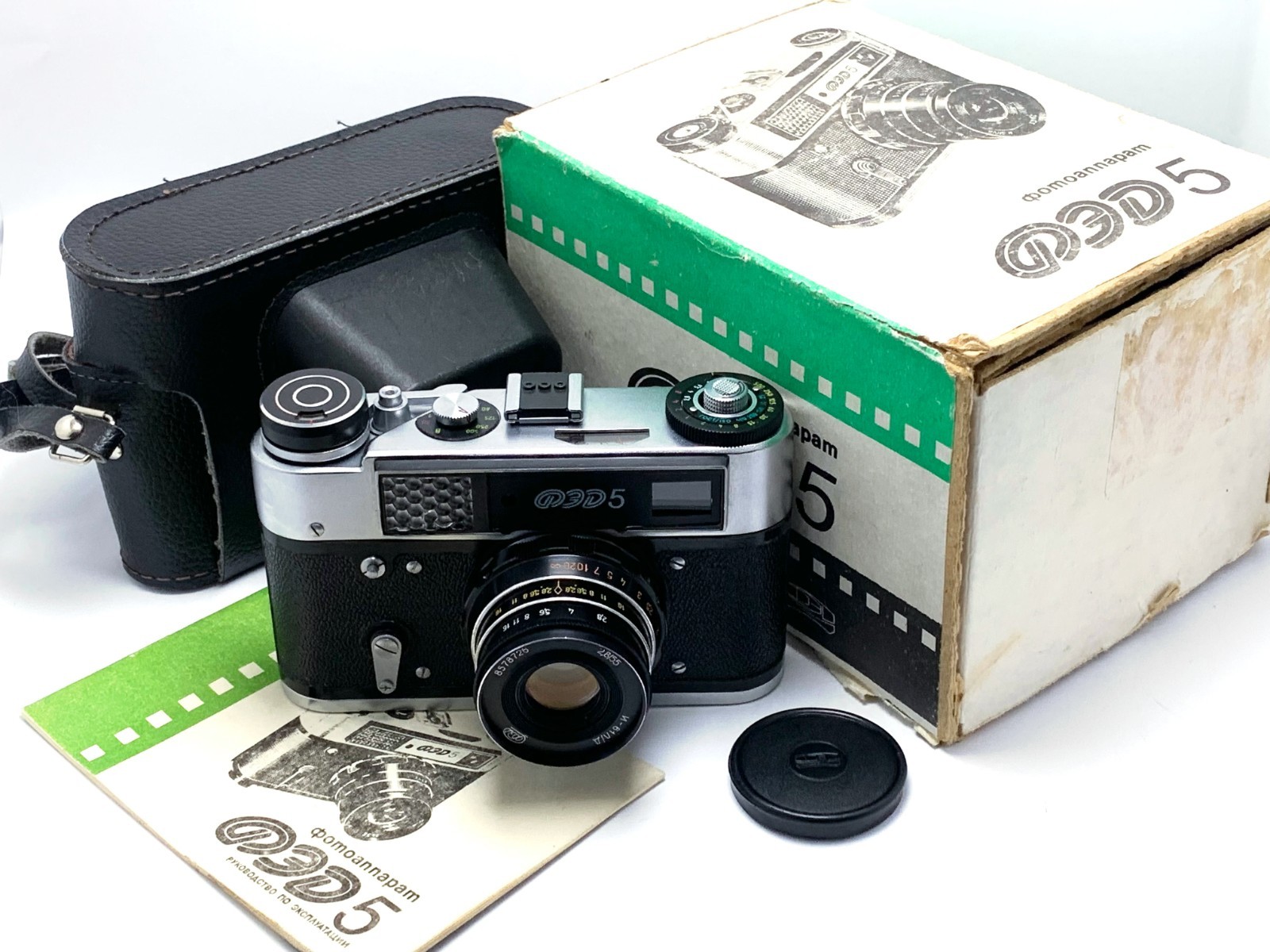
The FED 5 is a 35mm rangefinder camera produced by the FED factory in Kharkiv, Ukraine (then part of the Soviet Union), representing the final evolution of the FED rangefinder lineage that began in the 1930s. It combines the classic Leica-inspired mechanical design of earlier FED models with modernized features, most notably a redesigned top plate incorporating a built-in selenium light meter.
Overview
Introduced in 1977 and produced until approximately 1990, the FED 5 was developed as a modernized successor to the FED 3 and FED 4 models, aiming to bring the long-running Soviet rangefinder series into the era of integrated exposure metering. Unlike its predecessors, which were purely mechanical and lacked built-in metering, the FED 5 features a selenium-cell exposure meter housed in a prominent dome on the front of the camera’s top plate. This advancement marked a significant shift in the FED design philosophy, aligning it more closely with contemporary Japanese rangefinders of the 1970s and 1980s that featured coupled metering systems.
The FED 5 was primarily targeted at amateur photographers and domestic consumers within the Eastern Bloc, offering a relatively affordable yet mechanically robust 35mm rangefinder option. It retained the 39mm Leica Thread Mount (LTM), allowing compatibility with a wide range of Soviet and pre-war Leica lenses, including the standard FED 50mm f/2.8 Industar-22 or the sharper Industar-30 and -33 variants. The camera's construction remains largely mechanical, with a cloth focal-plane shutter and manual operation, reflecting FED’s commitment to durability and simplicity despite the addition of metering technology.
Positioned as the last in the FED rangefinder series, the FED 5 closed a production lineage that began in the 1930s with near-exact copies of the Leica II. While later Soviet camera development shifted toward SLR platforms like the Zenit and Kiev lines, the FED 5 served as a final statement of the rangefinder tradition in Soviet camera manufacturing. Its production ceased around 1990, coinciding with the economic and political upheaval of the Soviet Union’s dissolution.
Specifications
| Specification | Value |
| Type | Rangefinder |
| Film Format | 35mm (135 cartridge) |
| Years Produced | 1977–1990 |
| Lens Mount | 39mm Leica Thread Mount (LTM) |
| Shutter | Horizontal-travel cloth focal-plane shutter, speeds 1/30 to 1/500, B, and X-sync at 1/30 |
| Metering | Built-in selenium-cell light meter (uncoupled), with needle visible in top-mounted meter window |
| Exposure Modes | Manual only; meter provides exposure guidance via match-needle system |
| Viewfinder | Combined optical viewfinder and rangefinder patch with framelines for 50mm and 135mm lenses |
| Dimensions | 150 mm (W) × 75 mm (H) × 45 mm (D); weight approximately 580 g (body only) |
Key Features
- Integrated selenium light meter: Unlike earlier FED models, the FED 5 includes a non-coupled selenium meter with a top-plate needle indicator, eliminating the need for external meters.
- Redesigned top plate: Features a modernized layout with a recessed meter window and updated film advance lever and rewind knob.
- Leica Thread Mount (LTM) compatibility: Supports a wide range of 39mm screw-mount lenses from FED, Zorki, Leica, and other manufacturers.
- Mechanical reliability: Fully manual operation with no battery dependency for shutter function (meter requires light but no battery).
- Dual framelines: Viewfinder includes automatic parallax-corrected framelines for 50mm and 135mm focal lengths.
Historical Context
The FED 5 was developed during a period of stagnation in Soviet consumer electronics, where innovation was often incremental due to limited resources and technological isolation. Its release in 1977 came decades after the peak of rangefinder popularity in the West, where manufacturers like Leica, Canon, and Nikon had already transitioned to SLR dominance. However, within the Eastern Bloc, rangefinders remained in production due to their mechanical simplicity and lower manufacturing costs compared to SLRs.
Despite its late arrival, the FED 5 was a significant upgrade for Soviet consumers, offering built-in metering—a feature absent from earlier FED and Zorki models. It competed primarily with domestic alternatives such as the Zorki-4 and later Zorki-12, though those models either lacked meters or used less reliable CdS cells requiring batteries. The FED 5’s selenium meter, while prone to degradation over time, required no external power and functioned passively in available light.
Market reception was modest, largely confined to Eastern Europe and the USSR. The camera was never officially exported in large quantities, limiting its global presence. Nevertheless, it represented a rare modernization of a long-standing Soviet design, bridging the gap between pre-war mechanical ideals and modern exposure assistance.
Collectibility & Value
Today, the FED 5 is a niche collectible, sought after by enthusiasts of Soviet-era cameras and mechanical rangefinder users. While not as rare as early FED or Zorki models, it is less common than its predecessors due to its later production and shorter run. Units in working condition typically sell for $100–$250 USD, depending on shutter functionality, rangefinder accuracy, and meter condition.
Collectors should be cautious when purchasing a FED 5, as selenium meters are prone to failure after decades of exposure to light and humidity. While the camera operates mechanically without the meter, a dead meter diminishes its value for those seeking full functionality. Other common issues include stiff or torn shutters, misaligned rangefinder mechanisms, and light leaks from deteriorated film chamber seals. Due to the complexity of rangefinder calibration and the scarcity of specialized repair technicians, functional examples are preferred over cosmetic-only specimens.
Despite these challenges, the FED 5 holds historical significance as the final iteration of a 50-year rangefinder tradition rooted in the original Leica copies of the 1930s. Its blend of vintage mechanics and late-Soviet modernization makes it a compelling artifact of Cold War-era photographic technology.
Similar Cameras
- Leica M3 (1954–1966) – The gold standard of 35mm rangefinders; shares LTM compatibility and mechanical precision, though far more advanced and expensive.
- Zorki-4 (1956–1973) – A contemporary Soviet rangefinder with similar LTM mount and build quality, but lacks built-in metering.
- FED 3/4 – Direct predecessors to the FED 5; mechanically similar but without a light meter.
- Canon Canonet QL17 G-III (1972–1982) – A Japanese-made rangefinder with coupled metering and automatic exposure, representing the technological peak of the format.
- Yashica Electro 35 (1966–1980) – Another Japanese electro-mechanical rangefinder with aperture-priority automation, contrasting the FED 5’s fully manual approach.
Repair & Maintenance
The FED 5 requires no batteries for shutter operation, as it is fully mechanical. The selenium light meter functions without batteries but degrades over time due to material fatigue and exposure to moisture. Repairing or replacing the meter is generally impractical; most users treat it as a passive indicator or ignore it entirely.
Common maintenance issues include shutter blade lubrication (which can gum up over time), rangefinder alignment (often requiring specialized calibration tools), and cleaning of the viewfinder and lens mount. The cloth focal-plane shutter is susceptible to tearing if advanced improperly or stored under tension. Regular servicing by a technician experienced in Soviet cameras is recommended for reliable use.
Due to the scarcity of original spare parts and the complexity of the rangefinder mechanism, repair difficulty is rated as moderate to high. However, the camera’s robust construction and simple design allow many units to remain functional after decades of storage, provided they are carefully serviced before use.
eBay Listings


As an eBay Partner, we earn from qualifying purchases. This helps support our independent vintage technology research.
Service Manuals & Schematics
- Manual (1977) — archive.org
- Service Manual — archive.org
- Manual (1953) — archive.org
- Owner's Manual — archive.org
- Manual (1972) — archive.org
Related Models
- FED 1 (1934-1955)
- FED 2 (1955–1970)
- FED 3 (1961–1979)
- FED 4 (1964–1977)
- Agfa Optima Sensor 1535
- Argus Argus A
- Argus Argus Autronic (1960)
- Argus Argus C-44R
- Argus Argus C
- Argus Argus C2