FED 3
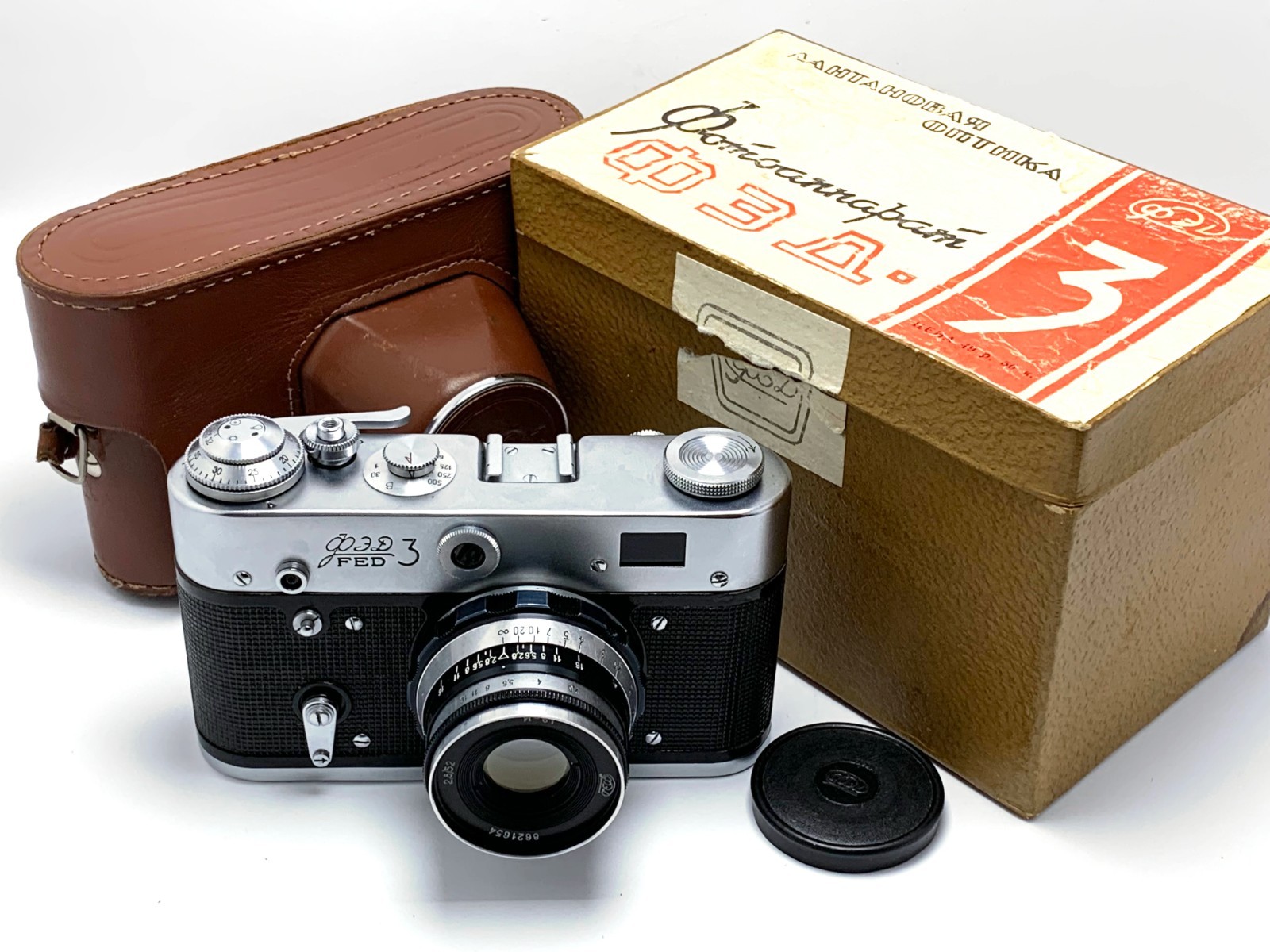
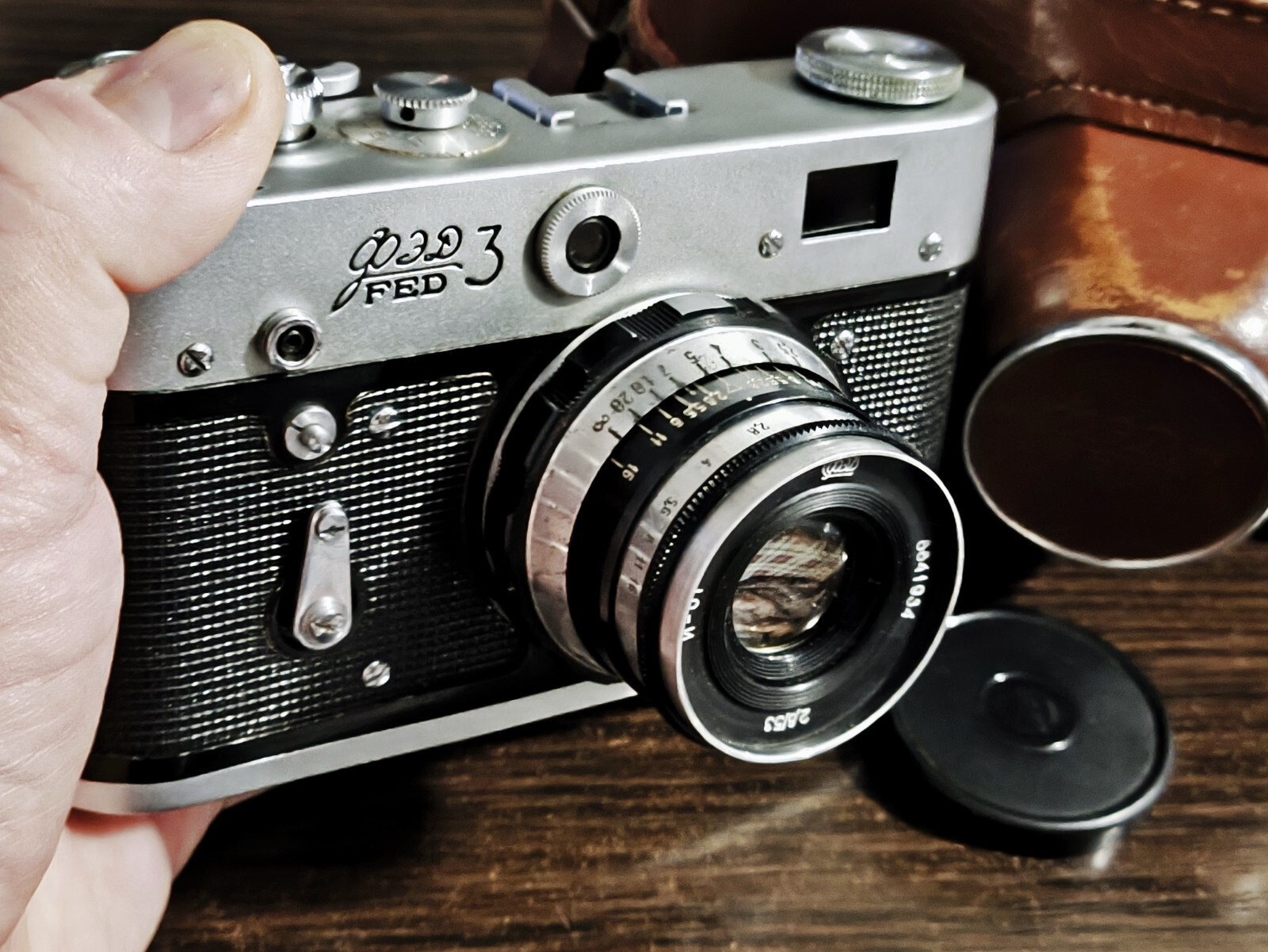
The FED 3 is a 35mm rangefinder camera produced by the FED factory in Kharkiv, Ukraine (then part of the Soviet Union), representing the most widely manufactured and commonly encountered model in the FED rangefinder lineage. Designed as a direct descendant of the pre-war Leica II (Model D), the FED 3 refined earlier FED iterations with improved ergonomics, mechanical reliability, and optical performance, serving as a workhorse camera for Soviet photographers throughout the 1960s and 1970s.
Overview
Introduced in 1961, the FED 3 succeeded the FED 2 and marked a significant evolution in the FED series, which had its roots in the 1930s as a Soviet effort to replicate the German Leica II. The FED factory, originally established as a children’s commune producing precision instruments, had been manufacturing Leica-inspired rangefinders since 1934. By the time the FED 3 was launched, the design had matured into a robust, no-frills mechanical camera tailored for amateur and semi-professional use within the Eastern Bloc. Over 2.2 million units were produced during its 18-year production run, making it the most numerous FED model and a symbol of mass-produced Soviet photographic engineering.
The FED 3 retained the core principles of its predecessors: a fully mechanical body, a coupled rangefinder focusing system, and compatibility with the proprietary FED screw-mount (Leica Thread Mount, LTM). It was primarily marketed to Soviet citizens through state-run retail networks and was widely used by photojournalists, enthusiasts, and state institutions. While lacking built-in light metering or automation, the FED 3 emphasized durability, simplicity, and repairability—hallmarks of Soviet industrial design. It was typically sold with the FED’s own 50mm f/2.8 Industar-22 lens, a collapsible LTM optic based on the Zeiss Tessar design, though it could accept any LTM lens.
Specifications
| Specification | Value |
| Type | 35mm rangefinder |
| Film Format | 35mm (135 cartridge) |
| Years Produced | 1961–1979 |
| Lens Mount | FED screw-mount (Leica Thread Mount, 39mm) |
| Shutter | Horizontal cloth focal-plane shutter, speeds 1–1/1000 sec, B, X-sync at 1/30 sec |
| Metering | None (unmetered) |
| Exposure Modes | Manual only |
| Viewfinder | Optical viewfinder with brightline framelines (50mm and 90mm), coupled rangefinder patch |
| Dimensions | 145 × 80 × 55 mm; ~580 g (body only) |
Key Features
- Fully mechanical operation: No batteries required; all functions operated manually via mechanical linkages.
- High-speed shutter: Capable of 1/1000 sec, a notable improvement over earlier FED models and many contemporary Leica derivatives.
- Dual framelines: Viewfinder displays 50mm and 90mm framelines, enabling use of longer focal length lenses with approximate framing.
- Interchangeable LTM lenses: Compatible with a wide range of Soviet and foreign Leica Thread Mount optics.
- Collapsible lens standard: Shipped with the collapsible 50mm f/2.8 Industar-22, reducing size when not in use.
Historical Context
The FED 3 was developed during a period of relative stabilization in Soviet consumer manufacturing, following the disruptions of World War II and the post-Stalin industrial reorganization. Its release in 1961 coincided with the height of the Cold War, during which domestic production of precision goods was prioritized to reduce reliance on Western imports. The camera was positioned as an affordable, reliable tool for Soviet photographers, contrasting with the high cost and limited availability of Western rangefinders like the Leica M3 or Canon VT.
Despite its derivative design, the FED 3 held its own in a market that included the Zorki 4 (a more basic FED competitor also based on Leica designs) and the later Kiev 4 (a more complex, but less reliable, rangefinder). The FED 3’s reputation for consistent build quality—especially in early 1960s units—earned it respect among users in Eastern Europe and beyond. While export versions were limited, many FED 3s found their way to Western markets through military surplus and secondhand dealers, often praised for their mechanical precision and low cost.
Collectibility & Value
Today, the FED 3 is one of the most accessible vintage rangefinders on the used market, with prices typically ranging from $50 to $150 USD depending on condition, lens inclusion, and mechanical functionality. Early models (1961–1965) are slightly more desirable due to tighter build tolerances and higher-quality metallurgy, while later units (post-1970) may exhibit increased wear or inconsistencies due to aging tooling and declining manufacturing standards in the Soviet Union.
Collectors should inspect the shutter for accuracy across all speeds, check the rangefinder alignment (a common issue in aged units), and verify the smooth operation of the film advance and rewind mechanisms. The collapsible Industar-22 lens should extend and lock securely, with no haze, fungus, or separation. While not rare, well-maintained FED 3s with clean optics and precise mechanics are valued as functional historical artifacts and capable film shooters. Their affordability makes them ideal entry points into rangefinder photography.
Similar Cameras
- Leica II (Model D) – The original German design that inspired the FED series.
- Zorki 4 – Soviet-made LTM rangefinder, less refined but more rudimentary than the FED 3.
- FED 2 – Immediate predecessor, with slower 1/500 sec top shutter speed.
- Kiev 4 – Ukrainian rangefinder with built-in meter, but less reliable mechanics.
- Canon VT – Japanese LTM rangefinder with similar feature set and build quality.
Repair & Maintenance
The FED 3 requires no batteries and operates entirely mechanically, making it highly reliable when properly maintained. However, common issues include sticky or inaccurate shutters (especially at high speeds), misaligned rangefinders, and worn film advance levers. Cloth shutter curtains may degrade over time, particularly if stored in humid conditions. Regular CLA (clean, lubricate, adjust) by a technician experienced in Soviet cameras is recommended for long-term use. Replacement parts are limited but can sometimes be sourced from donor bodies. Lubrication with high-quality clock oil and careful calibration of the shutter mechanism are critical for maintaining accuracy. Given the camera’s mass production and mechanical simplicity, many repairs can be performed with basic tools and technical documentation, though disassembly requires precision to avoid damaging the rangefinder linkage or shutter assembly.
eBay Listings


As an eBay Partner, we earn from qualifying purchases. This helps support our independent vintage technology research.
Related Models
- FED 1 (1934-1955)
- FED 2 (1955–1970)
- FED 4 (1964–1977)
- FED 5 (1977–1990)
- Agfa Optima Sensor 1535
- Argus Argus A
- Argus Argus Autronic (1960)
- Argus Argus C-44R
- Argus Argus C
- Argus Argus C2