EyeMo 71 (1925)
It clicks like a time bomb, weighs like a brick, and has stared down war zones with a 47mm lens — this is the Bell & Howell Eyemo Model 71, the camera that didn’t just record history, it survived it.
Overview
The Bell & Howell Eyemo Model 71 isn’t just a camera — it’s a survivor. Introduced in 1925 by Bell & Howell Co. of Chicago, this 35mm motion picture film camera was built for one thing: getting the shot, no matter what. Whether crouched in a trench during WWII or perched on a stunt car about to explode, the Eyemo 71 was there, spring motor wound tight, ready to run for 20 seconds at 24 fps on its internal 100-foot magazine. And then, if needed, it could keep going — with optional 400 ft or even 1,000 ft magazines that stretched runtime to over 11 minutes.
It’s compact, all-metal, and rugged as hell — aluminum casting under a black lacquer finish, built to take dings, drops, and desert sand without missing a frame. At 3.25 kg, it’s no lightweight, but for its era, it was considered portable enough for “on the spot” reporting, a godsend for newsreel cameramen racing to breaking stories. The spring-wind motor starts at full speed the moment you press the trigger and stops dead when you let go — no lag, no hesitation. And yes, you can change frame rates mid-shot, from as low as 4 fps to a blistering 64 fps on high-speed variants, though the common model sticks to 12, 16, and 24 fps.
It’s not reflex, so you’re not seeing through the lens — just an optical viewfinder that gives you a rough idea of what’s being captured. Some models even show aperture and focus settings in the finder, along with a handy bubble level. And if you’re the kind of shooter who needs three lenses at your fingertips, certain Eyemo 71s came with a rotating three-lens turret, including the compact “Spyder” version that let you swap optics without fumbling for tools.
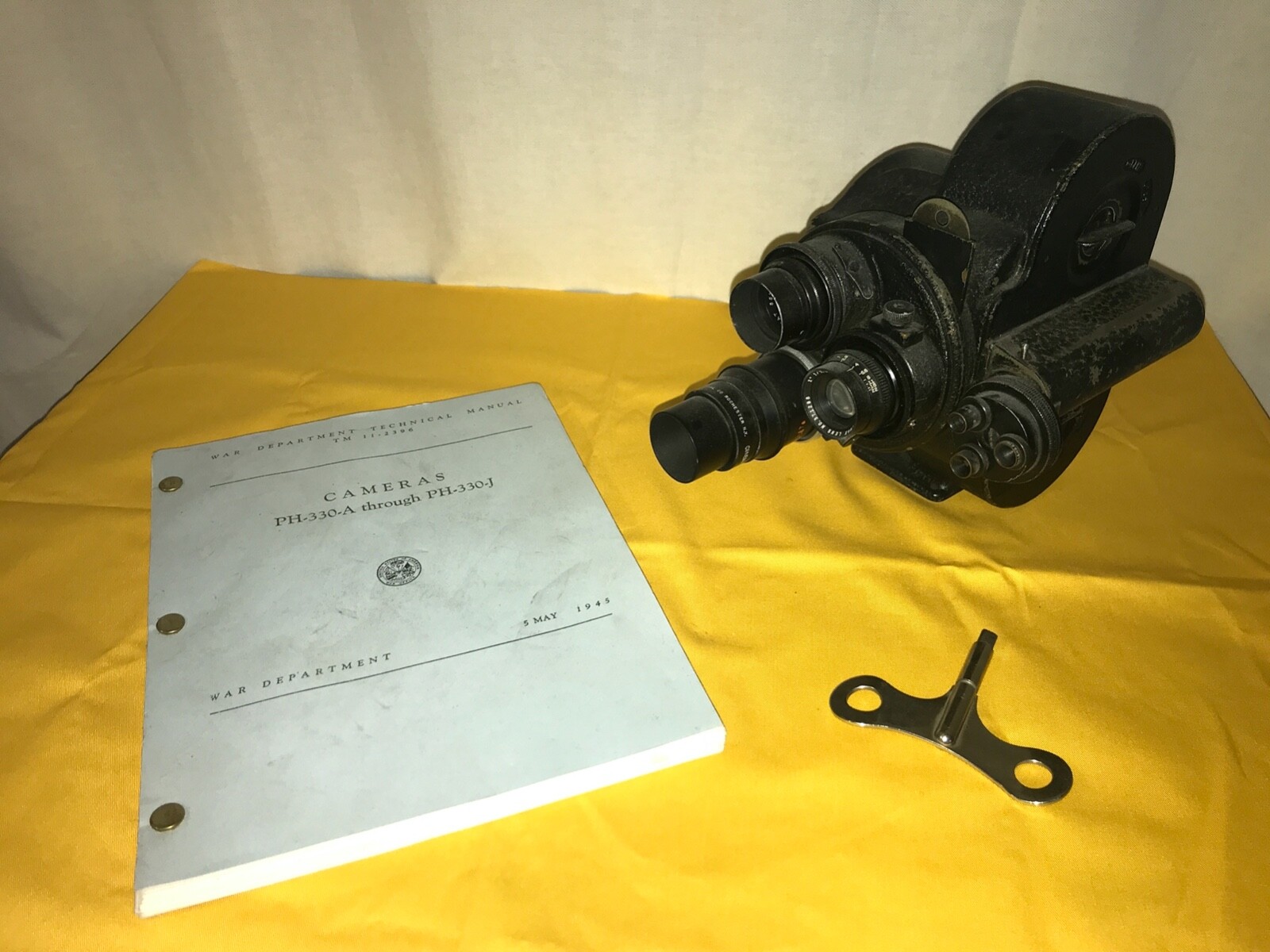
This was the camera that went to war. Literally. From 1942 to 1945, Bell & Howell shifted production entirely to military models designated PH-330, and the Eyemo became the go-to for U.S., Canadian, and Allied combat cinematographers. It didn’t flinch in the mud of Guadalcanal, the snow of Korea, or the jungles of Vietnam. After the war, thousands were sold as surplus, scattering into newsrooms, indie film sets, and eventually, collectors’ shelves.
Specifications
| Manufacturer | Bell & Howell Co., Chicago |
| Product type | 35mm motion picture film camera |
| Production years | Introduced in 1925, produced through the 1970s |
| Motor | Built-in clockwork (spring wind) motor |
| Variable-speed operation | 8-48 FPS (frames per second) |
| Format | 35mm |
| Film length (internal) | 100 ft (30 m) of film |
| Film capacity (optional magazine) | 400 ft (120 m) or 1,000 ft (300 m) magazine |
| Frequencies d'image (speeds) | 12, 16, et 24 i/s (fps) for common model |
| Viewfinder | Non-reflex; optical viewfinder |
| Mount | 1 + 1/2 in (38 mm) diameter lens mount (standard) |
| Standard lens | Taylor-Hobson F 2,5 de 47mm (for specific variant) |
| Counter | Indicates length of film used in feet |
| Dimensions (LxPxH) | 11,1(14,5) x 15,5(18,5) x (20,2) cm |
| Weight | 3,25 KG |
| Body/Finish | Aluminum casting, black lacquer |
| Film run time at 24 fps (internal) | About 20 seconds of film per winding |
| Film run time with magazines | 4 + 1/3 and 11 minutes respectively (for 400 ft and 1000 ft magazines) |
| Speed range (overall model range) | Runs at speeds of four through 64 fps, depending on the model |
| Lens configurations | Some models take one lens only; others feature a rotating three-lens turret. |
Key Features
The Spring Motor That Changed Everything
The built-in clockwork motor wasn’t just convenient — it was revolutionary for its time. No need for bulky external drives or hand-cranking while trying to frame a shot. A full wind gives you about 35 feet of film at 16 fps on early models, and the motor delivers consistent speed from start to stop. Press the trigger, and it’s instantly at full speed; release, and it halts. That kind of responsiveness made it perfect for news and combat, where timing was everything.
And yes, you can adjust speed while filming — a rare trick in the 1920s. Whether you’re dropping to 8 fps for silent-era look or cranking up to 48 for slow motion, the Eyemo 71 lets you adapt on the fly. High-speed variants even hit 64 fps, though those were specialty models.
Three-Lens Turret: The Spyder Advantage
Some Eyemo 71 models — like the N, O, P, and Q — came with a three-lens turret, including the compact “Small 3-Lens Turret” (aka Spyder turret). This wasn’t just about convenience; it was about survival. In a combat zone, you don’t have time to swap lenses. Having a 25mm, 50mm, and 75mm Bell & Howell Anastigmat ready to rotate into place meant you could go from wide shot to tight close-up in a heartbeat. The Spyder turret, with its offset arms, kept the lenses from bumping into each other — a small detail that mattered when your camera was bouncing in a jeep.
Drive Flexibility: Crank, Spring, or Electric
While the spring motor is the heart of the Eyemo, it’s not the only option. You can hand-crank it with an accessory crank — useful if the spring gives out or you need precise control. Or, starting in 1932, you could outfit it with an electric motor, powered by DC battery or AC. There was even a synchronized motor available for sync sound work, though that was more common in later models.
But here’s the catch: it’s loud. There’s no commercially available blimp to quiet it down, so if you’re trying to shoot dialogue, you’re out of luck. That’s why it was mostly used for news, combat, and stunts — places where sound was secondary or added later.
Optical Viewfinder: What You See Is (Mostly) What You Get
It’s not through-the-lens, so parallax is a real issue, especially up close. But the optical viewfinder does more than just frame the shot — on some models, it displays aperture, focus settings, and even a bubble level, all visible while you’re rolling. That kind of integrated feedback was advanced for the 1920s and made the Eyemo a favorite among professionals who needed to work fast and accurately.
Historical Context
The Eyemo 71 was born in 1925, evolving directly from the Filmo 70. Early versions, like the 71-AA (1926–27), had just two speeds. By 1927, the 71-AB arrived with three speeds — 12, 16, and 24 fps — and a high-speed “Speed” variant that could hit 64 fps. The following year, the 71-B introduced the three-lens “Spyder” turret, cementing the Eyemo’s reputation for versatility.
In 1932, electric motor and 400 ft magazine options became available, expanding its use beyond handheld news work. But its defining moment came during WWII, when production shifted entirely to military models (PH-330) from 1942 to 1945. These cameras were issued to combat cameramen across Allied forces, capturing some of the most iconic footage of the war — including the brutal assault on Tarawa, later seen in *With the Marines at Tarawa* (1944).
After the war, civilian production resumed, but the low-speed versions were phased out by 1947. Most models ceased production by 1949, though some variants kept rolling into the 1970s. The surplus market flooded with military Eyemos, making them accessible to indie filmmakers and news crews for decades.
Collectibility & Value
Today, the Eyemo 71 is a legendary, highly collectible piece of cinema history — but condition is everything. Prices range from $450 to $1,800, depending on model, functionality, and included accessories. A Model 71-K with a single lens and no extras might be at the low end, while a fully loaded P or Q model with a Spyder turret, magazines, lenses, and manuals can command top dollar.
But buyer beware: most are sold “as-is” with untested mechanicals. Common problems include jammed movements, worn springs, and seized gears. Missing parts are almost guaranteed — especially film magazines (200' or 400'), power cables, tools, filters, and manuals. Lens sets (25mm, 50mm, 75mm Bell & Howell Anastigmats) are often separated from their cameras. And don’t expect pristine — these were field tools, not display pieces. Dings, scuffs, and military markings are part of the story.
Still, for collectors and filmmakers who want to hold a piece of cinematic history, the Eyemo 71 is worth the hunt. It’s not just a camera — it’s a time capsule with a spring motor.
eBay Listings
As an eBay Partner, we earn from qualifying purchases. This helps support our independent vintage technology research.
Related Models
- Arriflex 16 BL (1965)
- Arriflex 16 SR (1975)
- Arriflex 16 ST (1952)
- Arriflex 35 BL (1972)
- Arriflex 35 IIC (1964)
- Beaulieu 4008 ZM II (1977)
- Beaulieu 5008 S (1976)
- Bell & Howell 134 (1940)
- Bell & Howell 2709 (1912)
- Bolex H16 Reflex (1956)