Contax T3 (2001–2005)
That rare pocket camera that makes you forget you’re not using a rangefinder—until the lens cover snaps shut and you realize it fits in your jeans.
Overview
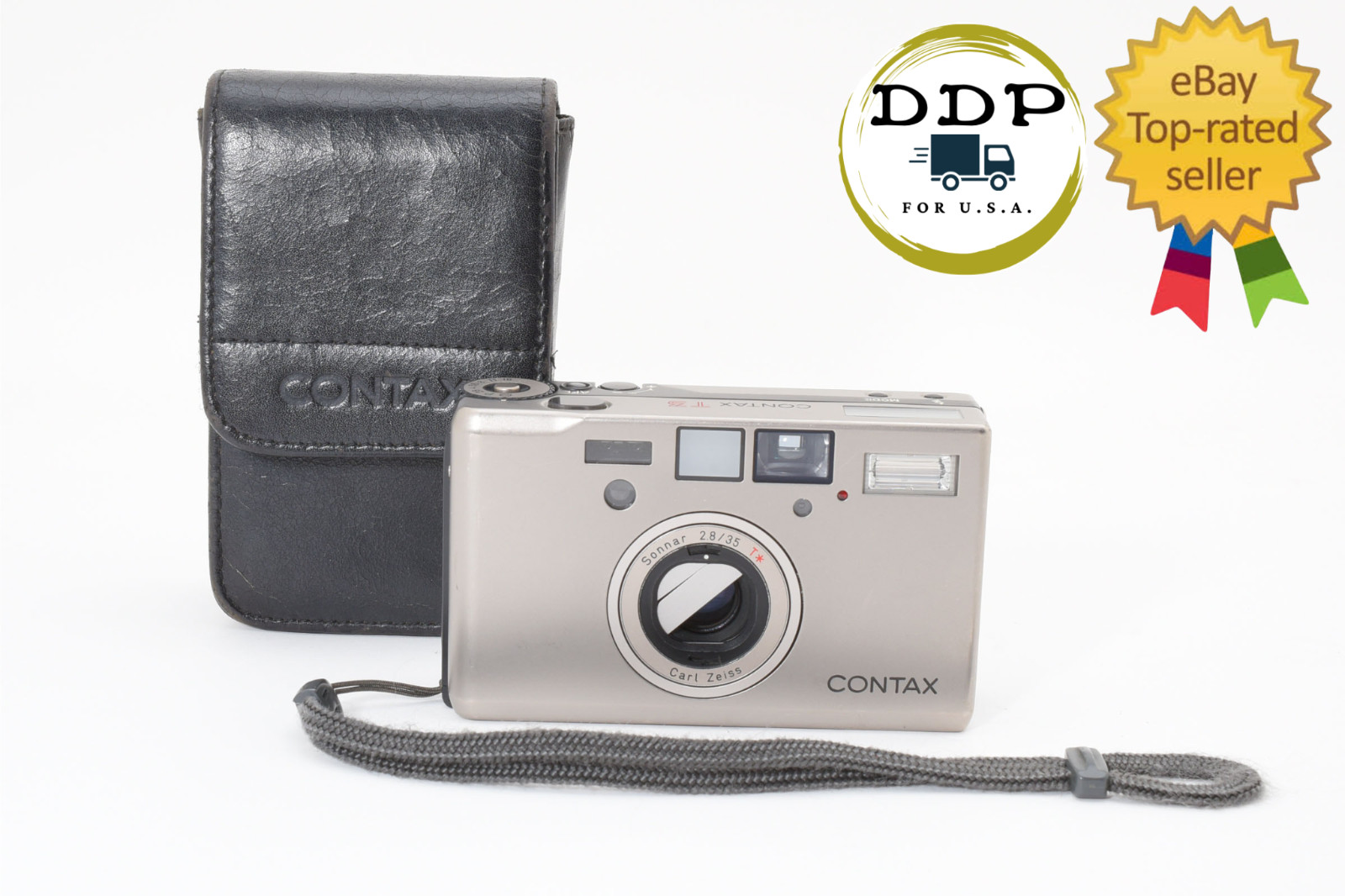
The Contax T3 doesn’t announce itself with fanfare. It sits in your palm like a slab of brushed metal with a secret. You press the power button—synthetic sapphire under your thumb—and the lens cover slides open with a soft, final click. Then it’s alive: autofocus hunting, shutter charging, the tiny viewfinder blinking to life. This is a 35mm point-and-shoot that refuses to apologize. Made in 2001 by Kyocera Corporation, it arrived when digital was already rewriting the rules, yet it doubled down on analog excellence. At launch, it cost about US$1,000—serious money for a compact—and it didn’t care. It knew what it was: the last, best evolution of the premium pocket film camera.
It’s a direct successor to the beloved Contax T2, but tighter, more refined. About one-third smaller than its predecessor, the T3 packs the same DNA into a sleeker titanium body. The lens is a 35mm f/2.8 Carl Zeiss T* Sonnar—six elements in four groups—with a reputation that borders on myth. Owners report images of startling sharpness, micro-contrast that gives texture to skin and concrete alike, and a near-total absence of vignetting. It’s technically superb, sometimes to a fault: some describe the rendering as “soulless,” too clean, too precise. But if you want to see exactly what was in front of the lens—no smoothing, no romantic blur—this is your tool.
And it’s not just the lens. The T3 uses expensive coreless motors, the same kind found in the Contax AX, a much larger and more complex SLR. These motors drive the film advance and shutter with near-silent efficiency. The shutter itself is a double between-the-lens design, electromagnetic, with speeds from 180 seconds to 1/1200th—fast enough to freeze motion in daylight at f/2.8. But there’s a catch: at its widest aperture, the top speed is only 1/500th. That’s a deliberate quirk of the auto program, which biases toward f/2.8 for any shutter speed slower than 1/160th. It’s not a flaw, exactly, but a design choice that prioritizes low-light usability over high-speed flexibility.
The camera’s intelligence is buried in its electronics. It’s entirely dependent on them. Power comes from a single CR2 battery, and when it dies, everything stops. No manual override, no mechanical fallback. The control layout is button-driven, minimal—just four functions on the main menu. Flash modes get their own dedicated button. And if you dig deeper, there’s a second, hidden menu for custom functions: hold the flash and mode buttons while powering on, and a blinking “cf” appears, cycling through settings like “1a” or “1b.” It’s not intuitive, but it’s there for those who want to tweak.
Specifications
| Manufacturer | Kyocera Corporation |
| Format | 35mm |
| Image size | 24 x 36 mm |
| Lens | Carl Zeiss T* Sonnar 35mm f/2.8 (6 elements in 4 groups, f/2.8-f/16) |
| Minimum focusing distance | 35cm |
| Viewfinder | 0.5x (appx) combined viewfinder with projected framelines, macro indicator, digital shutter speed readout and parallax correction |
| Shutter | Double between-the-lens shutter, electromagnetic control 180 – 1/1200s |
| Top shutter speed | 1/1200th of a second |
| Focusing | External passive autofocus with AF assist light and focus lock function. Manual focus can be set by mode button. Dedicated AF lock button. |
| Metering | Aperture priority with SPD cell (EV 1 – 18) +/-2 EV in 1/3 EV steps |
| Film Speed | DX-coded films, auto ISO (25 – 5000). Non-DX defaults to ISO 100. |
| Flash | Built-in flash only. Anti-red eye preflash option. Range 0.7-3m at ISO 100. Flash cycle 3s. |
| Loading | Auto – winds to first frame |
| Date/time stamp | Yes, with data back |
| Weatherproofing | Minimal |
| Power | 1 x 3V CR2 or equivalent |
| Weight | 230g (without battery) |
| Dimensions (appx) | 105 x 30.5 x 63mm (WxDxH) |
Key Features
The Zeiss Lens That Changed Everything
The 35mm f/2.8 Carl Zeiss T* Sonnar isn’t just good—it’s legendary. Compared to the T2’s 38mm lens, the T3’s 35mm offers a slightly wider field of view, more natural for street and environmental shooting. The T* coating cuts flare, and the optical formula delivers edge-to-edge sharpness that rivals much larger systems. It’s not a bokeh monster—this is a compact, after all—but wide open, it isolates with quiet confidence. And at f/5.6, it’s clinical. Photographers who prize accuracy over atmosphere often call this the best lens ever put on a point-and-shoot. The only trade-off? That 1/500th speed limit at f/2.8. In bright sun, you’ll need ND filters or slower film to avoid overexposure unless you stop down.
Titanium Body, Sapphire Touchpoints
The T3 feels expensive because it is. The body is milled from titanium—light, strong, and cold to the touch. The shutter button is synthetic sapphire, a jewel-like detail that resists scratching. The viewfinder glass is also synthetic sapphire, ensuring clarity and durability. These aren’t gimmicks; they’re part of a philosophy that every interaction should feel precise. The camera is small—105mm wide, 63mm tall, just 30.5mm deep—but dense. It fits in a jacket pocket, but it won’t disappear like a disposable. And when the lens retracts, a front curtain closes to protect the optics. It’s a small thing, but it speaks to the care in design.
Focusing and Metering: Smart, But Not Foolproof
The T3 uses external passive autofocus with an AF assist light—useful in dim light, though it can spook subjects. There’s a dedicated AF lock button, and manual focus can be engaged via the mode button, letting you set distances from 0.35m to infinity. The minimum focusing distance of 35cm is a major upgrade over the T2’s 70cm, making the T3 far more versatile for close-ups and tight compositions. Metering is aperture-priority only, using an SPD cell with a range from EV 1 to 18. Exposure compensation is generous: +/-2 EV in 1/3-stop increments. But because it’s aperture-priority, you can’t directly set shutter speed—only influence it by choosing aperture. That works fine most of the time, but in tricky light, you might find yourself wishing for more control.
The Hidden Weak Spot: That Plastic Sprocket
Inside the film chamber, there’s a plastic take-up spool with a single tooth that engages the film. It’s a known failure point. With use, the tooth wears down or snaps. When that happens, the camera can’t advance film. Later repairs often replace it with a two-tooth version, which is more durable. But parts are scarce. The T3’s tightly packed internals make disassembly risky, and few technicians still work on them. This isn’t a camera you casually tinker with. It’s a precision instrument, and treating it like a toy can be costly.
Historical Context
The Contax T3 was released in 2001 as the follow-up to the still-popular T2, arriving at a moment when digital photography was accelerating. Film was being pushed to the margins, yet Kyocera doubled down on analog quality. The T3 was part of the T-series of premium compact cameras, a line that represented the pinnacle of what a pocketable 35mm could be. It competed with other high-end compacts like the Nikon 35Ti, Ricoh GR1s, Olympus Stylus Epic, Canon Z115, Canon Z135, and Leica Minilux. Among them, the T3 stood out for its lens and build, though some preferred the ergonomics of the Ricoh or Minolta TC-1. The Yashica T4 Super, a more affordable option, was often called the “poor man’s T3”—a tribute to the T3’s status. In 2005, Kyocera discontinued all photographic equipment, ending the Contax line. The T3, produced in far fewer numbers than the T2, became an instant relic.
Collectibility & Value
Today, the Contax T3 commands very high market value—often significantly above its original US$1,000 launch price. Scarcity and celebrity use have driven demand, but functional units are increasingly rare. The plastic single-tooth film take-up spool remains a critical vulnerability; when it fails, repair is expensive and parts are hard to find. Because so few technicians specialize in these cameras, a broken T3 can become a paperweight. This makes working examples not just desirable, but risky to use. Owners often treat them like museum pieces—loaded for a special roll, then retired. It’s a reliable camera when functioning, but its electronics are all-encompassing. No battery, no operation. No fallbacks. For collectors, the champagne silver, black, and gold-plated finishes all carry premium status, with gold-plated models being especially sought after. If you’re buying, test the film advance thoroughly. And if it’s cheap? Be suspicious.
eBay Listings


As an eBay Partner, we earn from qualifying purchases. This helps support our independent vintage technology research.