CONTAX RTS
The Contax RTS (Real Time System) was the first modern 35mm single-lens reflex (SLR) camera produced by Contax, marking the brand’s re-entry into the professional SLR market after a long hiatus. Introduced in 1975, it combined cutting-edge electronics, precision engineering, and a design collaboration with Porsche, setting a new benchmark for high-end SLRs.
Overview
The Contax RTS was developed as a joint venture between Zeiss Ikon (West Germany) and Yashica (Japan), leveraging German optical expertise and Japanese manufacturing precision. It was the first in a new generation of Contax SLRs that revived the storied Contax name, which had been dormant in the SLR market since the 1960s. The RTS was designed to compete directly with the Nikon F and Canon F-1, targeting professional photographers and serious enthusiasts who demanded top-tier build quality, advanced metering, and superior optics.
One of the RTS’s defining characteristics was its use of the Contax/Yashica (C/Y) lens mount, which allowed compatibility with a wide range of Carl Zeiss lenses, including the renowned Planar, Distagon, and Sonnar series. These lenses were optically superior to many contemporaries and became a major selling point. The camera featured a vertically traveling metal focal-plane shutter, TTL (through-the-lens) metering, and a full-aperture metering system, enabling accurate exposure readings without stopping down the lens.
The RTS also introduced a modular design philosophy, with interchangeable viewfinders and focusing screens, though fewer accessories were developed compared to Nikon or Canon systems. Its sleek, minimalist body design was the work of the Porsche Design Studio, giving it a distinctive, industrial aesthetic that stood out in the professional camera market. Despite its advanced features, the RTS remained mechanically reliable with a strong die-cast metal chassis and brass top and bottom plates.
Specifications
| Specification | Value |
| Type | 35mm SLR |
| Film Format | 35mm (135) |
| Years Produced | 1975–1982 |
| Lens Mount | Contax/Yashica (C/Y) |
| Shutter | Vertical-travel metal focal-plane; 1–1/2000 sec, B, X-sync at 1/125 sec |
| Metering | TTL full-aperture center-weighted metering with CdS cell |
| Exposure Modes | Manual exposure only |
| Viewfinder | Interchangeable pentaprism with fixed focusing screen; ~95% coverage, 0.85x magnification |
| Dimensions | 142 × 92 × 52 mm; ~650 g (body only) |
Key Features
- Full-aperture TTL metering: Enabled precise exposure readings without stopping down the lens, improving viewfinder brightness and accuracy.
- Porsche-designed body: Featured a clean, ergonomic design with intuitive controls and high-quality materials.
- Zeiss lens compatibility: Optimized for Carl Zeiss T* lenses, offering exceptional optical performance.
- Interchangeable viewfinder and screens: Allowed customization for different shooting scenarios.
- X-sync at 1/125 sec: Faster flash sync speed than many competitors (e.g., Nikon F’s 1/80 sec), beneficial for fill-flash in daylight.
Historical Context
The Contax RTS was launched at a pivotal time in SLR development, when electronic automation was beginning to replace fully mechanical systems. In 1975, the professional camera market was dominated by the Nikon F (and later F2), Canon F-1, and Pentax LX. The RTS distinguished itself by offering a hybrid approach: electronic control with mechanical reliability. It was not fully automated—lacking aperture-priority or shutter-priority modes—but its electronic shutter and precise metering made it a favorite among photographers who preferred manual control with modern assistance.
The RTS was also significant for re-establishing the Contax brand as a premium player. After the original Contax rangefinders of the 1930s–1960s, the RTS represented a bold return, combining German engineering with Japanese production efficiency. Its collaboration with Porsche Design gave it a unique identity in both form and function. While it didn’t achieve the same market penetration as Nikon or Canon, it earned a loyal following, particularly in Europe and among studio photographers who valued lens quality.
Collectibility & Value
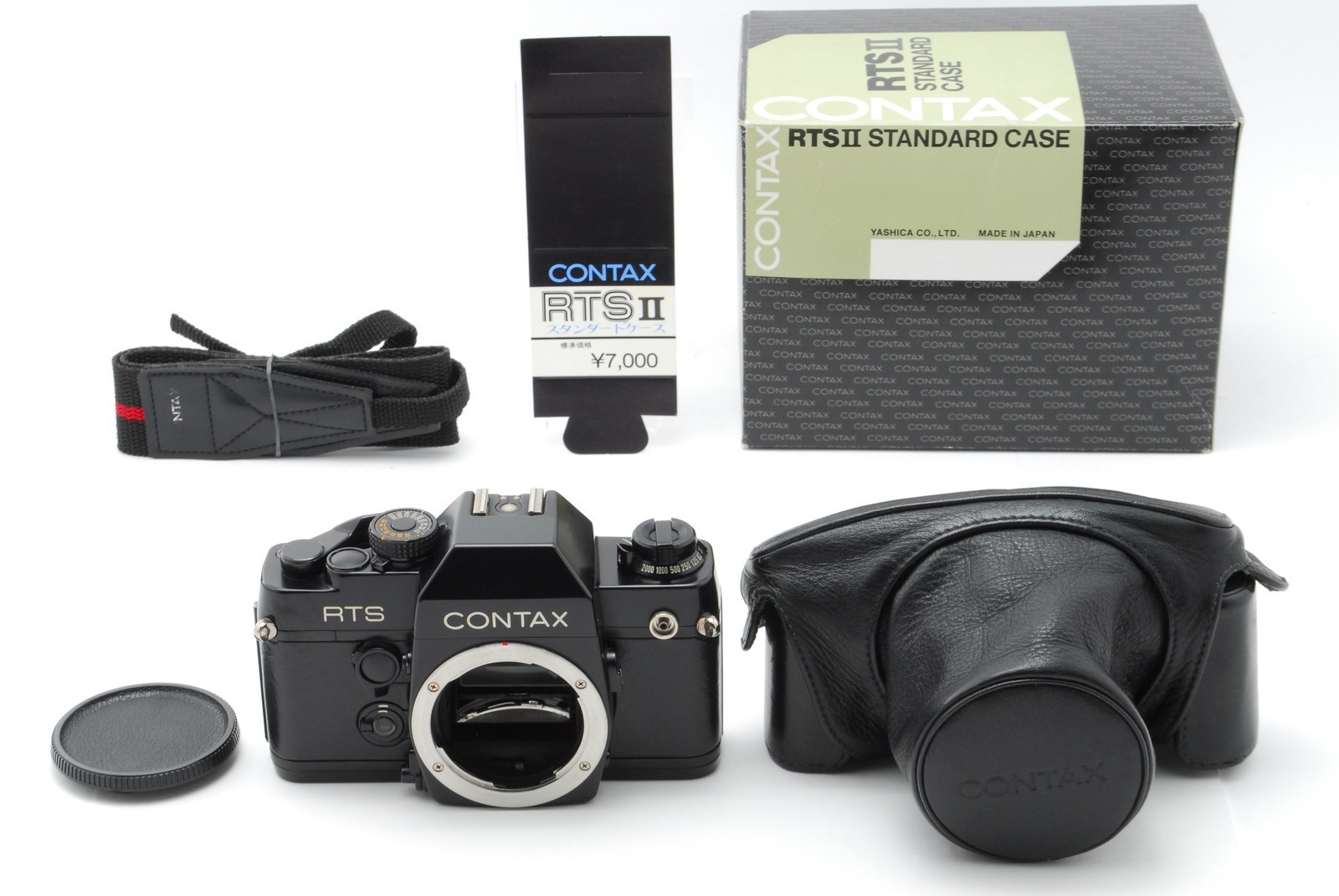
Today, the Contax RTS is a sought-after collectible, particularly among enthusiasts of classic SLRs and Zeiss lens users. Well-maintained bodies in good working condition typically sell for $300–$600, with rare variants or limited editions commanding higher prices. Fully functional units with original boxes and documentation are especially prized. The camera’s all-metal construction and high build quality contribute to its longevity, but age-related issues are common.
When purchasing an RTS, buyers should check for shutter accuracy, mirror movement smoothness, and meter functionality. The CdS meter cells can degrade over time, leading to inaccurate readings. Battery corrosion in the bottom battery compartment is another frequent issue, as the camera uses two 1.5V SR44 or PX625 batteries for metering. While the shutter is mechanically timed and will operate without batteries, the meter will not function. Additionally, the rubber grips and seals may dry out or crack, and the self-timer mechanism can become sticky if not regularly serviced.
Similar Cameras
- Nikon F2 (1971–1980) – A fully mechanical professional SLR with modular design and extensive lens support.
- Canon F-1 (1971–1981) – Canon’s flagship mechanical SLR, known for durability and precision.
- Pentax LX (1980–2001) – A compact, modular SLR with excellent build quality and advanced metering.
- Minolta XE (1974–1977) – A joint project with Leica, featuring a similar electronic shutter and clean design.
- Olympus OM-1 (1972–1978) – A compact, lightweight SLR with a strong lens lineup and excellent viewfinder.
Repair & Maintenance
The Contax RTS uses two 1.5V silver oxide (SR44) or alkaline (LR44) batteries for the light meter, housed in a compartment on the base plate. The shutter is electronically controlled and will not operate without power, unlike fully mechanical cameras. Common repair issues include degraded CdS cells, sticky shutter curtains, and worn shutter speed timing at slower speeds. The camera’s complex internal electronics, while advanced for its time, are sensitive to moisture and age.
Professional CLA (clean, lubricate, adjust) services are recommended every 5–10 years for regular users. Due to the camera’s age, finding qualified technicians familiar with the C/Y system can be challenging. Replacement parts are limited but still available through specialty repair shops and online markets. Lubricants used in the shutter and mirror mechanisms may have hardened over time, leading to inconsistent speeds or delayed mirror return. When storing an RTS, it should be kept in a dry, temperature-stable environment with the battery removed to prevent corrosion.
eBay Listings



As an eBay Partner, we earn from qualifying purchases. This helps support our independent vintage technology research.