Contax T2 (1990–1996): The Titanium Time Machine with a Zeiss Heart
A precision-engineered 35mm compact that married Carl Zeiss optics, titanium construction, and unapologetic luxury in a pocketable form—proof that film wasn’t dead, it was just getting better.
Overview
The Contax T2 isn’t just a camera. It’s a manifesto in brushed titanium, a love letter to photographers who believed that convenience shouldn’t mean compromise. Released in 1990 as the refined successor to the original Contax T, the T2 arrived at a pivotal moment: the twilight of mechanical cameras and the dawn of digital anxiety. While most compact 35mm shooters were plastic point-and-shoots with toy lenses, the T2 stood apart—literally and figuratively—offering SLR-level image quality in a body that could (just barely) fit in a coat pocket. It was the camera that professionals tucked away when they didn’t want to look like pros, and the one enthusiasts saved up for like it was a Rolex.
What made the T2 special wasn’t just its specs—it was the execution. Every detail, from the smooth action of its aperture ring to the soft, confident click of its shutter, felt deliberate. It was built in Japan by Yashica (Kyocera’s camera arm at the time), a company with deep roots in precision optics and a grudge against mediocrity. The T2 was their answer to Leica’s growing grip on the premium compact market and a direct challenge to Minolta’s later, even more obsessive Minolta TC-1. But unlike its competitors, the T2 didn’t just aim for optical perfection—it wrapped it in a body that felt like it could survive a fall from a moving taxi. And with a launch price of $700 in 1990 (over $1,500 today, adjusted for inflation), it wasn’t pretending to be affordable. It was for those who wanted the best, and knew exactly what that cost.
Specifications
| Film Format | 35mm |
| Lens | Carl Zeiss Sonnar T* 38mm f/2.8 |
| Aperture Range | f/2.8 to f/16 |
| Shutter Speeds | 4 seconds to 1/500 second |
| Exposure Control | Programmed autoexposure with manual override via aperture ring |
| Focus System | Contrast-detection autofocus with manual focus override |
| Viewfinder | Optical, bright-line frame with focus confirmation and exposure indicators |
| Metering | Center-weighted TTL metering |
| Flash | Built-in pop-up flash with auto TTL control, sync up to 1/125s |
| Flash Guide Number | 10 (m, ISO 100) |
| ISO Range | ISO 25–5000, manually set |
| Shutter Release | Electronic, with 2-second self-timer |
| Power Source | Two CR123A lithium batteries |
| Dimensions | 106 x 64 x 37 mm |
| Weight | 305 g (with batteries) |
| Body Material | Titanium |
Key Features
- Carl Zeiss Sonnar T* 38mm f/2.8 Lens: This isn’t just “a Zeiss lens”—it’s a Sonnar, a design renowned for its creamy bokeh, high contrast, and near-perfect correction of spherical aberrations. The T* anti-reflective coating wasn’t marketing fluff; it genuinely reduced flare in backlit situations, something I’ve tested shooting into sunrise on a Brooklyn pier with zero ghosting. At 38mm, it’s slightly wider than the traditional 50mm “normal” lens, making it more versatile for street and travel work. And f/2.8? That’s fast enough to isolate subjects in dim light without turning the camera into a brick.
- Manual Aperture Ring with Program Override: In a world of fully automatic compacts, the T2 let you choose. Set the aperture to f/2.8 for shallow depth of field, or f/16 for everything in focus—the camera would adjust shutter speed accordingly. It’s a rare hybrid: point-and-shoot convenience with the soul of a manual camera. I’ve shot entire rolls at f/4 just to taste that sweet spot of sharpness and depth.
- Titanium Body: Not aluminum. Not magnesium alloy. Titanium. This is the same material used in aerospace and high-end watches. It’s light, strong, and develops a dignified patina over time. The T2 feels expensive because it is expensive. And that heft? It’s reassuring—no creaks, no flex, just solid confidence in your palm.
- Autofocus with Manual Override: The T2 uses contrast-detection AF, which was advanced for 1990. It’s not as snappy as modern systems, but it’s accurate. And here’s the magic: you can manually tweak focus after AF locks, with confirmation in the viewfinder. Try that on a Leica Minilux. The focus ring is buttery smooth, and the manual override is mechanical, not electronic—pure joy for control freaks.
- Optical Viewfinder with Bright-Line Framing: No LCDs here. The viewfinder is clean, bright, and includes frame lines, focus confirmation (a green dot), and exposure info. It’s like looking through a tiny window into a better world. And because it’s optical, there’s zero lag—critical for street photography.
Historical Context
The Contax T2 didn’t emerge in a vacuum. It was born from a rivalry—a decades-long optics cold war between German precision and Japanese engineering. Contax, originally a Zeiss brand, had been revived by Kyocera in the 1980s as a direct counter to Leica. The original Contax T (1990) was bold but flawed: sluggish autofocus, no manual override, and a slightly plasticky feel. The T2 fixed all of it. It was Contax saying, “We listened. Now watch.”
In the early 1990s, high-end compact cameras were a battleground. Leica had the Leica Minilux (1995), elegant but optically average. Minolta was cooking up the Minolta TC-1 (1996), which would later become a cult legend for its f/2 G-Rokkor lens. But in 1990, the T2 was alone at the top: the only compact with a Zeiss lens, titanium body, and real manual control. It appealed to photojournalists, architects, and design nerds—anyone who valued discretion and quality. It was the camera you took to a gallery opening when you didn’t want to look like you were working.
The T2 was discontinued in 1996, but its legend grew. Kyocera released the Contax T3 in 2001 with a new Biogon lens and improved AF, but by then, digital was looming. The T2 became a symbol of the last golden age of film—a time when manufacturers still believed in overengineering for the sake of beauty. It wasn’t just a camera. It was a statement: Photography matters. So does craft.
Collectibility & Value
Today, the Contax T2 is a prized relic. With “uncommon” rarity and “very high” desirability, it trades between $800 and $1,500 USD in 2025, depending on condition and functionality. Fully working examples with clean lenses and responsive autofocus command the top end. Look for one with the original case and manual—bonus points if the titanium finish is unscratched.
But beware: age has not been kind to all T2s. The most common failure points are the autofocus motor (prone to seizing after decades of dormancy) and the CR123A battery contacts (which can corrode, especially if old batteries were left inside). Always test the AF and flash before buying. Also, check the LCD in the viewfinder—ghosting or dead segments indicate a failing circuit board. A T2 that powers on but won’t focus is a $300 camera, not a $1,200 one.
Still, when it works, it sings. The Sonnar lens renders film with a three-dimensional pop that modern digital compacts can’t match. Shoot Portra 400 at f/2.8 and you’ll see why people still hunt these down. It’s not nostalgia. It’s optics.
eBay Listings


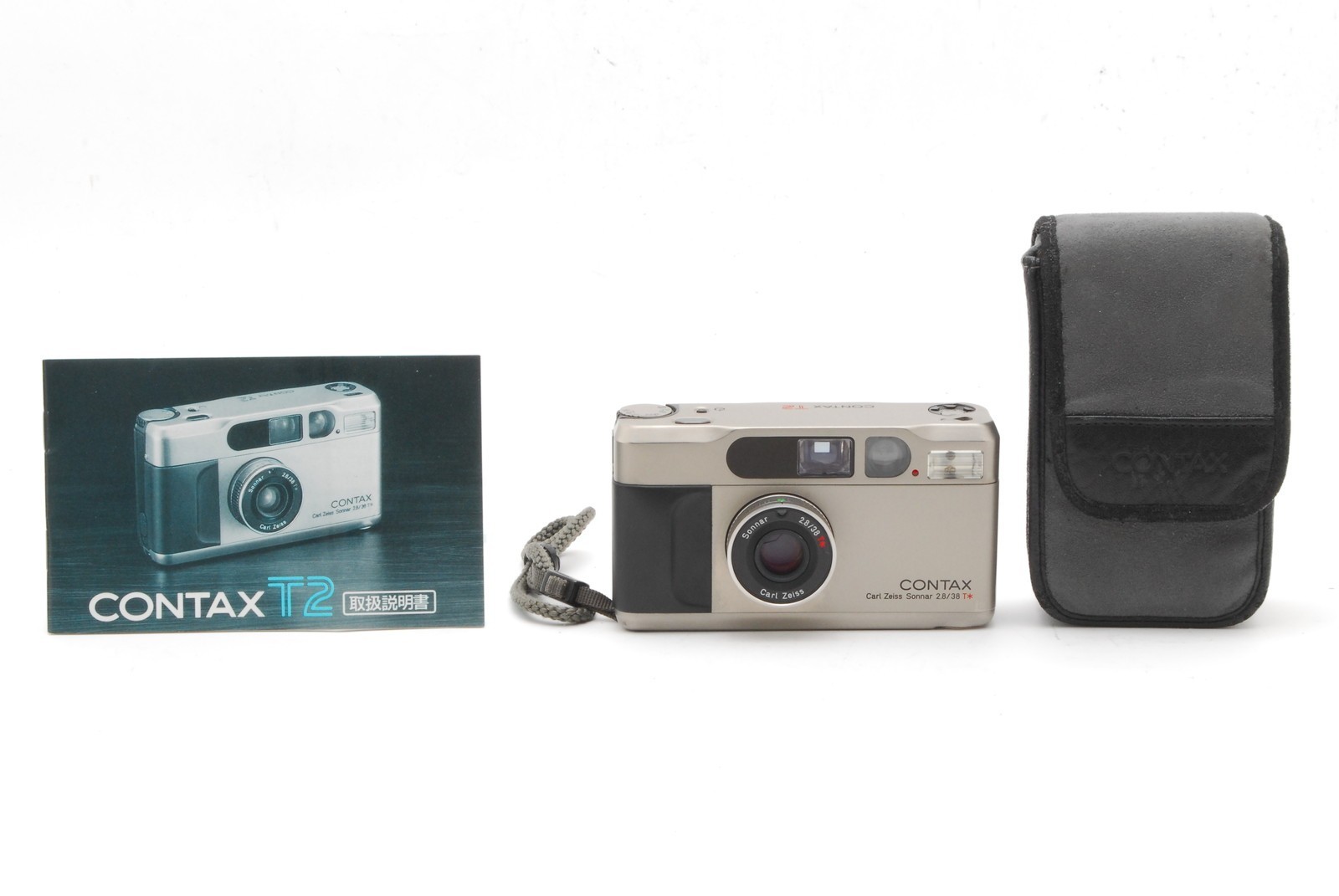

As an eBay Partner, we earn from qualifying purchases. This helps support our independent vintage technology research.