Contax G2 (1996–2005): The Last Mechanical Poet of Autofocus Rangefinders
A precision-engineered 35mm autofocus rangefinder that fused Carl Zeiss optics, electronic intelligence, and analog soul—just before the digital tsunami hit.
Overview
The Contax G2 wasn’t just a camera—it was a philosophical statement in magnesium and glass. Released in 1996 as the refined successor to the Contax G1, the G2 stood defiantly at the crossroads of tradition and innovation, offering professional photographers a rare hybrid: a true rangefinder experience with autofocus, electronic viewfinder assistance, and motorized film handling. At a time when SLRs were becoming increasingly automated and bulky, the G2 whispered elegance, subtlety, and speed. It was the kind of camera that made photojournalists pause mid-stride and Leica loyalists raise an eyebrow—because here was a German-branded, Japanese-built machine that dared to modernize the rangefinder without sacrificing its soul.
Used by discerning shooters from Tokyo street photographers to European editorial crews, the G2 was never about mass appeal. With an original MSRP of $2,200—equivalent to a small car down payment in 1996—it targeted only the most committed. But for those who wielded it, the G2 delivered a uniquely fluid shooting experience: near-silent operation, buttery-smooth focusing with manual override, and a viewfinder that dynamically adjusted framelines for its three native lenses (28mm, 45mm, and 90mm). It was the last serious attempt to evolve the mechanical rangefinder into the electronic age before digital mirrorless cameras made the entire category feel nostalgic rather than cutting-edge.
Specifications
| Film Format | 35mm |
| Lens Mount | Contax G-mount |
| Lens System | Integrated and interchangeable Carl Zeiss lenses |
| Interchangeable Lenses | Yes |
| Shutter Speeds | 1/6000 to 30 seconds, Bulb |
| Shutter Type | Vertical-travel focal-plane shutter |
| Exposure Modes | Aperture-priority AE, Manual, Program AE |
| Metering Modes | Center-weighted, Spot |
| Autofocus | Contrast-detection autofocus with manual override |
| Viewfinder | Electronic viewfinder with diopter adjustment, framelines for 28mm, 45mm, and 90mm lenses |
| Focusing Screen | Rangefinder-style manual focus assist with split-image and microprism collar |
| Flash Sync | X-sync at 1/120 sec, hot shoe and PC terminal |
| Flash Modes | Auto, Manual, Fill-in, Red-eye reduction |
| Film Speed Range | ISO 6–5000 (DX-coded or manual) |
| Film Advance | Automatic motorized advance |
| Film Rewind | Automatic motorized rewind |
| Battery | 2x CR123A lithium batteries |
| Power Life | Approx. 60 rolls of 24-exposure film |
| Dimensions | 123 x 70 x 56 mm (4.8 x 2.8 x 2.2 in) |
| Weight | 630 g (22.2 oz) with batteries and body only |
| Construction | Die-cast aluminum alloy chassis with polycarbonate shell |
| Weather Sealing | Dust and moisture resistant construction |
Key Features
- Autofocus Rangefinder with Manual Override: The G2’s contrast-detection autofocus was revolutionary for a rangefinder. Unlike SLRs that relied on phase detection, the G2 used live image analysis through the lens—making it accurate but deliberate. The real magic? You could instantly override it with a twist of the focus ring, thanks to its smooth, direct-drive manual focus coupling. This hybrid system felt like a collaboration between machine and photographer.
- Electronic Viewfinder with Dynamic Framelines: The EVF wasn’t just a novelty—it was essential. As you mounted a 28mm Biogon or 90mm Sonnar, the framelines adjusted automatically. The viewfinder also displayed exposure data, focus confirmation, and even a focus assist magnifier when you turned the ring. It was the closest thing to a “smart” rangefinder before the term existed.
- Integrated 45mm f/2 Planar Lens: The standard lens wasn’t an afterthought—it was a masterpiece. The Planar T* 45mm f/2 delivered Leica-M-level sharpness with smoother bokeh and better contrast. Paired with the optional 28mm f/2.8 Biogon (ultra-wide, minimal distortion) and 90mm f/2.8 Sonnar (dreamy compression, perfect for portraits), the G2 system offered a complete pro toolkit in compact form.
- Rangefinder-Style Focusing Screen: Despite being electronic, the G2 retained a split-image/microprism collar in the viewfinder—because sometimes you just want to nail focus by eye. This nod to tradition made it feel less like a robot and more like a tool.
- Dust and Moisture Resistance: In an era when most rangefinders were delicate instruments, the G2’s sealed construction meant it could handle a sudden rainstorm or dusty alley—critical for working photographers.
Historical Context
The Contax G2 emerged in 1996, a time when autofocus meant SLRs with clunky mirrors and noisy motors. Rangefinders, by contrast, were analog sanctuaries—quiet, compact, and tactile. The Leica M6, introduced in 1984, was still the gold standard: purely mechanical, beautifully simple, and beloved by purists. But it offered no autofocus, no metering automation beyond center-weighted, and no electronic assists. The G2 was Contax’s answer: “What if we kept the rangefinder’s spirit but gave it a brain?”
It was a bold gamble. The Contax G1 (1994–1996) had laid the groundwork, but its autofocus was sluggish and its ergonomics awkward. The G2 fixed both: faster AF, better grip, and that crucial manual focus assist. Competitors like Leica wouldn’t offer autofocus until the Leica M7 in 1998—and even then, it used phase detection via a secondary sensor, not through-the-lens contrast detection like the G2. In that narrow window from 1996 to 2000, the G2 was arguably the most advanced 35mm rangefinder on the planet.
But the digital revolution loomed. By 2003, DSLRs were gaining traction, and by 2005—when production of the G2 quietly ended—film was already in retreat. Contax’s parent company, Kyocera, exited the camera business entirely. The G2 became a footnote to some, but a cult icon to others: the last great analog-digital hybrid rangefinder.
Collectibility & Value
Today, the Contax G2 is uncommon but not rare—fewer than 30,000 units were reportedly made. Its current market value ranges from $800 to $1,500 USD (2025), depending on condition, included lenses, and functionality. A G2 with the 45mm Planar and 28mm Biogon can easily command the upper end, especially if the autofocus still snaps crisply and the viewfinder remains bright.
But beware: aging is the enemy. The most common issues include autofocus motor failure (often due to dried lubricants or worn gears), viewfinder display degradation (faint or flickering EVF), and battery compartment corrosion from leaking CR123A cells. Always test the camera before buying—check all shutter speeds, metering accuracy, and lens communication. Clean the contacts, inspect for mold in the viewfinder, and verify that the rangefinder alignment is still spot-on (a misaligned G2 is a paperweight).
Despite its quirks, the G2 remains highly desirable. It’s a bridge between worlds: the last word in 35mm rangefinder refinement, and a fascinating “what if” in camera history. For collectors, it’s not just a camera—it’s a beautifully engineered artifact of a moment when film still had a fighting chance.
eBay Listings
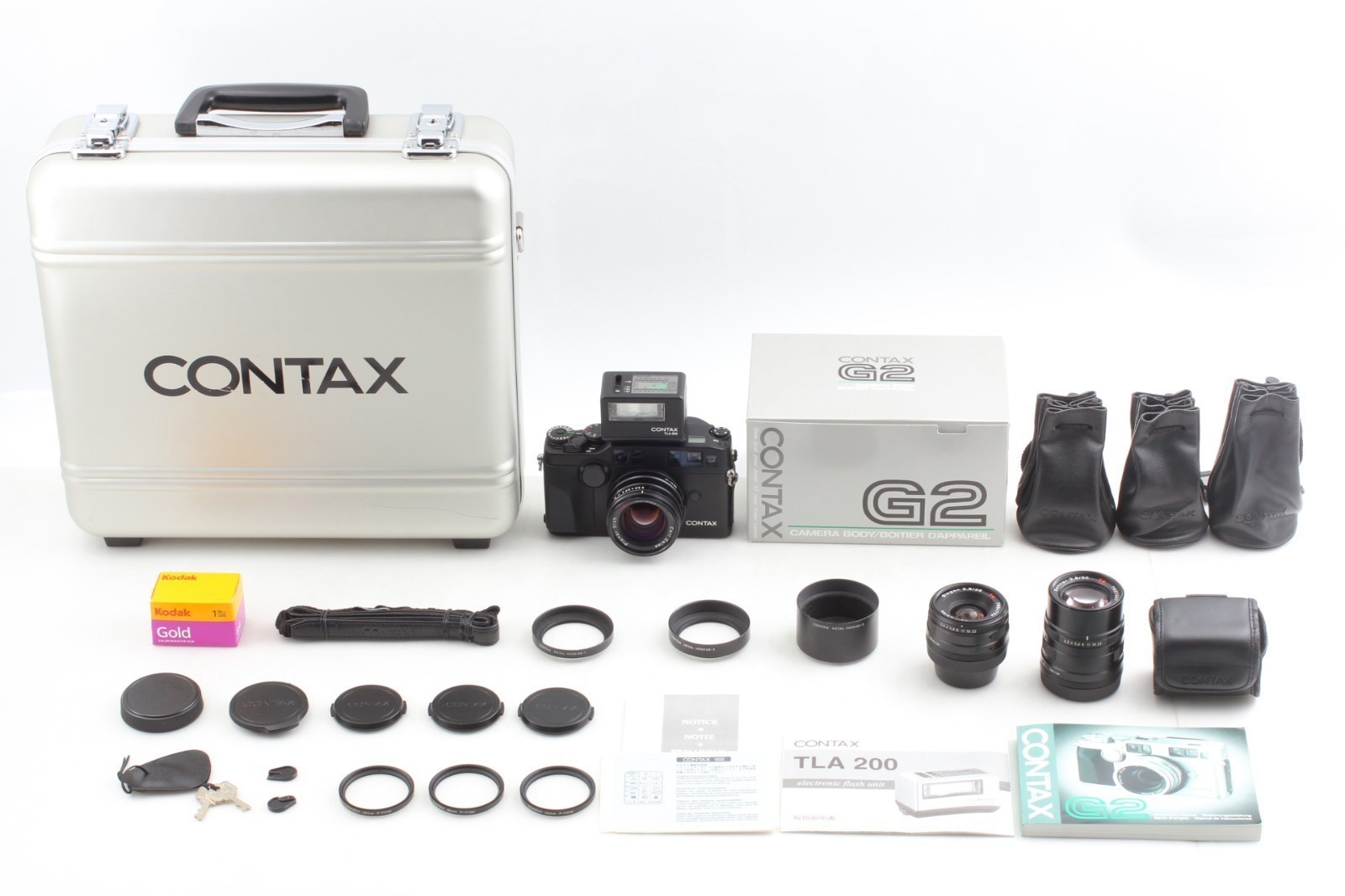


As an eBay Partner, we earn from qualifying purchases. This helps support our independent vintage technology research.
Related Models
- Contax G1 (1994-2000)
- Agfa Optima Sensor 1535
- Argus Argus A
- Argus Argus Autronic (1960)
- Argus Argus C-44R
- Argus Argus C
- Argus Argus C2
- Argus Argus C3 (1939-1966)
- Argus Argus C44R
- Argus C-44R