Certo Dollina I (1935–1939)
At 560 grams, it rests in the hand like a compact promise of precision—German engineering folded into a pocketable form.
Overview
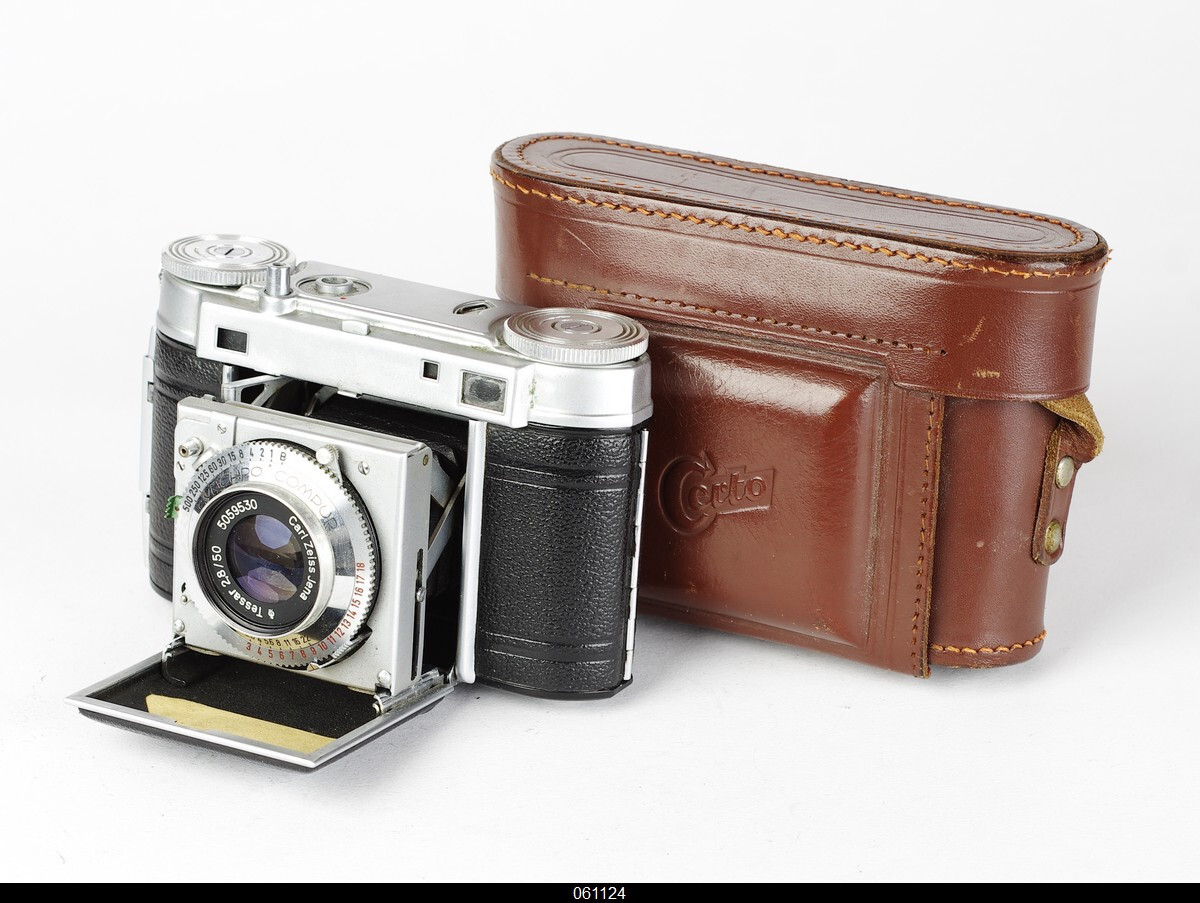
The Certo Dollina I isn’t flashy, but it doesn’t need to be. Built by Certo Camera Werk in Dresden, Germany, this 35mm folding viewfinder camera occupies a quiet but critical space in the lineage of pre-war miniature photography. Introduced in early 1936 as the mid-range model of the first-generation Dollina series, it arrived during a period of intense competition among German optical firms. At a time when Leica and Contax dominated headlines, Certo staked its claim not with radical innovation, but with disciplined execution. The Dollina I was never meant to be a rangefinder camera—though it featured a cold shoe ostensibly for one—but a well-built, mechanically reliable tool for serious amateurs who valued quality optics and robust construction without the premium price tag.
What sets the Dollina I apart from many contemporaries is its self-erecting strut-folding chassis. Made of sturdy metal, the mechanism snaps open with a firm press and locks securely into place, ready for use. The bed is molded bakelite covered in leatherette, a common but effective solution for dampening vibration and protecting the internal frame. Unlike some folding cameras that demand careful alignment before shooting, the Dollina I allows focusing at any state—open or closed. The unit focusing system, operated by a knob on the top plate, can be adjusted even when the camera is collapsed, and
Film transport moves left-to-right, with a frame counter visible on the top plate. The sprocket wheel, unusually, has only three teeth and is engaged by a button on the front of the body—a design quirk that demands attention during loading. The rewind release requires pulling out the advance knob and turning it back clockwise a partial turn, a sequence that feels deliberate rather than intuitive. The shutter release sits directly on the shutter body, with no mechanical linkage to the camera body itself, meaning actuation must be done by finger directly on the shutter—a limitation for cable release or remote use unless adapted.
Specifications
| Manufacturer | Certo Camera Werk, Dresden, Germany |
| Product type | 35mm folding viewfinder camera |
| Production years | 1935–1939 |
| Lens options | Meyer Trioplan 5cm f/2.9 (3 element); Schneider Radionar 5cm f/2.9 (3 element); Schneider Xenar 5cm f/2.8 (4 element); Schneider Xenar 5cm f/2.9 (5 element); Steinheil Cassar 5cm f/2.9 (3 element); Carl Zeiss Tessar 5cm f/2.8 (4 element) |
| Shutter | Compur 300; reportedly speeds 1 – 1/300, B, T; some units may have Compur-Rapid 500 |
| Focusing | Unit focusing operated by a knob on the top of the body |
| Viewfinder | A simple reverse-telescope, built unobtrusively into the top plate at the left side |
| Film transport | Left-to-right |
| Frame counter | On the top plate |
| Sprocket wheel | Has only three teeth, operated by a button on the front of the camera |
| Rewind release | Operated by pulling out the advance knob and turning it back clockwise a partial turn |
| Shutter release | On the shutter body; no mechanical linkage between the shutter and the rest of the camera |
| Accessory shoe | Cold shoe, ostensibly for an accessory rangefinder |
| Tripod bushing | On the bottom left; not the modern standard size |
| Weight | 560gm |
| Chassis | Compact strut-folding, self-erecting chassis made of sturdy metal |
| Bed | Molded bakelite covered in leatherette |
Key Features
Unit Focusing with Pre-Opening Adjustment
One of the Dollina I’s most distinctive operational traits is its ability to focus while collapsed. The unit focusing system moves the entire lens assembly via a knob on the top plate, and the gearing allows adjustment regardless of the camera’s folded state. This means a photographer can set focus to, say, 10 feet before opening the camera, then simply unfold and shoot. The lack of interlock between focus and folding mechanisms speaks to a deliberate design choice—flexibility over enforced sequence.
Self-Erecting Strut-Folding Chassis
The chassis is a study in functional minimalism. When the release catch is pressed, the front standard rises and locks automatically, guided by twin struts that unfold in a single motion. The metal construction feels substantial, and the bakelite bed provides a rigid base that resists warping over time. Unlike cloth-bellows models that degrade with light and humidity, the Dollina I’s structure remains stable if stored properly. The self-erecting feature isn’t just a gimmick—it ensures consistent lens alignment shot after shot, a necessity for maintaining image quality with high-performance lenses like the Tessar or Xenar.
Three-Tooth Sprocket Wheel with Front Button Engagement
The film advance mechanism centers on a sprocket wheel with only three teeth—a design intended to reduce weight and complexity, but one that demands precise engagement. A button on the front of the camera must be pressed to engage the sprocket with the film perforations. If missed, the film won’t advance correctly, risking overlapping frames or jams. This system reportedly works reliably when clean and lubricated, but sources suggest it’s a common point of failure if neglected. The left-to-right transport direction, combined with the top-mounted frame counter, makes tracking exposures straightforward, though the counter must be manually reset after loading.
Compur 300 Shutter with Direct Release
Mounted on the lens panel is a Compur 300 shutter, offering speeds from 1 second to 1/300, plus Bulb and Time settings. Some units may instead carry the Compur-Rapid 500, though documentation does not clarify whether this was a factory option or later replacement. The shutter release is located on the shutter body itself, requiring direct finger pressure. There is no mechanical linkage to a body-mounted release, limiting remote operation unless an adapter is used. While the speeds are accurate when serviced, the lack of a synchronized release point can make handheld long exposures tricky. The shutter is user-serviceable but delicate—owners are advised against disassembly without proper tools and experience.
Reverse-Telescope Viewfinder
The viewfinder is a simple reverse-telescope design, integrated into the top plate on the left side. It provides a clear, albeit small, frame for composition. The viewfinder does not couple to the focusing mechanism, so what’s seen is not what’s focused. While rudimentary by modern standards, it was typical for mid-tier 35mm cameras of the 1930s. Its unobtrusive placement avoids interfering with the accessory shoe or top plate controls.
Historical Context
The Dollina I emerged in early 1936 as part of Certo’s strategic push into the 35mm market. Initially, the base model was simply called "Dollina." With the introduction of the budget-oriented Dollina 0 and the rangefinder-equipped Dollina II later that year, the original model was rebranded the Dollina I to clarify its position as the mid-range offering. The Dollina II is described as being identical to the Dollina I except for the addition of a rangefinder, confirming their shared mechanical core. Monthly production of the Dollina I was reportedly around 30 units, suggesting limited but steady output. The series as a whole demonstrated that Certo could compete with established names from Dresden and Wetzlar, leveraging quality German optics and solid engineering to carve out a niche.
Collectibility & Value
Market data for the Dollina I remains sparse, but available records suggest modest value. A price guide from 1990 listed it at $47.00, rising to $70.00 by 2005. One unit sold at auction for £38, including buyer’s premium, indicating continued interest at entry-level collector tiers. While no specific failure modes are documented for the Dollina I, the closely related Dollina II is known to suffer from film winding mechanism issues—particularly with the three-tooth sprocket engagement—so similar problems may affect the I. Repair is not recommended for beginners; service notes from similar models warn that internal mechanisms are delicate and require professional handling. Given its shared construction with the II, the Dollina I likely benefits from the same high-quality feel noted by owners—solid, precise, and built to last, provided it has been stored and used with care.
eBay Listings

As an eBay Partner, we earn from qualifying purchases. This helps support our independent vintage technology research.
Related Models
- Certo Dollina 0 (1936-)
- Agfa Ansco Clipper
- Agfa Billy (1927-)
- Agfa Standard (1926-)
- Agfa Superior
- Belca Belfoca I (1950-1959)
- Belca Belfoca (c1950-1956)
- Zeiss Ikonta