CERTO DOLLINA
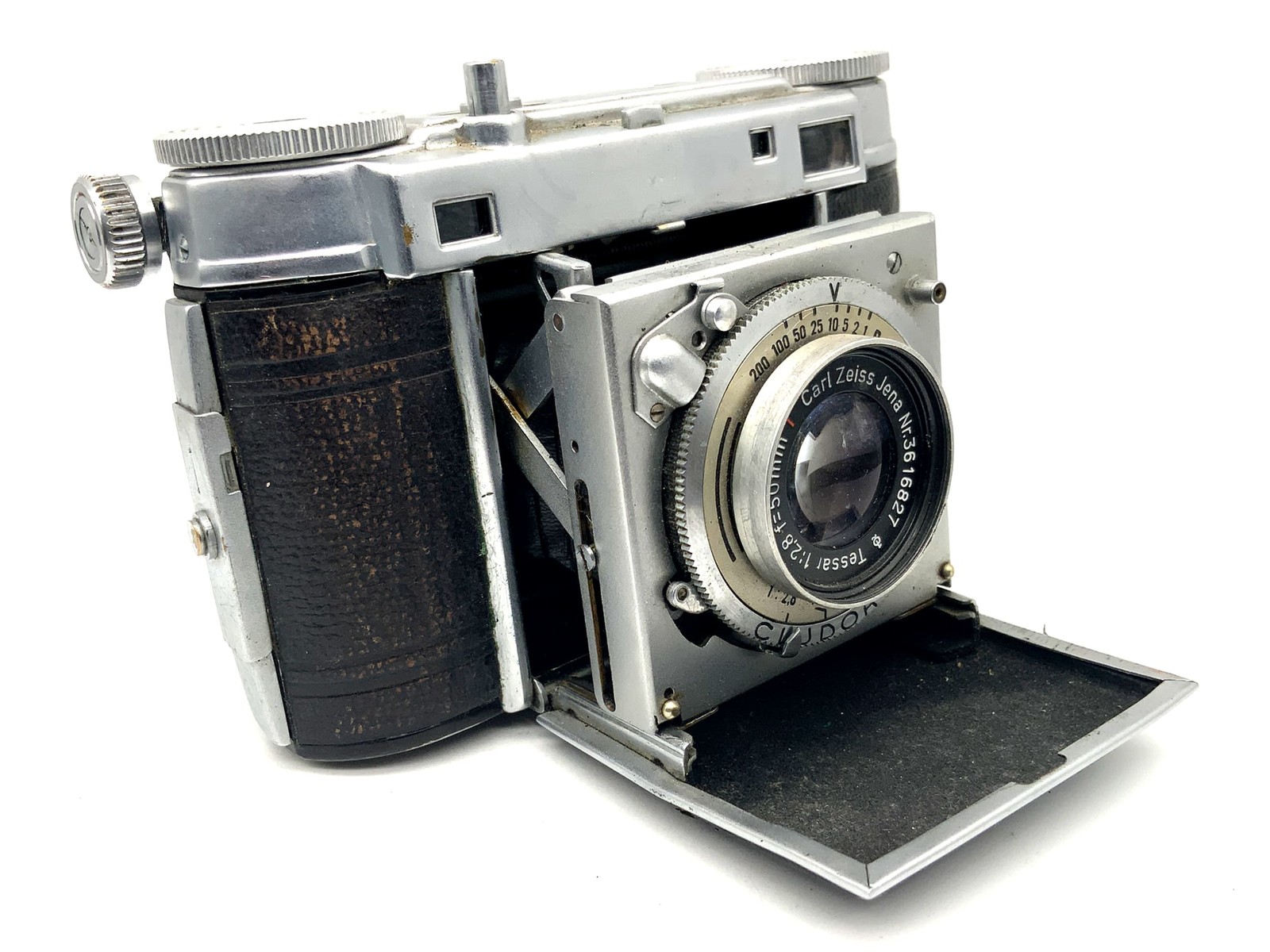
The Certo Dollina is a compact 35mm folding camera produced by the German manufacturer Certo between 1935 and 1940. Designed as a portable, high-quality camera for amateur photographers, it combines precision engineering with the optical excellence of a Tessar-type lens in a streamlined folding body.
Overview
Introduced during a period of rapid innovation in 35mm camera design, the Certo Dollina emerged as a refined example of pre-war German compact camera craftsmanship. Manufactured by Certo-Cameras GmbH in Dresden, a company known for its high-quality plate and roll-film cameras since the early 20th century, the Dollina represented the firm’s strategic pivot toward the growing 35mm market. It was positioned as a premium compact folder, targeting amateur enthusiasts who sought portability without sacrificing optical performance. The Dollina's design emphasized mechanical reliability and ease of use, featuring a rigid folding strut system that protected the lens and shutter assembly when closed, while allowing for quick deployment.
The camera was part of a broader trend in the 1930s toward miniaturization and convenience in photography, competing with contemporaries like the Kodak Retina and the Wirgin Edinex. Unlike many of its peers, the Dollina retained a traditional cloth focal-plane shutter mechanism, a hallmark of Certo’s engineering heritage. It was typically fitted with a 45mm f/3.5 Certo Doppelinar (a Tessar-type lens); some models had a Trioplan, but never a Zeiss Tessar. , a significant advantage over scale-focus competitors. Its top plate included both a viewfinder and rangefinder window, with a combined eyepiece for alignment. The camera used standard 135 cassettes and advanced film via a manual lever, typical of the era.
Specifications
| Specification | Value |
| Type | Folding viewfinder/rangefinder camera |
| Film Format | 35mm (135 cartridge) |
| Years Produced | 1935–1940 |
| Lens Mount | Fixed lens (non-interchangeable), shutter-mounted |
| Shutter | Leaf shutter only (typically Derval or Compur-Rapid); speeds from 1 sec to 1/300 sec, B |
| Aperture Range | f/3.5 to f/16 (Doppelinar 45mm) |
| Metering | None (uncoupled; exposure determined manually) |
| Exposure Modes | Manual only |
| Viewfinder | Optical viewfinder with scale focusing; no rangefinder |
| Focusing | Manual via scale focusing only |
| Dimensions | Approx. 105 x 60 x 35 mm (closed); weight ~450 g (depending on lens/shutter combination) |
| Flash Sync | Cold shoe and PC terminal (on Compur-shutter models) |
Key Features
- High-quality 45mm Tessar lens: Delivers sharp, contrast-rich images with minimal aberration, a benchmark of 1930s optical design.
- Dual shutter options: Available with either a durable cloth focal-plane shutter or the more advanced Compur-Rapid leaf shutter, offering speeds up to 1/300 sec.
- Compact folding design: Collapsible strut frame allows for portability while maintaining rigidity during use.
- Integrated rangefinder (later models): Coupled focusing system enables precise manual focusing, a rarity in compact folders of this class.
- Standard 135 film compatibility: Uses readily available 35mm cassettes, aligning with the emerging consumer film standard.
Historical Context
The Certo Dollina was launched at a pivotal moment in photographic history—the mid-1930s—when 35mm film was transitioning from a novelty to a dominant format. The success of the Leica and the introduction of the Kodak Retina in 1934 created a burgeoning market for compact, high-quality 35mm cameras in Europe. Certo, traditionally known for its large-format and roll-film cameras like the Certo Reflex, sought to capture a share of this expanding segment. The Dollina was thus developed as a positioned as a mid-tier compact 35mm camera, more affordable than Leica or Contax but well-built for its class, while offering superior optics and build quality compared to budget models.
The Dollina competed directly with cameras such as the Wirgin Edinex, the Adox Adrette, and early Zeiss Ikon models. Its use of the Tessar lens—often sourced directly from Zeiss—gave it strong optical credibility. However, Certo’s limited international distribution and the onset of World War II in 1939 curtailed production and export. By 1940, manufacturing had ceased due to wartime material restrictions and the bombing of Dresden-based facilities. As a result, the Dollina was produced in relatively small numbers, contributing to its obscurity compared to more widely marketed contemporaries.
Collectibility & Value
The Certo Dollina is a rare and increasingly sought-after camera among collectors of pre-war German photography equipment. Due to its limited production run and the destruction of manufacturing infrastructure during WWII, surviving examples in functional condition are uncommon. The presence of a Compur shutter increases value slightly; all lenses were Certo-made, with . Cameras with the coupled rangefinder are particularly prized, as they represent the final and most advanced iteration of the Dollina line.
When evaluating a Dollina for purchase, collectors should inspect the bellows for pinholes or deterioration—a common issue in folding cameras of this era—as well as the functionality of the shutter across all speeds. The strut hinges should be tight, with no lateral play, and the rangefinder alignment must be accurate if present. Original leather and chrome plating significantly affect condition grading. One frequent issue is shutter curtain decay in focal-plane models, which can be difficult to repair due to the complexity of the mechanism. Lubricant drying and aperture blade sticking are also typical with long-term storage. Given the age and scarcity of parts, professional servicing by a specialist in vintage German cameras is recommended before regular use.
Similar Cameras
- Kodak Retina I (Type 117) – A direct competitor with similar form factor and 35mm folding design, introduced in 1934.
- Wirgin Edinex 35 – German-made 35mm folder with interchangeable lenses and high build quality.
- Adox Adrette II – Compact 35mm folder featuring a Derval shutter and 45mm lens, produced in the same era.
- ZiM 35 – East German postwar folder with similar layout, though technically simpler.
- Nikon I – Early Nikon rangefinder, though more advanced and larger, shared the 35mm format and precision engineering ethos.
Repair & Maintenance
The Certo Dollina requires no batteries, as it is fully mechanical. Shutter maintenance is critical: the cloth focal-plane shutter (on non-Compur models) is sensitive to moisture and age, and replacement of the curtain is a complex task requiring specialized skills. The Compur-Rapid shutter, while more durable, often suffers from sticky blades or inconsistent speeds due to dried lubricants and should be serviced by a technician experienced with vintage leaf shutters. The rangefinder mechanism, if present, may require realignment ("collimation") if images are consistently out of focus despite correct distance setting. Regular use, gentle cleaning of lens elements with appropriate solutions, and storage in a dry, temperature-stable environment are essential for long-term preservation. Spare parts are extremely limited, making non-functional Dollinas difficult to restore.
eBay Listings


As an eBay Partner, we earn from qualifying purchases. This helps support our independent vintage technology research.