Certo Certina (1964/1966)
At 920 grams, it lands in your hands like a slab of East German engineering—simple, solid, and ready to surprise.
Overview
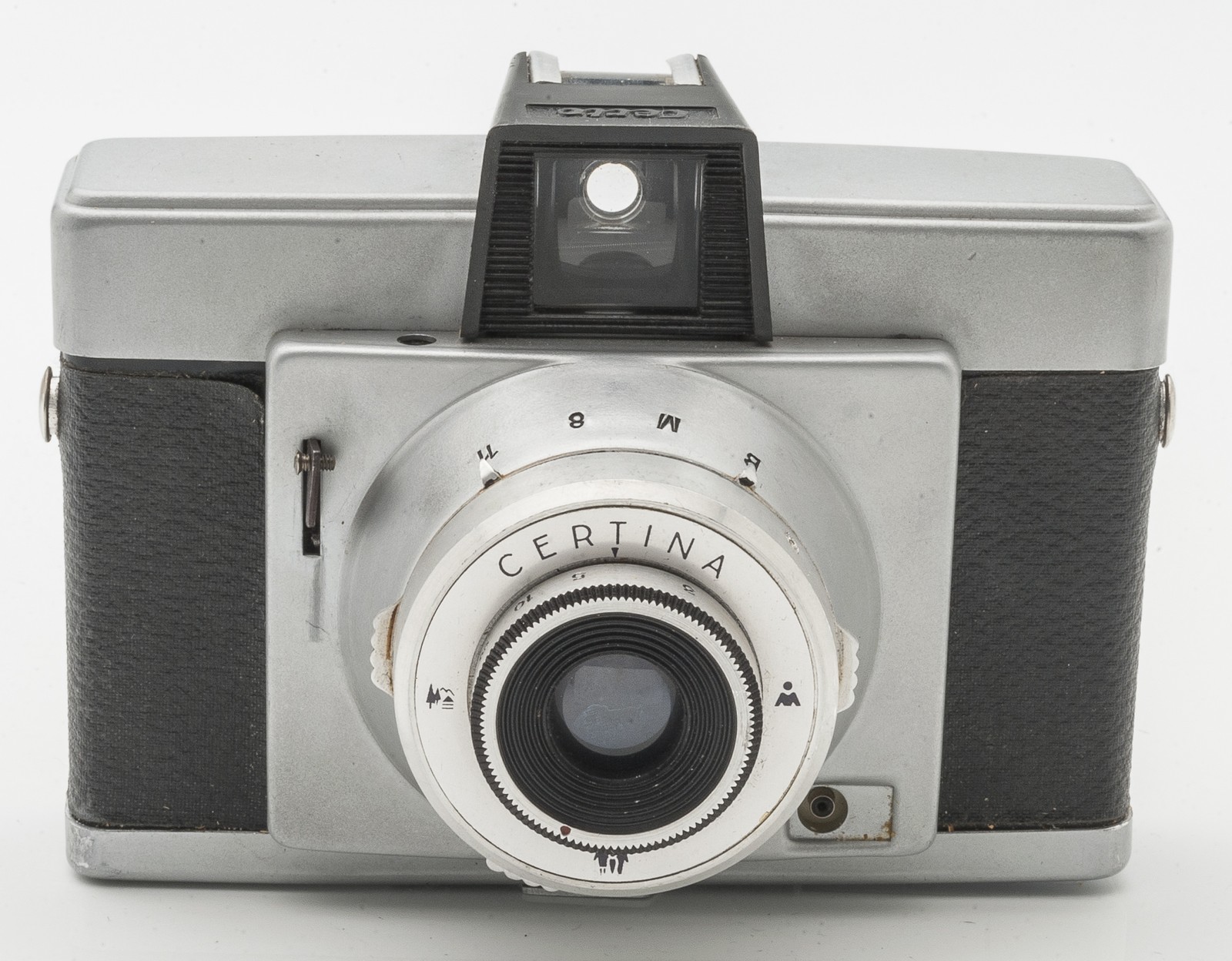
The Certo Certina isn’t trying to win any beauty contests or technical accolades. It’s a no-frills, fixed-lens medium format viewfinder camera built in 1966 by Certo-Kamera-Werk, a Dresden-based manufacturer with roots stretching back to 1902. Designed as a user-friendly beginner’s tool, it reflects the ethos of postwar East German consumer optics: functional, durable, and accessible. While not a rangefinder or precision instrument, it delivers exactly what it promises—pictures, on 120 film, in either 6x6 or 16-frame 4x4 format when using the internal mask. The steel body and mechanical simplicity suggest longevity, even if optical performance leans more toward nostalgic charm than clinical sharpness.
This is a camera built around the lens barrel. Nearly all controls—focus, aperture, shutter—are mounted there, making operation tactile and centralized. Focusing is manual, aided by distance markings in meters and helpful pictograms for common subjects like portraits or groups. The lens itself is described as a “very simple meniskus type” achromat, a design choice that keeps costs down and character up. It’s not fast—aperture options are limited to f/8 and f/11—but paired with the single-speed shutter (approximately 1/60 sec on “Moment” and Bulb for long exposures), it demands deliberate use. Natural light photographers will need patience, while those embracing unpredictability may find it liberating.
Film loading is assisted by a removable back secured with a rotating latch, a design that also houses a switch to toggle between the two red windows—one for 6x6, one for 4x4 framing. This dual-format flexibility was a clever touch for a beginner’s camera, letting users stretch a roll of 120 film further when needed. A frame advance lever replaces the knob found on its predecessor, the Certo-Phot of 1958, marking a small but meaningful ergonomic improvement. Flash synchronization is supported via a dedicated socket, though the accessory shoe is cold—no electrical connection, just a perch for mounting.
Specifications
| Manufacturer | Certo-Kamera-Werk / Certo |
| Product type | Simple, fixed-lens medium format viewfinder camera |
| Production years | Introduced in 1964/1966 |
| Film format | Uses 120 film |
| Picture formats | Can be used for 6x6 frames. With a 4x4 mask, can take 16 smaller pictures on 120 film |
| Lens type | Very simple meniskus type, achromat lens |
| Focusing | Adjustable focusing. Distance setting eased by symbols (icons) and distance markings in meters |
| Aperture settings | f/8 or f/11 |
| Shutter | Single-speed shutter. Shutter has two settings: "M" for "Moment" (approximately 1/60) and "B" for Bulb |
| Flash | Flash-synchronized. Has a flash sync socket. Has an accessory shoe without any connection to flash (a cold shoe) |
| Film advance | Frame advance lever |
| Viewfinder | Big optical viewfinder |
| Body material | Made of steel |
| Back | Removable back held on via a rotating latch |
| Red windows | Two red windows for 4x4 and 6x6 frames. Inside the removable back there is a switch to select one of the two red windows |
| Weight | 920 grams (about 2 pounds) |
Key Features
Frame Advance Lever Instead of Knob
Replacing the winding knob of the earlier Certo-Phot, the Certina introduced a frame advance lever—a small but significant upgrade in usability. This lever streamlines the winding process, reducing the number of turns needed and offering a more modern feel.
Steel Body with Rotating Latch Back
The all-steel construction gives the Certina a heft that belies its beginner status. At 920 grams, it feels substantial in the hand, more like a tool than a toy. The removable back is secured by a rotating latch, a simple but effective design that allows quick access to the film chamber. Inside, a switch selects between the two red windows—6x6 or 4x4—ensuring accurate frame spacing regardless of format. This dual-format capability was a practical feature for budget-conscious shooters who wanted flexibility without complexity.
Manual Focus with Symbolic Distance Aids
Focusing is entirely manual, adjusted via a ring on the lens barrel. What sets it apart is the use of symbolic icons—figures representing people at various distances—alongside meter markings. These pictograms make it easier for novice photographers to estimate focus without needing to interpret numbers. While the meniskus lens won’t deliver edge-to-edge sharpness, the focusing system lowers the barrier to entry, aligning with the camera’s role as an accessible introduction to medium format.
Single-Speed Shutter with Bulb Option
The shutter offers two settings: “M” for Moment (reportedly around 1/60 sec) and “B” for Bulb. There’s no range of speeds, no self-timer, no automation—just a straightforward mechanical release. This limitation forces users to think about light and exposure creatively, often relying on sunny-16 or similar rules. The Bulb setting opens the door to long exposures, especially when paired with the flash sync socket,
Dual Red Windows for Format Selection
One of the Certina’s more distinctive features is the dual red window system. By flipping a switch inside the back, users can align the red window with either the 6x6 or 4x4 frame counter. This allows a single roll of 120 film to yield either 12 square images or 16 smaller ones, depending on the mask used. The red windows are viewed externally, requiring careful winding to avoid overlap or light leaks—a ritual familiar to users of older roll film cameras.
Historical Context
Introduced in 1964/1966, the Certo Certina emerged during a period when East German optics were balancing innovation with state-driven production constraints. Certo, by then part of the VEB Pentacon combine, had a legacy in folding and medium format cameras, but the Certina represented a shift toward simplified, mass-market designs. It was marketed as a solid, user-friendly option for beginners, echoing broader trends in consumer photography. Notably, it was also sold under the name Revue Junior by Foto-Quelle, a major German retail chain, suggesting a strategy of private-label distribution to reach wider audiences. The camera’s design borrows heavily from the 1958 Certo-Phot, though the addition of the frame advance lever marks a clear generational update.
In its time, the Certina competed not with high-end German precision but with the growing wave of plastic, lo-fi cameras that would later gain cult status. According to available documentation, it was considered a good competitor to cameras like the Holga and Lomo—cameras celebrated more for their unpredictable results than technical fidelity. This comparison underscores the Certina’s place not as a technical marvel, but as a functional, character-driven tool.
Collectibility & Value
Current market listings show the Certo Certina trading between $24.67 and €75.00. Prices vary significantly based on condition and included accessories, though no original retail price has been documented. A recurring issue noted among owners is cloudiness in the viewfinder’s beam-splitter—a common flaw in older Certo models, though not universally present. Some users report difficulties with operation, particularly in understanding the film advance and red window system without a manual. One photographer noted acquiring a second copy after the first had “major issues,” suggesting unit-to-unit variability. Despite its simplicity, a working Certina delivers a tactile, deliberate shooting experience that appeals to film enthusiasts drawn to analog quirks.
eBay Listings



As an eBay Partner, we earn from qualifying purchases. This helps support our independent vintage technology research.