CANON T50
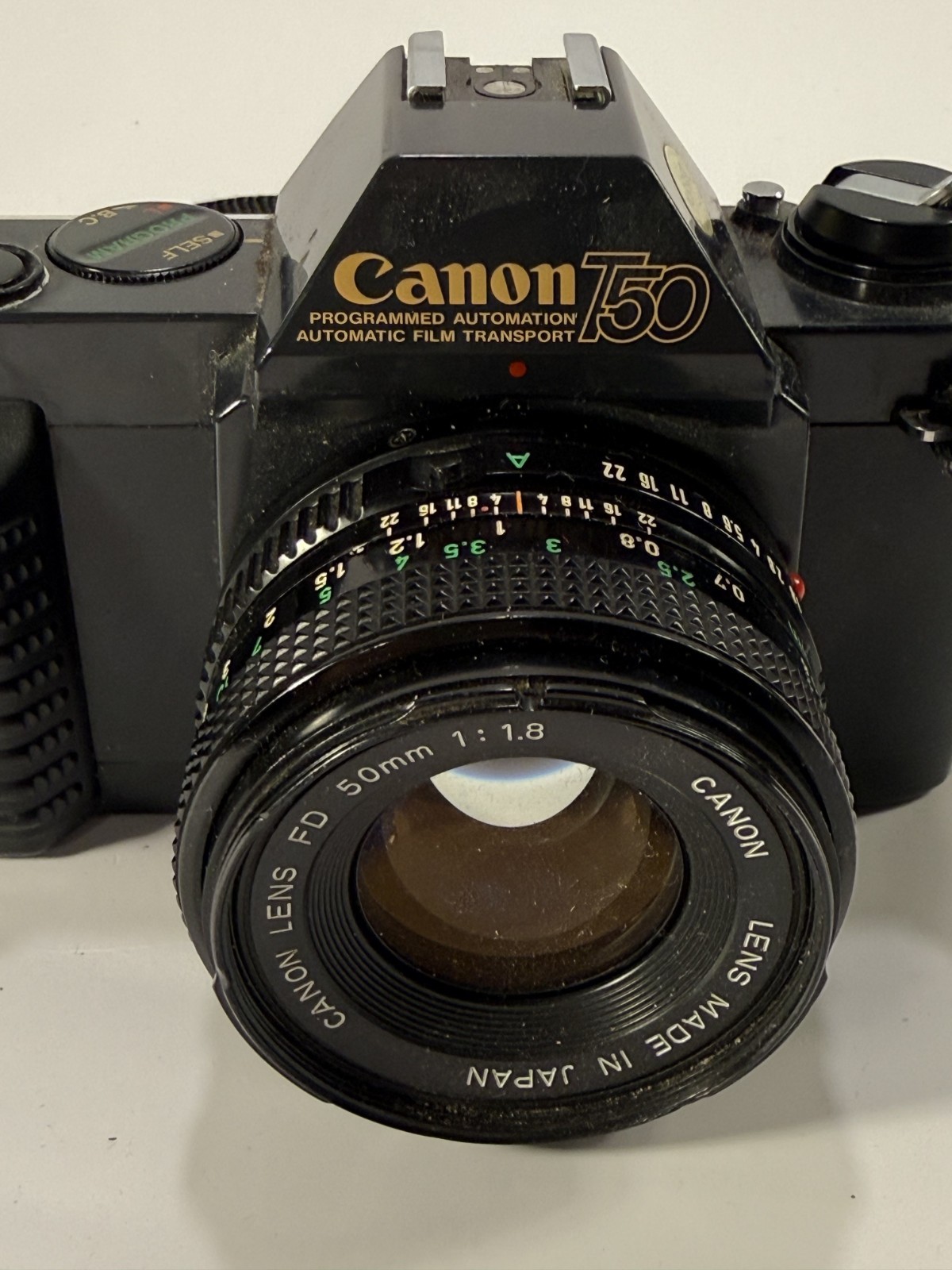
The Canon T50 is a compact, entry-level 35mm film SLR camera introduced in 1983 as the inaugural model of Canon’s new T-series. Designed for amateur photographers, it features fully automatic Program AE exposure control, a built-in motor drive, and a simplified user interface, marking Canon’s strategic shift toward accessible, electronics-driven SLR systems during the early 1980s.
Overview
Released in March 1983, the Canon T50 was positioned as an entry-level 35mm single-lens reflex (SLR) camera aimed at consumers transitioning from point-and-shoot rangefinders to interchangeable-lens systems. It was the first model in Canon’s T-series, a line designed to bridge the gap between fully manual professional SLRs and fully automated compact cameras. The T50 marked a pivotal moment in Canon’s transition from mechanical to electronic control systems, emphasizing ease of use over manual customization. It was developed alongside the more advanced T70 and later T90, forming a new product hierarchy centered on electronic automation and user accessibility.
The T50’s primary innovation for its market segment was its integration of Program AE (Auto Exposure) as the sole exposure mode, eliminating the need for users to manually set shutter speed or aperture. This was paired with a built-in motorized film advance and rewind system, powered by a 6V 4LR44 battery, enabling continuous shooting at approximately 1.4 frames per second. Its compact polycarbonate body, weighing just 470g with battery, made it one of the lighter SLRs of its era, enhancing portability and appeal to casual photographers.
Canon designed the T50 to work exclusively with its FD lens mount, supporting both pre-AI FD and New FD lenses. However, due to its reliance on electronic aperture control via the lens’s “Program” contact, it functions optimally with New FD (FDn) lenses introduced from 1979 onward. The camera’s metering system uses center-weighted average TTL (through-the-lens) metering with a silicon photodiode sensor, providing reliable exposure in most lighting conditions. Despite its automation, the T50 retains a mechanical backup: in the event of battery failure, the shutter defaults to a mechanical 1/100 sec speed, allowing limited operation.
Specifications
| Specification | Value |
| Type | 35mm Single-Lens Reflex (SLR) |
| Film Format | 35mm (135 film) |
| Years Produced | 1983–1989 |
| Lens Mount | Canon FD Mount (compatible with FD and New FD lenses) |
| Shutter | Vertical-travel focal-plane shutter; speeds from 4 sec to 1/1000 sec, plus Bulb (electronically controlled); mechanical 1/100 sec backup |
| Metering | TTL center-weighted average metering via silicon photodiode |
| Exposure Modes | Program AE only (fully automatic) |
| Viewfinder | Fixed pentamirror with 0.82x magnification, 94% coverage; displays focus confirmation, over/under exposure warning |
| Dimensions | 135 × 83 × 55 mm (W×H×D); weight: 470 g (with battery) |
| Film Advance | Built-in motor drive (1.4 fps), automatic rewind |
| Battery | 6V 4LR44 (or 4SR44) battery; powers shutter, metering, film transport, and LED indicators |
| Flash Sync | Hot shoe and PC sync terminal; X-sync at 1/60 sec |
| Self-Timer | Yes, 10-second delay with LED and beeper indication |
Key Features
- Program-Only Exposure Mode: Fully automatic exposure eliminates user input, ideal for beginners.
- Integrated Motor Drive: Built-in winder enables continuous shooting at 1.4 fps and automatic rewind.
- Compact, Lightweight Design: Polycarbonate shell reduces weight while maintaining durability.
- FD Lens Compatibility: Works with Canon’s full range of FD and New FD lenses, though optimal with FDn.
- Electronic Interface with Lenses: Uses electrical contacts to control aperture settings automatically in Program mode.
Historical Context
The Canon T50 was launched at a time of rapid technological transformation in the SLR market. The early 1980s saw Japanese manufacturers aggressively integrating electronics into camera systems to simplify operation and attract amateur photographers. Canon, having established its FD lens system in the 1970s, sought to modernize its lineup to compete with Minolta’s groundbreaking XD-11 and the upcoming Minolta Maxxum 7000. The T50 was not a high-performance camera, but rather a strategic product to expand Canon’s market reach into the consumer SLR segment.
It directly competed with models like the Pentax ME-F and Nikon EM, though unlike those cameras, the T50 offered no manual or aperture-priority modes. This limitation underscored its role as a true beginner’s SLR. Despite its simplicity, the T50 was well-received for its reliability, compact form, and ease of use. It paved the way for the T70 (1984), which added shutter-priority and manual modes, and ultimately the T90 (1986), a professional-grade electronic SLR. The T50’s success demonstrated the viability of fully automated SLRs, influencing Canon’s eventual shift to the EF-mount and EOS system in 1987.
Collectibility & Value
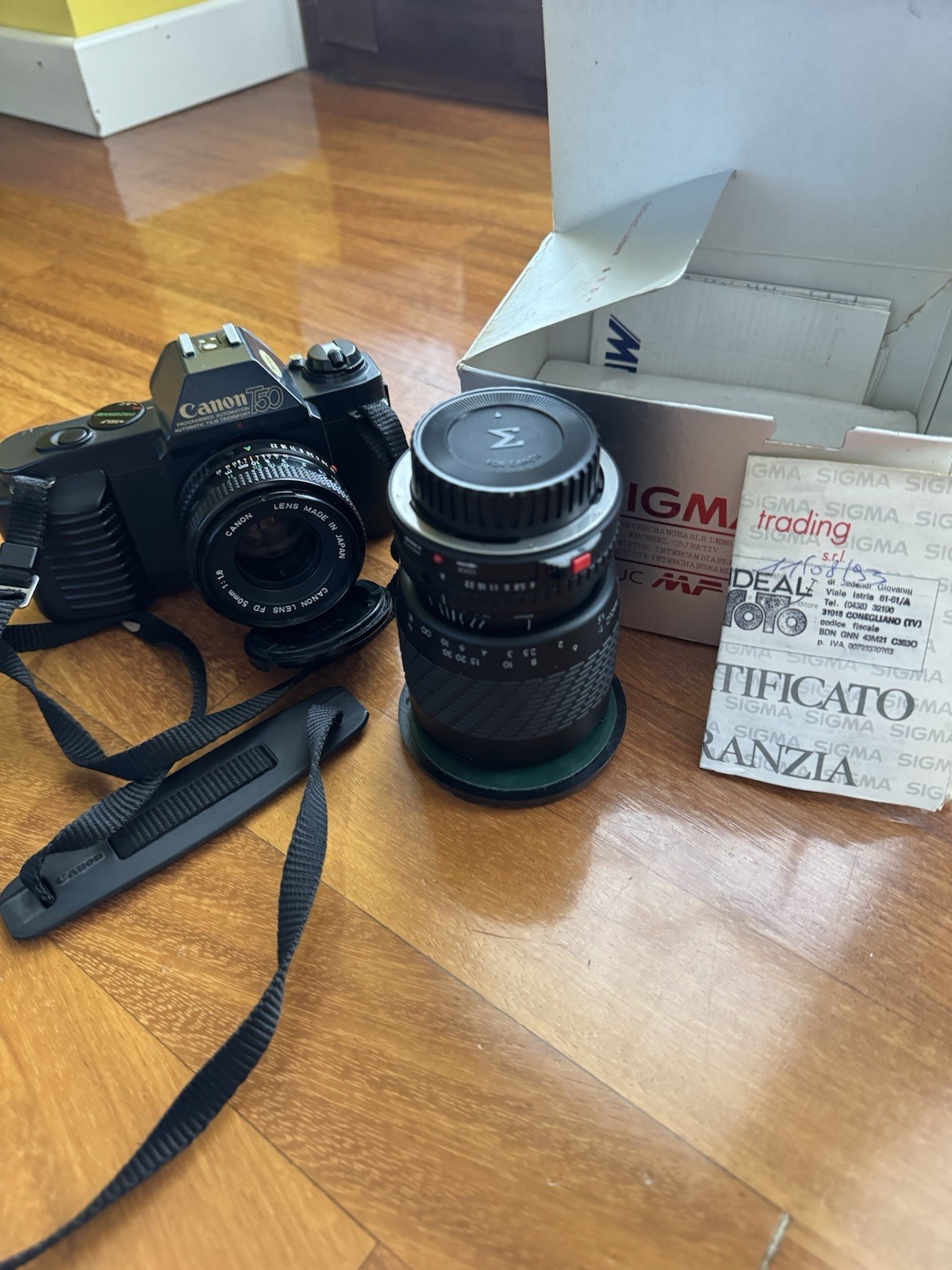
Today, the Canon T50 is regarded as a historically significant but modestly collectible camera. It is not rare—production continued for six years across multiple regions—and examples are commonly found on secondary markets such as eBay, KEH, and Japanese used camera shops. In working condition, the T50 typically sells for $50–$100 USD, depending on cosmetic condition and included accessories. Fully functional units with original boxes and manuals command a slight premium, especially in Japan where retro camera interest remains strong.
When purchasing a T50, buyers should verify the functionality of the motor drive, shutter, and light meter. Common issues include degraded rubber grips, sticky shutter mechanisms due to dried lubricants, and corrosion in the battery compartment—particularly if older 4SR44 batteries (which can leak) were used. The 4LR44 battery is still available but increasingly scarce; modern replacements like 4LR44 alkaline or lithium equivalents (e.g., KRF-P9) are recommended. Because the camera relies entirely on electronics for exposure, a dead battery renders it non-functional except at 1/100 sec mechanical speed. Additionally, compatibility with modern FD lenses is excellent, but older FD lenses without the electronic aperture contact may not function correctly in Program mode.
Similar Cameras
- Pentax ME-F (1981) – Early autofocus SLR with automatic exposure, targeting similar entry-level users.
- Nikon EM (1979) – Compact Nikon SLR with aperture-priority automation, aimed at beginners.
- Minolta X-370 (1981) – Manual focus SLR with aperture-priority and manual modes, more versatile than T50.
- Olympus OM-20 (1984) – Compact OM-series SLR with auto and manual exposure options.
- Yashica FX-3 Super 2000 (1982) – Budget-friendly SLR with aperture-priority and manual focus.
Repair & Maintenance
The Canon T50 uses a 6V 4LR44 battery, which powers all electronic functions including the shutter, metering system, motor drive, and LED indicators. Battery life is moderate, typically lasting 15–20 rolls of film under normal use. Due to the age of these cameras, battery compartments may suffer from corrosion; cleaning with isopropyl alcohol and inspecting contact springs is recommended during servicing.
Common mechanical issues include sluggish or failed film advance, often caused by worn motor gears or dried lubricants in the drive mechanism. Shutter malfunctions—such as inconsistent speeds or failure to fire—are typically due to degraded capacitors or electronic faults in the control board. While the T50 is not hermetically sealed, its build quality is generally robust, though prolonged storage in humid environments can lead to fungus in the viewfinder or mirror box.
Repair difficulty is moderate: the camera’s modular design allows for disassembly with standard tools, but its dense internal electronics require careful handling. Replacement parts are limited but available through donor cameras or specialized vintage camera repair shops. For collectors and users, ensuring a clean, lubrication-free shutter and functional meter is essential for reliable operation. Regular use and battery removal during storage are recommended to prolong longevity.
eBay Listings


As an eBay Partner, we earn from qualifying purchases. This helps support our independent vintage technology research.
Related Models
- Canon A-1 (1978-1985)
- Canon AE-1 Program (1981-1984)
- Canon AE-1 (1976-1984)
- Canon AL-1 (1982-1985)
- Canon AT-1 (1977-1982)
- Alpa 6 (1948-1953)
- Agfa Agfaflex
- Agfa Ambiflex
- Agfa Easy
- Agfa Futura Af zoom