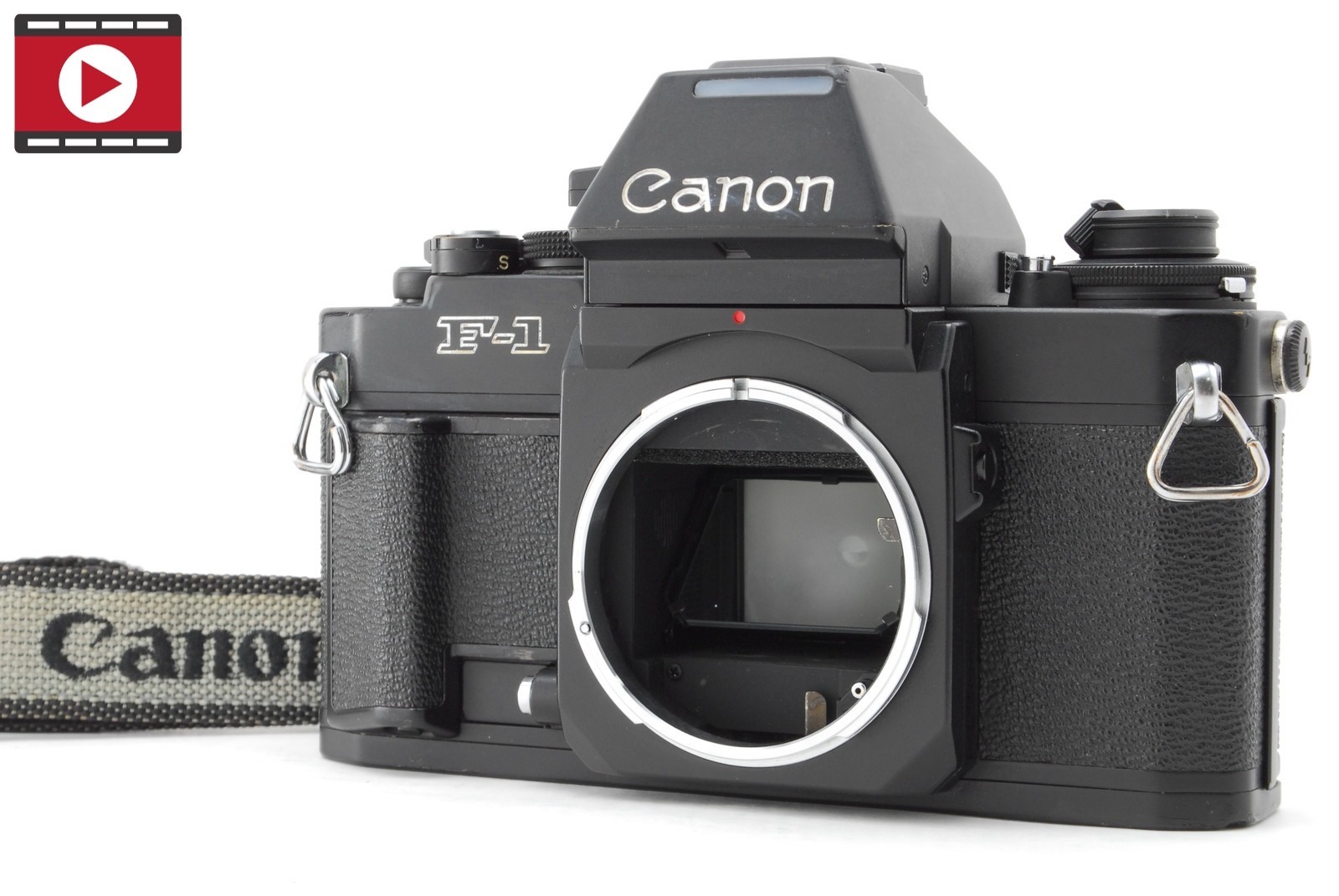
CANON NEW F-1
The Canon New F-1 is a professional-grade 35mm film SLR camera introduced in 1981 as a complete redesign of the original Canon F-1. Engineered for reliability, precision, and modularity, it served as Canon’s flagship manual-focus SLR during the transition from mechanical to electronic photography.
Overview
The Canon New F-1 was developed as a direct successor to the original Canon F-1 (1971), which had become a benchmark for professional 35mm SLRs. Unlike its predecessor, the New F-1 incorporated extensive electronics while retaining the rugged, modular design expected by photojournalists and studio professionals. Released at a time when automation was rapidly gaining traction—epitomized by the Nikon FA and Minolta X-700—the New F-1 took a conservative yet highly capable approach, emphasizing user control, durability, and system expandability. It was designed to coexist with Canon’s emerging AE-1 and A-series cameras, filling the high-end professional niche before the arrival of the EOS system in 1987.
The camera was built around a modular architecture, allowing photographers to customize the body with interchangeable viewfinders, focusing screens, film backs, and data backs. This system philosophy mirrored that of contemporaries like the Nikon F3 and Pentax LX, positioning the New F-1 as a tool for demanding environments. Despite its mechanical lineage, the New F-1 featured advanced TTL (through-the-lens) metering, aperture-priority autoexposure, and support for Canon’s A-series electronic flash units with dedicated TTL flash metering—a significant innovation at the time. It remained in production until 1992, outlasting many of its peers and serving as Canon’s final professional manual-focus SLR before the full transition to EF-mount autofocus EOS cameras.
Specifications
| Specification | Value |
| Type | 35mm Single-Lens Reflex (SLR) |
| Film Format | 35mm (135) |
| Years Produced | 1981–1992 |
| Lens Mount | Canon FD (bayonet) |
| Shutter | Vertical-travel focal-plane shutter; speeds from 1 sec to 1/2000 sec, plus Bulb (B), X-sync at 1/90 sec |
| Metering | TTL full-aperture center-weighted average metering with open-aperture reading; supports stop-down metering |
| Exposure Modes | Manual, Aperture-Priority Auto Exposure (AE) |
| Viewfinder | Interchangeable pentaprism or waist-level finder; standard NP-100 with fixed focusing screen, 97% coverage, 0.80× magnification |
| Dimensions | 150 × 95 × 58 mm (body only); weight: approx. 705 g (body only, without battery) |
Key Features
- Modular System Design: Interchangeable viewfinders (including AE prism with built-in meter), focusing screens, film backs (including motor drive back), and data imprinters for custom workflow integration.
- Aperture-Priority AE with Manual Override: Allows automatic exposure while retaining full manual control; metering via silicon photodiode (SPD) sensor with full-aperture reading.
- TTL Auto Flash Compatibility: First Canon SLR with dedicated TTL flash metering support using Canon Speedlite 244T, 300TL, and later units via the Accessory Shoe and dedicated PC terminal.
- High Shutter Durability: Rated for 100,000 actuations; mechanically timed at 1/90 sec and slower, electronically timed at faster speeds (requires battery for speeds above 1/90 sec).
- Comprehensive Metering Options: Supports both full-aperture and stop-down metering; metering range of EV 1–18 (at ISO 100, f/1.4); LED indicators in viewfinder for over/under exposure and shutter speed warning.
Historical Context
The Canon New F-1 was launched in September 1981, a pivotal moment in the evolution of SLR technology. While Canon’s consumer-oriented AE-1 (1978) and A-1 (1979) had embraced automation and microprocessor control, the New F-1 was designed for professionals who demanded mechanical robustness, system flexibility, and reliability under extreme conditions. It was developed in parallel with the Canon T90 (1986), which represented the apex of Canon’s manual-focus era with full program AE and ergonomic design, but the New F-1 remained the choice for photojournalists, military photographers, and studio users who valued modularity and serviceability.
At its release, the New F-1 competed directly with the Nikon F3 (1980), Pentax LX (1980), and Minolta XE. Unlike the Nikon F3, which used a simpler fixed prism, the New F-1 offered full system customization akin to the Pentax LX. However, its reliance on the FD lens mount—soon to be replaced by the EF mount in 1987—limited its long-term viability. Despite this, the New F-1 gained a reputation for exceptional build quality and was widely adopted by press photographers, particularly in Japan and Europe. It was also used by NASA astronauts during Space Shuttle missions due to its reliability in extreme environments.
Collectibility & Value
Today, the Canon New F-1 is a sought-after collector’s item, particularly in complete system configurations with motor drives, data backs, and rare viewfinders. In excellent working condition, a basic body with standard AE finder typically sells for $400–$700 USD, while full kits with motor drives (such as the MF-15 or MB-1) can exceed $1,200. Rarity increases significantly for models with the DP-11 Data Back or the high-magnification NP-11 finder, which are prized by collectors.
When purchasing a New F-1, it is essential to verify the functionality of the meter (which relies on a 6V PX28 or 4LR44 battery), shutter operation across all speeds, and the condition of the film advance and rewind mechanisms. Common issues include degraded light seals, stiff mirror movement, and corrosion in the battery compartment. Because the camera uses hybrid mechanical-electronic timing, it will not function electronically without a battery, though 1/90 sec and slower speeds remain mechanically operable. Servicing requires specialized tools and knowledge, particularly for meter calibration and shutter synchronization.
Similar Cameras
- Nikon F3: Professional 35mm SLR with fixed prism, titanium shutter, and extensive accessory system.
- Pentax LX: Compact modular SLR with interchangeable viewfinders and exceptional metering precision.
- Minolta XE: High-end manual-focus SLR with aperture-priority and manual modes, known for its smooth operation.
- Olympus OM-4: Rugged, compact professional SLR with TTL metering and titanium shutter.
- Leica R4: Late-generation manual-focus SLR from Leica, combining electronic automation with professional build.
Repair & Maintenance
The Canon New F-1 operates on a 6V lithium battery (originally PX28, now commonly replaced with 4LR44 or adapter). The meter and electronic shutter speeds (1/125 sec and faster) require power; mechanical speeds (1 sec to 1/90 sec) function without battery. Common maintenance issues include degraded light seals (which should be replaced every 10–15 years), sticky shutter curtains, and oxidized battery contacts. The camera’s complex internal mechanism benefits from periodic CLA (Clean, Lubricate, Adjust) by a technician experienced with professional SLRs. Due to its modular design, parts compatibility must be verified—especially when mixing components from different production batches. Overall, the New F-1 is considered repairable and durable, with many units still functional after decades of use.
eBay Listings



As an eBay Partner, we earn from qualifying purchases. This helps support our independent vintage technology research.
Service Manuals, Schematics & Catalogs
- Catalog (1991) — archive.org
- Catalog (1991) — archive.org
Related Models
- Canon A-1 (1978-1985)
- Canon AE-1 Program (1981-1984)
- Canon AE-1 (1976-1984)
- Canon AL-1 (1982-1985)
- Canon AT-1 (1977-1982)
- Alpa 6 (1948-1953)
- Agfa Agfaflex
- Agfa Ambiflex
- Agfa Easy
- Agfa Futura Af zoom