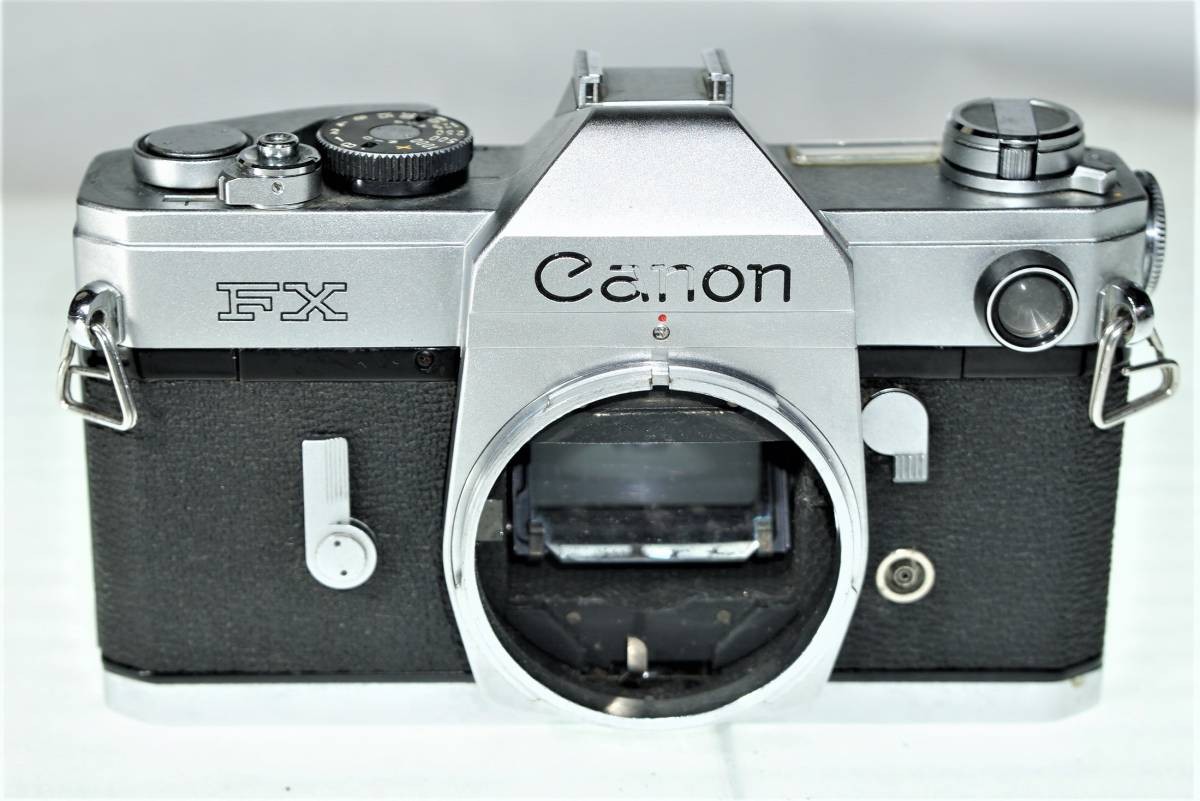
CANON FX
While not incorporating through-the-lens (TTL) metering, it represented a significant step in Canon’s transition from rangefinder to SLR dominance, offering photographers a more integrated and user-friendly exposure system.
Overview
The Canon FX was launched at a pivotal moment in photographic history, as SLR cameras began to overtake rangefinders in popularity, particularly among professionals and advanced amateurs. Released in March 1964, the FX served as a bridge between Canon’s earlier rangefinder models and its emerging line of FL-mount SLRs. It succeeded the Canonflex series and was designed to compete with other early Japanese SLRs like the Nikon F and Pentax Spotmatic. Unlike its predecessor, the Canonflex, the FX featured a more compact body and a horizontally traveling focal-plane shutter. However, it did not have a built-in exposure meter.
Targeted at serious amateur and semi-professional photographers, the FX offered manual exposure control with a stop-down metering system. It utilized Canon’s FL lens mount, allowing compatibility with Canon’s growing range of high-quality FL and R-series lenses. However, due to the external nature of the meter, accurate exposure required stopping down the lens manually while reading the meter via a needle visible in the viewfinder. This "stop-down" metering was common at the time but less convenient than later TTL systems. The Canon FX was succeeded by the Canon FT in 1968, which introduced TTL metering — a feature the FX did not have.
Despite its limitations by modern standards, the FX was a technically sound camera with robust build quality, a reliable Copal horizontal cloth shutter, and a bright viewfinder with a microprism focusing aid. It helped establish Canon as a serious contender in the SLR market and laid the groundwork for future innovations in metering and automation.
Specifications
| Specification | Value |
| Type | 35mm manual focus SLR |
| Film Format | 35mm (135 film) |
| Years Produced | 1964–1969 |
| Lens Mount | Canon FL mount (compatible with R, FL lenses; not natively compatible with FD) |
| Shutter | Horizontal-travel focal-plane shutter, speeds 1 sec to 1/1000 sec, plus B |
| Metering | |
| Exposure Modes | Manual only; stop-down metering |
| Viewfinder | Fixed pentaprism with microprism focusing spot, 0.92x magnification, ~95% coverage |
| Dimensions | 148 × 87 × 58 mm; ~610 g (body only) |
Key Features
- First Canon SLR with built-in exposure meter: Utilized a selenium-cell meter requiring no batteries, powered entirely by incident light.
- FL lens mount: Enabled use of Canon’s high-performance FL and R-series lenses, known for their sharp optics and smooth focusing.
- Stop-down metering system: Required lens to be manually stopped down for meter reading, with exposure indicated by a needle in the viewfinder.
- Horizontal cloth shutter: Offered reliable performance and flash synchronization at all speeds (X-sync at 1/60 sec).
- Robust mechanical construction: All-metal body with mechanical shutter operation, suitable for professional use in varied conditions.
Historical Context
The Canon FX was introduced during a transformative period in the camera industry. In the early 1960s, Japanese manufacturers were rapidly gaining ground on European brands, offering advanced features at competitive prices. The FX was a simplified, lower-cost SLR introduced after the Canonflex series, but it did not include metering and thus was not a direct competitor to the metered Spotmatic or professional Nikon F. While the Nikon F emphasized modularity and professional durability, and the Spotmatic offered full-aperture metering (in later versions), the FX carved its niche by combining mechanical reliability with accessible metering technology.
Canon’s decision to include a built-in selenium meter—though not TTL—was a strategic move to appeal to photographers transitioning from rangefinders or simpler cameras who valued exposure assistance. However, the lack of TTL metering and the need for stop-down operation limited its appeal compared to contemporaries that offered more seamless exposure workflows. Nevertheless, the FX played a critical role in establishing Canon’s reputation for innovation in SLR design. It was followed by the Canon FT in 1968, which introduced TTL metering, and eventually the FD-mount F-1 in 1971, cementing Canon’s position in the professional SLR market.
Collectibility & Value
Today, the Canon FX is considered a historically significant but moderately collectible camera. It is valued by Canon enthusiasts and collectors of vintage SLRs as a milestone model—the brand’s first metered SLR—and an important step in the evolution of Canon’s FL-mount system. Units in good working condition typically sell for $150–$300, depending on cosmetic state, functionality, and included accessories. Fully functional meters are increasingly rare, as selenium cells degrade over time and cannot be easily replaced, though the camera operates mechanically without power.
When purchasing an FX, collectors should verify shutter accuracy across all speeds, check for mirror bounce or sluggish movement, and inspect the viewfinder for haze or fungus. The meter, while a key feature, is often non-functional in surviving units due to selenium cell deterioration—a common issue in cameras of this era. Lenses with the FL mount are compatible but may require stop-down use on modern bodies; they are prized for their optical quality, particularly the FL 50mm f/1.8 and FL 55mm f/1.2. Overall, the FX is not as sought-after as the later F-1 or A-series cameras, but it holds a respected place in Canon’s lineage.
Similar Cameras
- Nikon F (1959) – Professional-grade SLR with interchangeable viewfinders and lenses; no built-in meter initially.
- Asahi Pentax Spotmatic (1964) – Introduced full-aperture TTL metering (in SP and later models), setting a new standard.
- Topcon RE Super (1963) – Advanced Japanese SLR with TTL metering and high-quality optics.
- Yashica TL Electro (1968) – Early electronic SLR with CdS metering and semi-automatic exposure.
- Minolta SRT-101 (1966) – Featured TTL metering, robust build, and excellent Rokkor lenses.
Repair & Maintenance
The Canon FX requires no batteries for operation—the selenium-cell meter generates its own power from light, though these cells often fail after decades due to material fatigue. Shutter maintenance is critical; the Copal horizontal cloth shutter can suffer from uneven speeds or sticky curtains if not regularly serviced. Common issues include stiff film advance levers, worn shutter curtains, and degraded light seals. Repairing the meter is generally impractical, as replacement selenium cells are unavailable and retrofitting with modern CdS meters alters originality. The camera’s mechanical simplicity makes it relatively serviceable, but sourcing original spare parts can be challenging. Lubrication should be performed carefully to avoid gumming in older mechanisms. For collectors, a clean, mechanically functional body with a working shutter is more valuable than one with a dead meter. Regular use and proper storage in a dry environment help preserve functionality.
eBay Listings


As an eBay Partner, we earn from qualifying purchases. This helps support our independent vintage technology research.
Service Manuals, Schematics & Catalogs
- Catalog (1991) — archive.org
- Catalog — archive.org
- Catalog (1991) — archive.org
Related Models
- Canon A-1 (1978-1985)
- Canon AE-1 Program (1981-1984)
- Canon AE-1 (1976-1984)
- Canon AL-1 (1982-1985)
- Canon AT-1 (1977-1982)
- Alpa 6 (1948-1953)
- Agfa Agfaflex
- Agfa Ambiflex
- Agfa Easy
- Agfa Futura Af zoom