CANON FTB
The Canon FTb is a 35mm film single-lens reflex (SLR) camera introduced in 1971 as a mechanical, professional-grade update to the earlier Canon FT. It marked a significant advancement in Canon’s manual focus SLR lineup, featuring the new FD lens mount and open-aperture TTL (through-the-lens) metering, making it a favorite among serious amateur and professional photographers of its era.
Overview
Launched in 1971, the Canon FTb was positioned as a robust, fully mechanical SLR aimed at advanced photographers who demanded precision, reliability, and accurate exposure metering without reliance on electronic automation. It succeeded the Canon FT and represented Canon’s commitment to refining manual-exposure SLR technology during the transitional period between fully mechanical cameras and the emerging era of electronic automation. The FTb was part of Canon’s push to establish credibility in the professional photography market, competing directly with Nikon’s F and F2 series.
The most significant upgrade over its predecessor was the adoption of the Canon FD lens mount, which enabled open-aperture TTL metering—a major advancement in exposure accuracy. This allowed photographers to compose and focus at the lens’s maximum aperture while metering at the taking aperture, improving both brightness and exposure precision. The FTb retained a completely mechanical shutter system, ensuring functionality even without batteries, though the light meter required a power source. Its rugged brass-and-steel construction, combined with a durable cloth focal-plane shutter, made it suitable for demanding field use.
The FTb was succeeded in 1973 by the FTb-N, which added a metering needle visible in the viewfinder (via a secondary window on the top plate), but the original FTb remained in production until 1973 and laid the foundation for Canon’s subsequent FD-mount SLRs, including the popular Canon F-1 and later the AE-1. It played a critical role in Canon’s transition toward modern SLR design, bridging the gap between basic manual cameras and more sophisticated electronically controlled models.
Specifications
| Specification | Value |
| Type | 35mm Manual Focus SLR |
| Film Format | 35mm (135 film) |
| Years Produced | 1971–1973 |
| Lens Mount | Canon FD (bayonet mount, with breech-lock ring) |
| Shutter | Vertically-traveling cloth focal-plane shutter; speeds from 1 sec to 1/1000 sec, plus Bulb (B) |
| Metering | TTL full-aperture CdS (Cadmium Sulfide) metering with stop-down activation |
| Exposure Modes | Manual only (stop-down metering via AE lock button) |
| Viewfinder | Fixed pentaprism with microprism collar and split-image rangefinder spot; 0.92x magnification, 94% coverage |
| Dimensions | 148 × 95 × 50 mm (5.8 × 3.7 × 2.0 in); Approx. 705 g (24.9 oz) body only |
Key Features
- Canon FD Lens Mount: Introduced with the FTb, this mount allowed full-aperture metering and later evolved into the New FD (nFD) mount. Lenses feature a breech-lock design for secure attachment.
- Stop-Down TTL Metering: Utilizes a CdS cell behind the lens for accurate exposure readings. Meter activates when the AE lock button is pressed, stopping the lens down to the selected aperture.
- Fully Mechanical Shutter: Operates without batteries; shutter speeds from 1 second to 1/1000 second are mechanically controlled.
- Battery-Independent Operation: While the light meter requires two 1.5V D batteries (originally PX625 mercury, now replaced with Wein Cell or adapters), the shutter functions mechanically.
- Robust Build Quality: Constructed with a die-cast aluminum chassis, brass top and bottom plates, and a durable cloth shutter curtain.
Historical Context
The Canon FTb was released at a pivotal moment in SLR development. By the early 1970s, Japanese manufacturers like Nikon, Minolta, Pentax, and Olympus were rapidly advancing SLR technology, integrating more sophisticated metering systems and improving lens compatibility. Canon had previously used the R and FL mounts, but the introduction of the FD mount with the FTb signaled a new direction—optimized for TTL metering and future electronic integration.
The FTb was designed to compete with models like the Nikon F2, Pentax Spotmatic, and Minolta SRT series. While not as modular as the Nikon F2, the FTb offered a more affordable yet professional-grade alternative with excellent ergonomics and reliable metering. It was particularly popular among photojournalists and travel photographers due to its durability and consistent performance in varied conditions.
Market reception was strong, especially in North America and Europe, where Canon was building brand recognition. The FTb helped solidify Canon’s reputation for quality engineering and laid the groundwork for the flagship Canon F-1 (1971), which shared many design elements. Its success also paved the way for the later consumer-focused AE-1, which would bring Canon into the electronic SLR mainstream.
Collectibility & Value
Today, the Canon FTb is a sought-after vintage SLR among film photography enthusiasts and collectors. While not as rare as the F-1, it is considered a classic example of early 1970s mechanical SLR design. In good working condition, prices typically range from $150 to $300 USD, depending on included accessories, lens condition, and cosmetic state. Fully functional units with original lenses (such as the FD 50mm f/1.8 or FD 55mm f/1.2) command higher premiums.
When purchasing an FTb, collectors should verify that the shutter operates accurately across all speeds, the light meter responds (though aging CdS cells often fail), and the film advance and rewind mechanisms function smoothly. Common issues include stiff shutter curtains (due to dried lubricants), inaccurate metering (from degraded CdS cells or dead batteries), and worn leatherette. The camera uses a mercury PX625 battery (6.25V), now obsolete; modern equivalents like the Wein Cell MRB625 or zinc-air alternatives are recommended, or users can modify the meter circuit for modern 1.5V batteries.
Despite its age, the FTb remains functional and repairable, with a strong community of technicians and parts suppliers supporting the FD-mount ecosystem. Its mechanical simplicity and compatibility with modern FD and even adapted EF lenses (via adapters) make it a practical choice for film shooters.
Similar Cameras
- Nikon Photomic FTn – Nikon’s professional SLR with TTL metering, competing directly with the FTb in performance and target market.
- Pentax Spotmatic F – Popular 35mm SLR with open-aperture metering and M42 screw mount.
- Minolta SRT-101 – Known for its robust build and advanced CLC (Contrast Light Compensation) metering system.
- Olympus OM-1 – Compact, lightweight SLR with excellent optics and mechanical reliability.
- Yashica TL Electro-X – Electronically controlled but similarly styled Japanese SLR with CdS metering.
Repair & Maintenance
The Canon FTb uses two 1.5V batteries (originally a single 6V PX625 mercury cell) for its CdS light meter; modern replacements include the Wein Cell MRB625 or alkaline 625A cells (with exposure compensation). The mechanical shutter requires no battery and is generally reliable, though periodic CLA (clean, lubricate, adjust) service is recommended every 5–10 years for heavy use. Common maintenance issues include sluggish shutter speeds (due to dried grease), light leaks from deteriorating foam light seals, and worn shutter curtains. The AE lock button and mirror mechanism should be inspected for smooth operation. Repair difficulty is moderate; experienced technicians familiar with vintage Canon gear can source parts and perform calibrations, though original spare parts are becoming scarce. Regular cleaning and proper storage in a dry environment will extend the camera’s functional life significantly.
eBay Listings
![Tested [Near MINT] Canon FTb QL 35mm SLR Film Camera Silver](https://i.ebayimg.com/images/g/WaEAAeSw95tpv7cH/s-l1600.jpg)
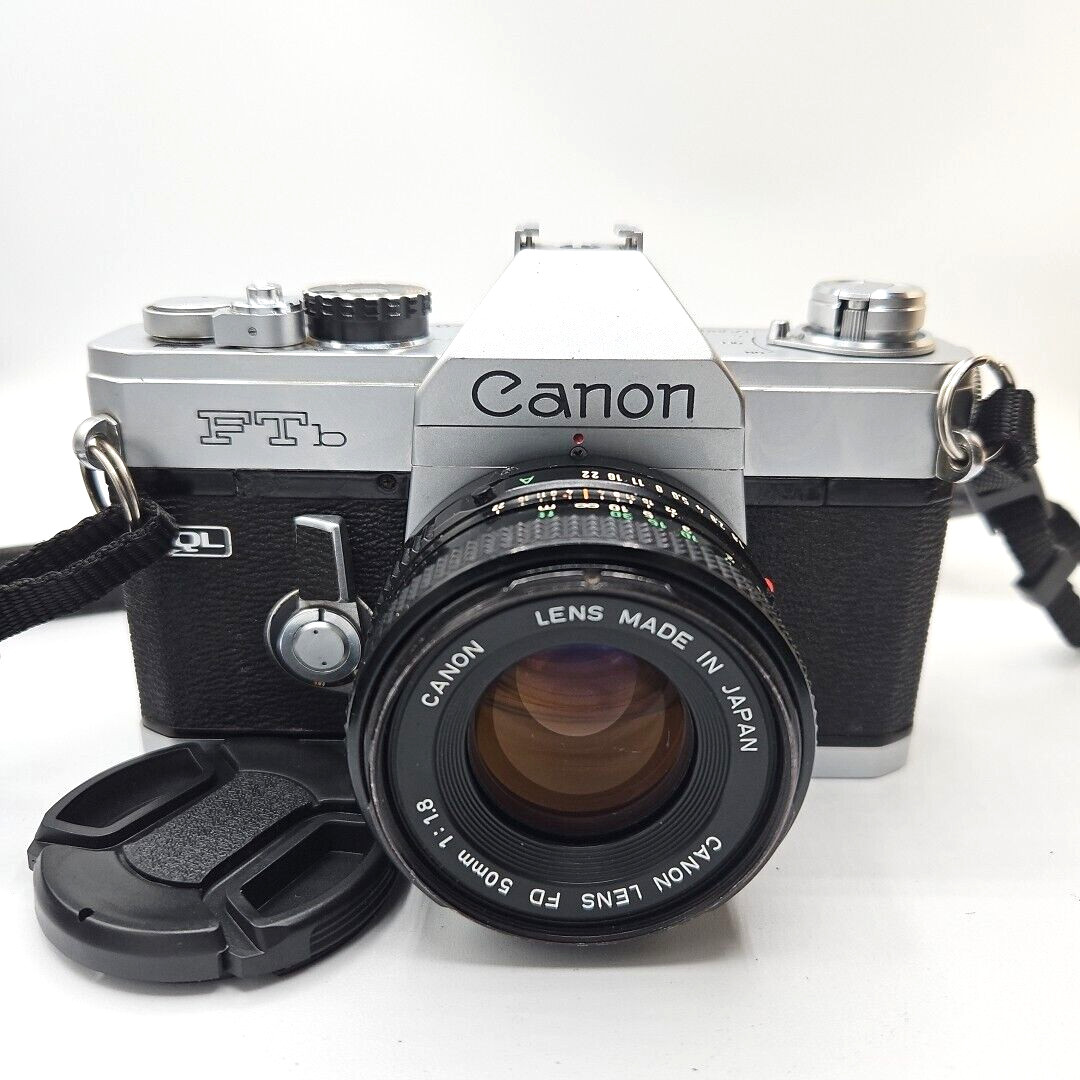


As an eBay Partner, we earn from qualifying purchases. This helps support our independent vintage technology research.
Service Manuals, Schematics & Catalogs
- Owner's Manual — archive.org
- Service Manual — archive.org
- Catalog (1991) — archive.org
- Catalog — archive.org
- Catalog (1991) — archive.org
Related Models
- Canon A-1 (1978-1985)
- Canon AE-1 Program (1981-1984)
- Canon AE-1 (1976-1984)
- Canon AL-1 (1982-1985)
- Canon AT-1 (1977-1982)
- Alpa 6 (1948-1953)
- Agfa Agfaflex
- Agfa Ambiflex
- Agfa Easy
- Agfa Futura Af zoom