CANON FP
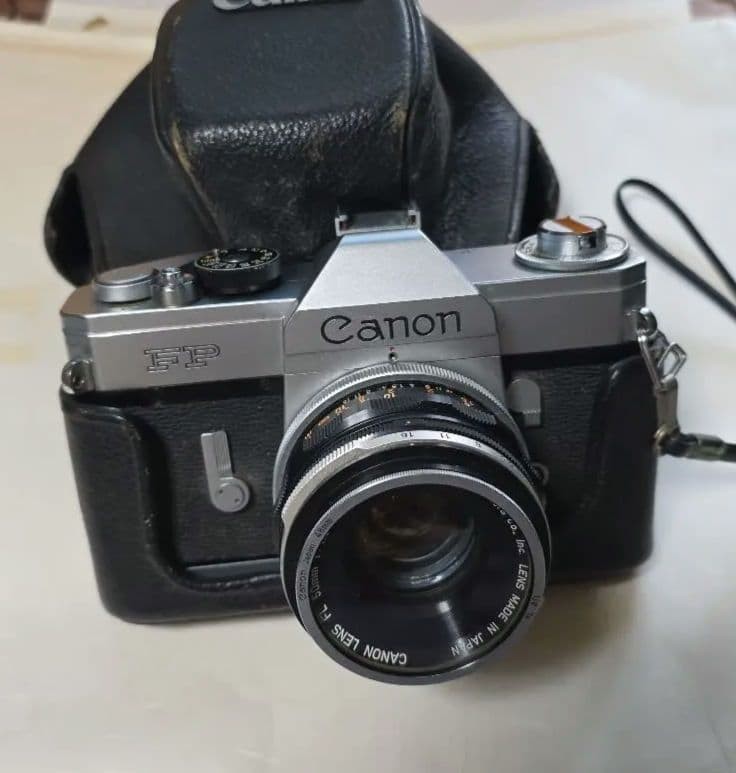
The Canon FP is a compact, fully mechanical 35mm single-lens reflex (SLR) camera introduced in 1964 as a simplified, meterless variant of the Canon FX. Designed for cost-conscious photographers and enthusiasts seeking a reliable, lightweight SLR without the complexity of built-in exposure metering, the FP occupies a niche position in Canon’s early line of FL-mount SLRs.
Overview
Released in 1964, the Canon FP was developed as a stripped-down, entry-level counterpart to the Canon FX, which had debuted the previous year. While the FX featured a built-in selenium-cell exposure meter, the FP omitted this component entirely to reduce manufacturing costs and retail price, making it one of the most affordable 35mm SLRs on the market at the time. This decision targeted amateur photographers, students, and budget-minded users who either preferred or could manage without through-the-lens metering, relying instead on handheld meters or experience-based exposure settings.
Despite its simplified design, the FP retained the core mechanical integrity of Canon’s SLR platform. It featured a robust all-metal body, a vertical-travel focal-plane shutter, and compatibility with Canon’s FL-mount lenses, which supported automatic diaphragm operation and full-aperture metering on metered bodies. The FP’s compact form factor—smaller and lighter than many contemporaries—made it a practical choice for travel and everyday use. Though lacking in electronic or metering features, the FP was praised for its solid build quality, smooth operation, and precise mechanical controls.
The FP played a transitional role in Canon’s SLR evolution. It bridged the gap between the early Canonflex series and the more advanced FT and FTb models that would later introduce through-the-lens (TTL) metering and improved ergonomics. As Canon prepared to launch the more sophisticated FT in 1966, the FP served as a budget-friendly alternative that kept the FL-mount system accessible during a period of rapid technological advancement in the SLR market.
Specifications
| Specification | Value |
| Type | Mechanical 35mm SLR |
| Film Format | 35mm (135 film) |
| Years Produced | 1964–1969 |
| Lens Mount | Canon FL mount (compatible with R, FL, and later FD lenses with stop-down metering) |
| Shutter | Vertical-travel focal-plane shutter, speeds from 1 sec to 1/1000 sec, plus B (bulb) |
| Metering | None (meterless) |
| Exposure Modes | Manual only (shutter speed and aperture set manually) |
| Viewfinder | Fixed pentaprism eye-level viewfinder with microprism focusing spot and etched focusing screen |
| Dimensions | 140 mm (W) × 85 mm (H) × 48 mm (D); weight: approximately 580 g (body only, no battery or lens) |
Key Features
- Meterless design for reduced cost and weight, appealing to experienced photographers who preferred external metering.
- FL lens mount compatibility with Canon’s growing range of high-quality R and FL lenses, enabling stop-down metering when used on later metered bodies.
- Mechanical shutter with no battery dependency—fully functional without any power source.
- Compact and lightweight body compared to other SLRs of the era, enhancing portability.
- Crisp, clear viewfinder with a central microprism collar for accurate manual focusing.
Historical Context
The Canon FP was introduced during a pivotal period in the evolution of 35mm SLR cameras. The early 1960s saw a surge in popularity for interchangeable-lens SLRs, driven by demand for greater creative control and the convenience of through-the-lens viewing. Competitors such as Nikon (with the F and F2), Pentax (Spotmatic series), and Minolta (SRT line) were rapidly advancing metering technology and lens systems. Canon, having launched the Canonflex in 1959, was still establishing its reputation in the professional SLR market.
The FP’s release in 1964 reflected Canon’s strategy to broaden its market reach by offering tiered models. While the FX targeted mid-level users with built-in metering, the FP served as a minimalist alternative, allowing Canon to compete in the budget SLR segment. Its lack of a meter was both a limitation and a selling point—eliminating the cost and fragility of selenium cells, which were prone to degradation over time. This made the FP a durable, long-term option for photographers who valued mechanical reliability over automation.
Despite its simplicity, the FP did not achieve the same commercial success as the Pentax Spotmatic or Nikon F. Its meterless design limited appeal in an era where built-in metering was becoming standard. However, it found a loyal following among students, travelers, and photographers in regions where cost was a primary concern. Production ceased in 1969 as Canon transitioned to the FD mount and more advanced metered models like the FTb, rendering the FL-mount line obsolete.
Collectibility & Value
Today, the Canon FP is a modestly collectible camera, valued more for its historical significance and mechanical simplicity than for rarity or high performance. While not as sought-after as the Canon F or FTb, it appeals to collectors interested in Canon’s early SLR development and minimalist camera design. Units in good working condition typically sell for $100–$200 USD, depending on cosmetic state and included accessories.
When purchasing a Canon FP, collectors should verify shutter functionality across all speeds, particularly 1/1000 sec and 1 sec, as timing inaccuracies are common in aged mechanical shutters. The light seals should be replaced if deteriorated, and the film advance mechanism should operate smoothly without slippage. Since the FP lacks a meter, there are no selenium cell issues to worry about—a notable advantage over metered contemporaries. However, the viewfinder screen may appear dim by modern standards, and original leather cases or instruction manuals can increase value.
Similar Cameras
- Pentax Spotmatic (1964) – Metered SLR with similar FL-mount size and M42 screw mount; significantly more advanced due to TTL metering.
- Nikon F (1959) – Professional-grade SLR with interchangeable viewfinders and focus screens; far more complex and expensive.
- Minolta SRT-101 (1966) – TTL metered SLR with CdS cell; superior exposure automation but heavier and costlier.
- Fujica ST705 (1965) – Meterless SLR with similar minimalist approach; less common than Canon FP.
- Yashica Pentamatic (1959) – Early Japanese SLR with M39 screw mount; predates FP but shares basic mechanical philosophy.
Repair & Maintenance
The Canon FP requires no batteries for operation, as all functions—shutter, film advance, and rewind—are fully mechanical. This makes it exceptionally reliable over time, provided it is properly maintained. Common issues include stiff shutter blades, inaccurate shutter timing (especially at extreme speeds), and wear in the film advance lever or rewind crank. Lubrication of the shutter mechanism and cleaning of the mirror box are recommended during servicing.
Repair difficulty is moderate; while the FP’s design is not overly complex, disassembly requires precision tools and familiarity with vintage SLR mechanics. Replacement parts are scarce, though donor bodies are occasionally available. The lens mount and flange focal distance should be checked if focusing issues arise. Due to its simplicity and lack of electronics, the FP is a durable camera that, when serviced, can remain functional for decades.
eBay Listings


As an eBay Partner, we earn from qualifying purchases. This helps support our independent vintage technology research.
Service Manuals, Schematics & Catalogs
Related Models
- Canon A-1 (1978-1985)
- Canon AE-1 Program (1981-1984)
- Canon AE-1 (1976-1984)
- Canon AL-1 (1982-1985)
- Canon AT-1 (1977-1982)
- Alpa 6 (1948-1953)
- Agfa Agfaflex
- Agfa Ambiflex
- Agfa Easy
- Agfa Futura Af zoom