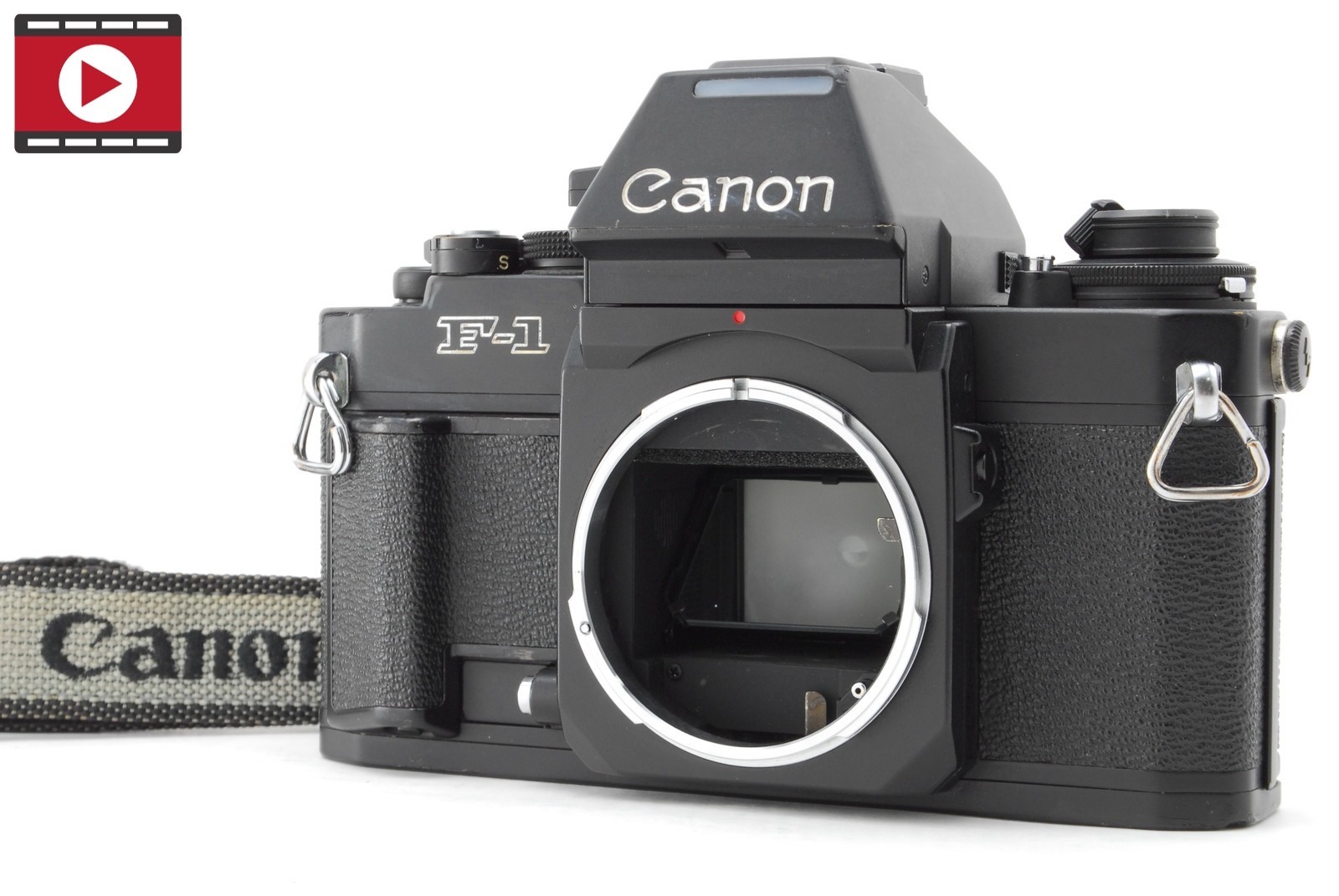
CANON F-1
The Canon F-1 is Canon’s first professional-grade 35mm single-lens reflex (SLR) camera, introduced in 1971 as a direct competitor to the Nikon F. Built for reliability, precision, and modularity, the F-1 established Canon as a serious contender in the professional photography market and laid the foundation for its future SLR systems.
Overview
Launched in March 1971, the Canon F-1 marked a pivotal moment in Canon’s history, representing the company’s entry into the high-end professional SLR market. Prior to its release, Canon’s SLR offerings were primarily aimed at advanced amateurs, with models like the Canonflex and Canon FTb. The F-1 was engineered from the outset to meet the rigorous demands of photojournalists, press photographers, and studio professionals who required durability, consistent performance, and system expandability. It was designed with a modular architecture, allowing extensive customization through interchangeable viewfinders, focusing screens, motor drives, and data backs.
The F-1 featured a vertically-traveling, titanium foil focal-plane shutter, capable of speeds from 1 second to 1/2000 second, plus Bulb, making it one of the fastest mechanical shutters of its era. It introduced the new FD lens mount (originally called the "New FD" or " breech-lock" mount), which provided improved lens-to-body communication and mechanical coupling for aperture control. The camera was fully mechanical except for its light metering system, ensuring operation without batteries for all core functions—a critical feature for professionals in remote or high-stress environments.
Canon positioned the F-1 as a system camera, emphasizing compatibility with a wide range of accessories, including the Motor Drive MF (capable of 5 fps), the Data Memory Back F, and various prismatic and waist-level viewfinders. Its rugged construction, with a die-cast aluminum chassis and extensive brass and stainless steel components, ensured longevity under harsh conditions. The F-1 remained in production until 1981, when it was succeeded by the electronically controlled Canon New F-1, though the original F-1 continued to be used by professionals well into the 1980s.
Specifications
| Specification | Value |
| Type | 35mm Manual Focus SLR |
| Film Format | 35mm (135) |
| Years Produced | 1971–1981 |
| Lens Mount | Canon FD (breech-lock) |
| Shutter | Vertically-traveling titanium foil focal-plane; 1 sec – 1/2000 sec, B |
| Metering | TTL full-aperture CdS metering (center-weighted) |
| Exposure Modes | Manual only |
| Viewfinder | Interchangeable pentaprism or waist-level finder; fixed focusing screen (interchangeable) |
| Dimensions | 149 × 92 × 59 mm; ~790 g (body only, no battery) |
Key Features
- Titanium Foil Shutter: Lightweight and durable, enabling a top speed of 1/2000 sec—among the fastest mechanical shutters of its time.
- Modular Design: Interchangeable viewfinders, focusing screens, and motor drives for customized operation.
- FD Breech-Lock Mount: Secure lens attachment with mechanical aperture coupling; precursor to modern FD lenses.
- Battery-Independent Operation: Shutter and film advance function without batteries; only metering requires power (1 × PX625 mercury or adapter with modern equivalent).
- System Expandability: Compatibility with Motor Drive MF, Data Back F, and multiple viewfinder options for specialized applications.
Historical Context
The Canon F-1 was developed in response to the dominance of the Nikon F (introduced in 1959), which had become the standard for professional photojournalism and scientific photography. By the late 1960s, Canon recognized the need for a robust, system-oriented SLR to compete in this high-stakes market. The F-1 was the result of extensive engineering, incorporating lessons from earlier models while introducing innovations such as the titanium shutter and the FD mount.
Upon release, the F-1 received widespread acclaim for its build quality, precision, and versatility. It was adopted by numerous press agencies and photographers covering major global events, including the Vietnam War and the 1972 Munich Olympics. Canon further strengthened its professional lineup by releasing the high-speed F-1 High Speed Motor Drive model in 1972, capable of 9 fps with a dedicated motor and grip. Despite its excellence, the F-1 faced stiff competition from Nikon’s F2 (1971) and later the F3, which maintained a strong foothold in newsrooms and studios.
Nevertheless, the F-1 established Canon’s credibility in the professional SLR arena and paved the way for future developments, including the AE-1, which targeted the amateur market with automation, and ultimately the EOS system with autofocus. The F-1’s success demonstrated that Canon could engineer a camera to rival the best in the world, marking a turning point in the company’s global reputation.
Collectibility & Value
Today, the Canon F-1 is a highly sought-after collector’s item, particularly in excellent working condition with original accessories. Fully functional bodies in good cosmetic shape typically sell for $300–$600, while complete systems with Motor Drive MF, viewfinders, and rare accessories can exceed $1,000. Models with the original leather case, manuals, and warranty cards command premium prices, especially if accompanied by early FD lenses such as the FD 55mm f/1.2 AL.
Collectors value the F-1 for its historical significance, mechanical robustness, and role as Canon’s first professional SLR. However, potential buyers should be cautious of common issues: shutter timing inaccuracies due to dried lubricants, light seal degradation, and CdS meter cell failure. The meter relies on a PX625 mercury battery (6.25V), which is no longer manufactured; modern replacements (e.g., Wein Cell or adapters with SR44) may require voltage adjustment for accurate metering. Additionally, the breech-lock FD mount can suffer from stiff or seized rings if lenses have not been regularly rotated.
When evaluating an F-1, it is essential to verify that all shutter speeds are accurate, the mirror movement is smooth, and the film advance and rewind mechanisms operate correctly. Original black-chrome ("chrome nose") versions are rarer and more desirable than the later all-black models, though both are considered authentic F-1s. With proper servicing, the F-1 remains fully usable for film photography, offering a tactile, mechanical shooting experience prized by analog enthusiasts.
Similar Cameras
- Nikon F (1959) – The benchmark for professional SLRs; robust, modular, and widely adopted.
- Nikon F2 (1971) – Contemporary competitor with interchangeable viewfinders and prism meters.
- Pentax LX (1980) – Precision-engineered SLR with modular design and exceptional build quality.
- Minolta SRT-101 – Known for reliable metering and robust construction, though less modular.
- Topcon RE Super (1963) – Japanese professional SLR with excellent optics and build, though less commercially widespread.
Repair & Maintenance
The Canon F-1 uses a single 1.35V mercury PX625 battery (or modern equivalent) to power its CdS light meter. The camera functions mechanically without batteries, but the meter will not operate. Due to the discontinuation of mercury cells, users often employ zinc-air replacements (Wein Cell) or adapters with SR44 batteries, though the latter may require a voltage reducer to avoid over-reading.
Common mechanical issues include sluggish shutter speeds, often due to congealed lubricants in the shutter mechanism or timing gears. The titanium shutter is durable but sensitive to improper servicing; only experienced technicians should disassemble it. Light seals around the back and prism area degrade over time and should be replaced to prevent light leaks. The film transport mechanism is generally reliable but may require cleaning and lubrication after decades of use.
Servicing an F-1 typically involves a complete CLA (clean, lubricate, adjust) by a technician familiar with vintage Canon systems. Replacement parts are scarce but still available through specialized suppliers and donor bodies. Given its complexity and value, professional servicing is recommended over DIY repairs unless the user has advanced technical skills. With proper maintenance, the Canon F-1 remains a fully functional and historically significant tool for film photographers.
eBay Listings



As an eBay Partner, we earn from qualifying purchases. This helps support our independent vintage technology research.
Service Manuals, Schematics & Catalogs
- Catalog (1991) — archive.org
- Catalog — archive.org
- Catalog (1991) — archive.org
Related Models
- Canon A-1 (1978-1985)
- Canon AE-1 Program (1981-1984)
- Canon AE-1 (1976-1984)
- Canon AL-1 (1982-1985)
- Canon AT-1 (1977-1982)
- Alpa 6 (1948-1953)
- Agfa Agfaflex
- Agfa Ambiflex
- Agfa Easy
- Agfa Futura Af zoom