Canon EOS R8 (2023)
At 461g, it’s the lightest full-frame mirrorless camera ever made — and it shoots 40 frames per second.
Overview
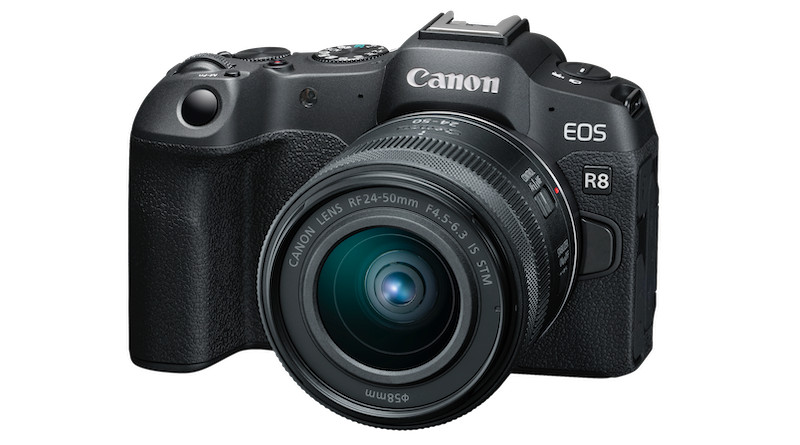
Canon didn’t just trim the fat with the EOS R8 — they redefined what a lightweight full-frame camera could do. Marketed as the "NEW VERSION" of the EOS RP, the R8 carries forward the lineage of Canon’s entry-level full-frame mirrorless line but injects it with high-end DNA pulled from the R6 Mark II. Released in April 2023 at $1,499 for the body alone, it slots in as Canon’s second sub-$1,500 full-frame body, this time trading some durability and weather sealing for a radical reduction in weight and a dramatic leap in speed. At 461 grams with battery and SD card, it earns its claim as the world’s lightest full-frame mirrorless camera — a title that immediately draws attention from travel shooters, street photographers, and anyone who’s ever winced at the weight of a pro rig.
The design borrows heavily from the EOS R and RP, maintaining that familiar, compact form factor that fits comfortably in hand. But there’s a telling change: the power switch has been repositioned, breaking from the RP’s layout and suggesting a deliberate refinement rather than a straight clone. This isn’t just a rebadge. The R8 leverages Canon’s Dual Pixel CMOS AF II system with 1053 autofocus points covering the entire sensor area, giving it a dense, responsive AF grid that locks onto subjects with confidence. It shoots at up to 40 frames per second using the electronic shutter, a spec once reserved for flagship sports cameras. That kind of speed in a sub-1.5-pound body changes the game for action and wildlife shooters who don’t want to carry a tank.
Image quality is built on a full-frame, approximately 24.2-megapixel sensor — the same effective resolution found in many of Canon’s recent mid-tier models. It delivers clean files with good dynamic range and color science that longtime Canon users will recognize immediately. The ISO range spans 100–102,400, expandable down to 50 (L) and up to 204,800 (H), allowing for serious low-light flexibility. Out of the box, the camera performs well at default settings, requiring little tweaking for competent exposure and color. One reviewer noted that the Fv (Flexible Priority) mode is particularly useful — it lets users manually adjust shutter speed, aperture, ISO, or exposure compensation while retaining the ability to fall back into full auto instantly, making it a rare hybrid that satisfies both beginners and seasoned shooters who want quick access without full manual commitment.
Specifications
| Manufacturer | Canon |
| Product type | Full-Frame Mirrorless Camera |
| Production years | Released in April 2023 |
| Original price | $1,499 (body-only) |
| Weight | 461g (16.3 oz) with battery and SD card |
| Dimensions (W x H x D) | 132.5 x 86.1 x 70.0mm (5.22 x 3.39 x 2.76") |
| Sensor | Full-Frame, approx. 24.2-megapixels |
| Continuous shooting | 40 FPS (maximum frame rate) |
| ISO range | 100–102,400 (expandable to 50 (L) and 204,800 (H)) |
| Video | 4K60 |
| Viewfinder | 0.39-inch OLED with 2.36M dots and 0.7x magnification; Frame coverage: 100% |
| LCD Screen | 3" Clear View LCD II, approx. 1.62 million dots |
| Autofocus | 1053 automatic AF points that cover the entire sensor area |
| Battery | LP-E17 battery |
| Connectivity | Wi-Fi and Bluetooth |
| Card type | SD card |
| Shutter modes | Includes Electronic shutter & Silent Mode |
| Focus modes | Includes Autofocus, Manual Focus Peaking, Focus Magnifier, Manual Focus Override, Focus Bracketing and Depth Compositing |
| Lens compatibility | Can use Non-EF Lenses on Adapters |
Key Features
461g Full-Frame Body with 40 FPS Burst
The R8’s defining achievement is its weight-to-performance ratio. At 461 grams, it undercuts every other full-frame mirrorless camera on the market. Yet it manages to deliver a 40 frames-per-second burst rate using the electronic shutter — a spec typically seen on high-end action cameras like the R3 or Sony A1. This makes it a compelling option for event photographers, wildlife enthusiasts, or anyone needing speed without the bulk. The trade-off? No mechanical shutter mode is specified in available documentation, and the camera lacks in-body image stabilization. That means users are reliant on lens-based IS and must contend with potential rolling shutter in fast-moving scenes. But for stills in good light, the speed is real and usable.
1053-Point Full-Sensor Autofocus Coverage
Canon’s Dual Pixel AF II system is one of the most mature in the industry, and the R8 benefits from its full deployment. With 1053 autofocus points spread across the entire sensor area, subjects can be tracked reliably even at the extreme edges of the frame. Eye Detection, Face Detection, and Animal Detection AF work seamlessly in both photo and video modes. The system is responsive in low light (down to -6.5 EV), and manual focus aids like peaking and magnifier are available for precision work. Owners report that focus transitions in video are smooth and natural, making the R8 a strong hybrid shooter despite its lack of advanced video codecs or ProRes support.
Fv Mode for Flexible Exposure Control
Fv (Flexible Priority) mode is a Canon hallmark that finally found its way into the RP-line successors. It allows users to set any combination of shutter speed, aperture, ISO, or exposure compensation manually while letting the camera auto-select the remaining values. Unlike full auto, it gives direct control where needed; unlike full manual, it adapts instantly to changing light. Reviewers highlight this as a key reason the R8 feels intuitive right out of the box — it’s a mode that grows with the user, equally useful for a novice experimenting with settings or a pro needing quick adjustments between shots.
3.0" 1.62M-Dot LCD and 0.7x OLED Viewfinder
The rear screen is a 3.0-inch Clear View LCD II with approximately 1.62 million dots — sharp, bright, and color-accurate, though not articulated (it only tilts up and down). It’s serviceable for vlogging and waist-level shooting but not ideal for complex video work. The 0.39-inch OLED electronic viewfinder offers 2.36 million dots and 0.7x magnification with 100% frame coverage. It’s a noticeable step down from the R6 II’s larger, brighter finder, but still clear and lag-free. Some users report it feels slightly cramped compared to higher-end models, but it gets the job done for most shooting scenarios.
Historical Context
The EOS R8 is positioned as the successor to the EOS RP, inheriting its compact size and entry-level price point but upgrading nearly every performance metric. Canon markets it as the second sub-$1,500 full-frame camera in its lineup, following the RP. Where the RP was criticized for slow processing and limited AF, the R8 answers with near-flagship autofocus and burst shooting. Reviewers note it borrows heavily from the R6 Mark II — particularly in AF and processing — but packages it into a smaller, lighter, less rugged body. This makes the R8 a performance-focused alternative for those who prioritize speed and portability over weather sealing and dual card slots.
eBay Listings
As an eBay Partner, we earn from qualifying purchases. This helps support our independent vintage technology research.