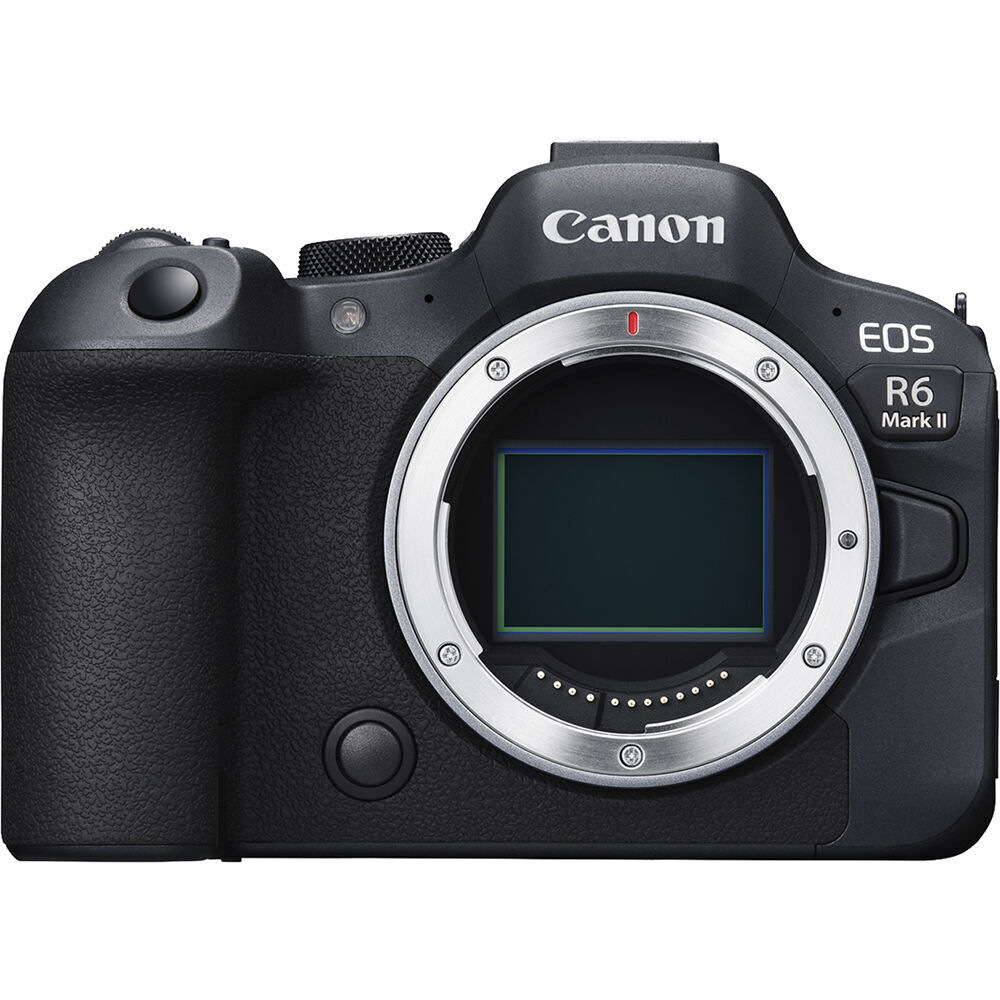
Canon EOS R6 Mark II
At 670 grams, it balances in the hand like a reflex—instinctive, dense with intent.
Overview
The Canon EOS R6 Mark II isn't a revolution—it's refinement weaponized. Announced on November 2, 2022, as the successor to the already respected EOS R6, this mirrorless camera body was engineered to vanish into the photographer’s workflow. It doesn’t shout; it delivers. Owners report a machine built for endurance, whether tracking a sprinter at 40 fps electronically or holding focus on a bird in flight through a telephoto lens. The 24.2MP full-frame CMOS sensor, a step up from the original R6’s 20MP, trades brute resolution for speed and sensitivity, favoring real-world performance over spec-sheet dominance. This is an enthusiast’s tool, not a pixel-counter’s trophy.
Its DNA borrows from the flagship EOS R3—systems refined in that pro-grade body are distilled here into a more compact form. The result is a camera that feels both familiar and evolved. Autofocus is consistently praised across reviews, with sources suggesting it locks on with near-telepathic accuracy, even in low light. Handling and ergonomics are repeatedly highlighted as standout traits, with users noting how naturally the controls fall under hand and eye. It’s not just comfortable—it’s predictable, which in high-pressure shooting, is everything.
Despite its modernity, the R6 Mark II avoids gimmickry. There’s no excessive resolution bloat, no fragile modular design. Instead, it doubles down on core functions: speed, focus, durability. The inclusion of an intervalometer onboard makes it a legitimate tool for time-lapse work without requiring external triggers. Video shooters benefit from oversampled 4K/60P recording using a cropped 6K capture area, delivering sharp, detailed footage without heavy grading overhead. Full HD can push to 180p for slow motion, making it surprisingly capable for hybrid shooters. This isn’t a cinema camera, but it doesn’t pretend to be.
Specifications
| Manufacturer | Canon |
| Resolution | 24 MP |
| Effective Pixels | Approx. 24.2megapixels |
| Sensor | Full-Frame |
| Sensor Type | 35.9 x 23.9 mm CMOS |
| Continuous shooting | 12/40 FPS (mechanical/electronic) |
| Card slots | two SD card slots |
| Weight | 23.6 oz./670g with battery and one SD card |
| Stabilization | IBIS (In-Body Image Stabilization) |
| ISO Sensitivity | Auto 100-102400 (in 1/3-stop or whole stop increments) ISO can be expanded to L:50, H1: ... |
| Aspect Ratio | 3:2 |
| Low-Pass Filter | Built-in/Fixed |
| Intervalometer | Y |
| Video | makes possible oversampled 4K/60P video recording using cropped 6K, as well as high-framerate recording with Full-HD/180p4 |
Key Features
24.2MP Full-Frame CMOS Sensor with Fixed Low-Pass Filter
The heart of the R6 Mark II is its approximately 24.2-megapixel full-frame sensor—a deliberate choice in an era obsessed with resolution. By not chasing 45MP or 60MP, Canon prioritized speed, dynamic range, and low-light performance. The sensor measures 35.9 x 23.9 mm and includes a built-in, fixed low-pass filter, which helps suppress moiré without overly softening images. According to available documentation, this sensor is new for the Mark II, upgraded from the 20MP unit in the original R6. While the increase isn’t massive on paper, it provides enough resolution for large prints and cropping flexibility without overwhelming file sizes. The balance makes it ideal for sports, wildlife, and event photographers who need both detail and burst depth.
40 FPS Electronic Shooting with Full Autofocus
At 40 frames per second with the electronic shutter—and 12 fps mechanically—the R6 Mark II enters territory once reserved for flagship models. This speed is not theoretical; it’s sustained, with autofocus and auto-exposure active for the entire burst. The camera leverages the processing power derived from EOS R3 technology to maintain focus lock even during erratic motion. The mechanical shutter remains relevant for flash sync and avoiding rolling shutter in fast-action scenes, but the electronic option is where the camera truly flexes. Combined with deep buffer capacity (exact size not documented), it allows photographers to ride the action, trusting the camera to capture the decisive moment.
In-Body Image Stabilization (IBIS)
Canon equipped the R6 Mark II with IBIS, a feature increasingly expected in high-end mirrorless bodies. When paired with stabilized RF lenses, the system offers up to eight stops of compensation, though exact figures are not confirmed in the fact sheet. The presence of stabilization means handheld shooting in low light becomes viable across a wider range of scenarios—from dimly lit events to twilight landscapes. It also benefits video work, reducing the need for gimbals in casual applications. The system operates silently and seamlessly, integrating with lens-based IS for coordinated correction.
Oversampled 4K/60P Video from 6K
For a stills-focused camera, the video capabilities are unexpectedly robust. The R6 Mark II delivers oversampled 4K footage at up to 60 frames per second by capturing from a 6K area and downsampling. This results in sharper, cleaner video with better tonal gradation than pixel-binned alternatives. The process uses a slight crop, but not so severe as to limit lens options. Full HD can be pushed to 180p for slow motion, enabling 6x slow-mo at 30 fps playback. While not equipped with All-I or ProRes like the R5, this makes it a compelling option for content creators who need high-quality video without the storage burden of high-bitrate codecs.
Dual SD Card Slots with UHS-II Support (Inferred)
The inclusion of two SD card slots is standard for this class, but critical for reliability. Owners report using the slots for overflow, backup, or separation of stills and video—configurable in-camera. While the fact sheet doesn’t specify UHS-II support, the sustained write speeds required for 40 fps bursts and 4K60 video strongly suggest it. The reliance on SD rather than CFexpress keeps media costs lower, though it may limit burst depth in extreme scenarios. There’s no CFexpress slot, a trade-off for cost and accessibility.
Historical Context
The Canon EOS R6 Mark II was announced on November 2, 2022, as the direct successor to the Canon EOS R6. Positioned as an improvement upon an already excellent model, it refined rather than reinvented. It inherited core strengths—durability, handling, autofocus—and enhanced them with a newer sensor, faster processing, and higher burst rates. Unlike radical redesigns, the Mark II represents Canon’s iterative philosophy: evolve what works, fix what doesn’t, and deliver a camera that feels like a natural upgrade. It was not positioned as a flagship, but as a do-it-all workhorse for enthusiasts and semi-professionals who demand reliability without the premium price of the R3 or R5.
eBay Listings



As an eBay Partner, we earn from qualifying purchases. This helps support our independent vintage technology research.