Canon EOS R50 V (2025)
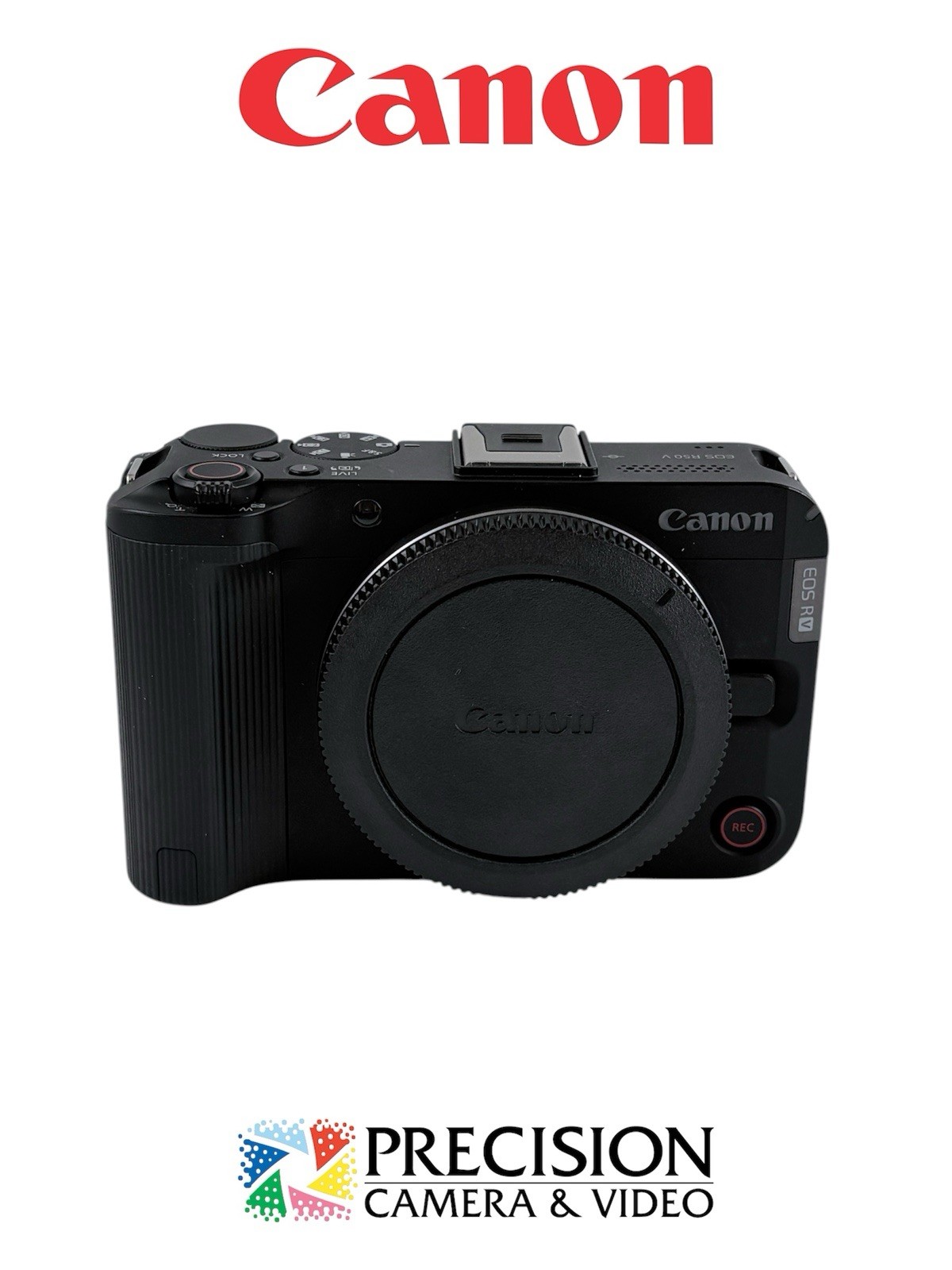
At 370 grams, it sits in your hand like a vlogger’s secret weapon—light, loud with red recording cues, and built for the front-facing frame.
Overview
The Canon EOS R50 V is a machine built for one audience: the content creator who prioritizes video over everything else. Announced on March 26, 2025, and launched the following month, this camera skips the viewfinder entirely and leans hard into its role as a selfie-ready, social-first video tool. It’s not trying to be a hybrid workhorse or a stills powerhouse—it’s a compact, red-lit beacon for YouTube Shorts, TikTok, and run-and-gun vlogging. At 119.3 x 73.7 x 45.2 mm and 370 grams with battery and SD card, it’s small enough to vanish in a jacket pocket, yet substantial enough to feel deliberate in hand.
Under the hood, it runs on Canon’s DIGIC X processor and packs a 24 MP APS-C CMOS sensor (approx. 22.3 × 14.9 mm), delivering 4K60 video with 10-bit 4:2:2 color via XF-AVC S and XF-HEVC S codecs. Continuous shooting hits 15 FPS, with a buffer capable of 95 JPEGs or 36 raw files—solid for its class. Autofocus is no joke: 4,503 phase-detection points cover the frame for stills, cropping down to 3,713 for video, all operating in low light down to LV -5. The ISO range reportedly spans 100–32,000 (expandable to 51,200), though some sources suggest a native ceiling of 3,200, leaving a slight ambiguity in dynamic range performance under extreme low light.
It speaks to Canon’s focus on video that the R50 V includes a front-facing red tally light—visible from both top and front—so subjects know when recording is active. The 3-inch, 1,040,000-dot LCD flips fully forward and lights up with a red border during recording, a small but critical detail for solo creators. There’s even a second tripod socket on the side, engineered for vertical mounting without adapters—a nod to the reality that most social content is shot portrait.
But make no mistake: this is a camera that trades stills versatility for video fluency. It lacks a viewfinder, built-in flash, sensor-shift stabilization, and a second card slot. The controls, while optimized for video, are reportedly limited for still photographers. And despite its modern design, it doesn’t include a sensor cleaner—manual dust removal is the only option.
Specifications
| Manufacturer | Canon |
| Sensor resolution | 24 MP |
| Sensor size | APS-C |
| Image Processor | DIGIC X |
| Continuous shooting speed | 15 FPS |
| Video capability | 4K60 |
| Viewfinder | no viewfinder |
| Lens mount | works with Canon RF & RF-S lenses |
| Weight | 13.1 oz./370 g with battery and SD card |
| ISO | ISO 100 ~ 32,000 for stills and video. To ISO 51,200 H for stills and video |
| Buffer | 95 frames JPG or 36 frames raw at 15 FPS |
| Shutter | Electronic Front-Curtain Shutter 1 / 4,000 ~ 30 seconds. Silent Electronic Shutter 1 / 8,000 ~ 30 seconds |
| Autofocus | 4,503 phase-detection AF points for stills |
| LCD Monitor | 3" (75 mm) diagonal. 1,040,000 dots |
| Image Stabilization | No sensor-shift image stabilization |
| Flash | No Built-in Flash. External Flash Dedicated hot shoe |
| Storage | Uses SD card |
| Battery | LP-E17 |
| Battery Life | Approx. 480 |
| Dimensions (Body) | Approx. 119.3 x 73.7 x 45.2 mm |
Key Features
Red Tally Light Visible from Front and Top
A rare inclusion at this price, the front and top-mounted red tally light ensures subjects know when recording is live—critical for solo vloggers, educators, or interviewers working without a monitor. It’s not just an LED; it’s a signal of intent, borrowed from professional cinema cameras and repurposed for the creator economy.
LCD Screen with Red-Colored Recording Emphasis
The 3-inch vari-angle LCD doesn’t just flip—it screams when rolling. A bold red border pulses around the screen during recording, eliminating guesswork. Combined with the tally light, it creates a feedback system that’s intuitive and immediate, reducing misfires and missed takes.
Extra Front REC Button for Video Selfies
Placed on the front grip, a secondary record button lets users start filming without reaching around, a small but meaningful detail for those framing themselves in real time. It’s the kind of ergonomic tweak that suggests Canon spent time watching how vloggers actually operate.
Second Tripod Socket on the Side for Vertical Video
This isn’t just a gimmick—it’s a structural commitment to vertical content. The side-mounted 1/4"-20 thread allows for true portrait orientation on standard tripods, avoiding the instability of L-brackets or phone-style clamps. It’s a quiet acknowledgment that the future of video is often 9:16, not 16:9.
No Sensor Cleaner
Owners report the absence of any ultrasonic or mechanical sensor cleaning system. Given the camera’s vlogging orientation—frequent lens changes in dusty environments—this omission feels like a missed opportunity. Dust spots on video are harder to edit out than in stills, making manual cleaning an unavoidable chore.
Historical Context
The EOS R50 V emerged in April 2025 as Canon’s most video-focused entry in its APS-C mirrorless lineup, sitting alongside the R100, R50, R10, and R7. Marketed explicitly for vloggers and content creators, it fills a niche between compact point-and-shoots and full hybrid mirrorless cameras. According to available documentation, it was designed to surpass the capabilities of older vlogging staples like the Canon G7X III, offering interchangeable lenses, better autofocus, and higher-bitrate video—while maintaining a compact form.
Interestingly, it diverges from its sibling, the EOS R50, which retains a viewfinder and more traditional controls. Sources suggest the R50 remains the better choice for still photographers, costing less while offering more physical controls. The R50 V, in contrast, doubles down on video-centric design, sacrificing stills functionality for features that matter to solo creators.
Collectibility & Value
As a 2025 release, the EOS R50 V is too new for established collectibility, and no data on long-term reliability or common failures has emerged. However, current market pricing reflects early adoption trends. The body-only configuration launched at an estimated retail price of $649.99 and has since been observed as low as $569. The kit with the RF-S 14-30mm IS STM PZ lens debuted at $849.99 and has dropped to $849, with one source listing a previous high of $929.99.
User feedback is positive in early reviews: one owner noted, “I received my Canon EOS R50 V today and I'm extremely happy with it! The build quality feels solid and premium, yet it's compact enough to travel with easily.” Another praised the expected Canon color science, stating, “I expect the usual flawless Canon colors and image quality.” Still, critics highlight its limitations: no viewfinder, no second card slot, no built-in flash, and no battery percentage meter—omissions that may affect long-term user satisfaction.
eBay Listings


As an eBay Partner, we earn from qualifying purchases. This helps support our independent vintage technology research.