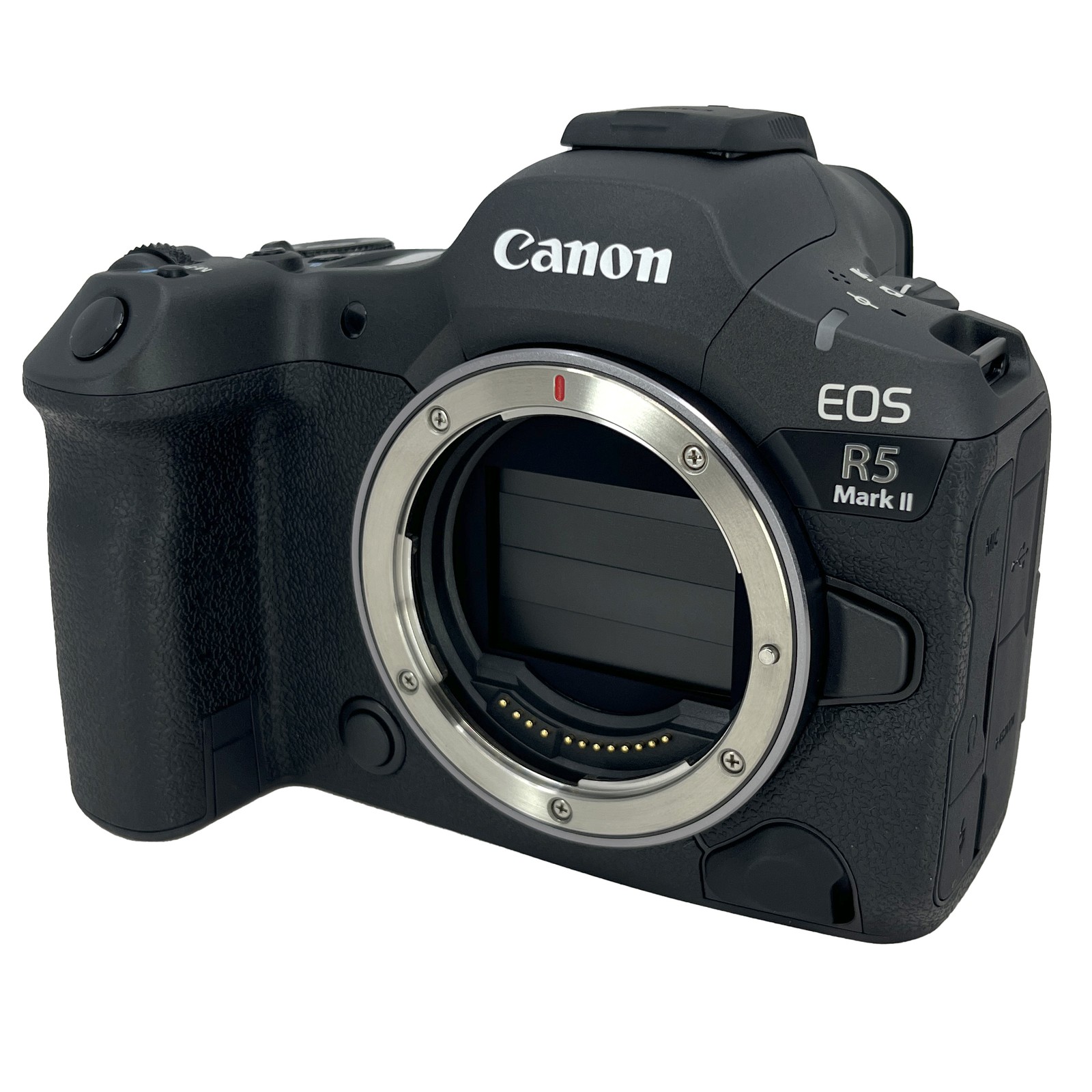
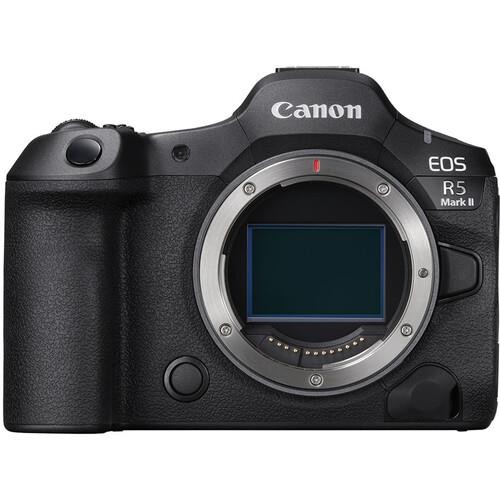
Canon EOS R5 Mark II
At 746 grams with battery and card, it lands in your hands like a promise kept — dense, deliberate, and humming with computational might.
Overview
The Canon EOS R5 Mark II is a full-frame mirrorless camera announced on July 17, 2024, positioned as the successor to the Canon EOS R5. This isn’t a rehash — it’s a recalibration, aimed squarely at demanding enthusiasts who need both stills and video performance without compromise. It inherits the best features of the EOS R5, then layers on next-generation processing and autofocus intelligence that push it into new territory. The body feels familiar but refined, with a stacked 45-megapixel sensor and an Accelerated Capture Image processor system that together enable blackout-free shooting at up to 30 fps with the electronic shutter. For those who remember the heat throttling debates of the original R5, this iteration feels like Canon answering with silicon and software: more speed, more resolution, more data, and — crucially — better thermal management, though specifics on overheating limits aren’t documented in the fact sheet.
What stands out immediately is the sheer density of computational photography packed into the chassis. The camera doesn’t just capture images — it processes, predicts, and enhances them in real time. The new DIGIC Accelerator works in tandem with the DIGIC X processor, enabling features like Neural Network Noise Reduction and in-camera upscaling that quadruples pixel count. These aren’t post-processing gimmicks; they’re baked into the shooting experience, suggesting a shift in how Canon envisions professional workflows. The inclusion of Eye Control AF for the first time on a 5 series model marks a notable evolution, now improved with updated optics and a better line-of-sight detection algorithm. It’s a feature that divides users — some swear by its speed, others find it distracting — but its arrival here signals Canon’s commitment to hands-free focus targeting in high-pressure scenarios.
Specifications
| Manufacturer | Canon |
| Product Type | full-frame mirrorless camera |
| Sensor | 45-megapixel back-illuminated stacked CMOS sensor |
| Effective Pixels | Approx. 45 megapixels |
| Total Pixels | Approx. 50.3 megapixels |
| Aspect Ratio | 3:2 |
| Low-Pass Filter | Built-in/Fixed |
| Sensor Cleaning | EOS integrated cleaning system |
| Processor | Accelerated Capture Image processor system consisting of the all-new DIGIC Accelerator and DIGIC X image processor |
| Continuous Shooting Speed | 12/30 FPS |
| Video Recording | capable of shooting 8K 60P RAW recordings |
| Video Recording | record up to 4K at 120p, or FHD at 240p |
| Video Recording | 4K DCI 60p SRAW recording option |
| Video Dynamic Range | supports a wider dynamic range (16+ stops) |
| Color Profile | 10-bit Canon Log 2 |
| In-Body Stabilization | 5-axis in-body IS (Image Stabilizer) |
| Viewfinder | blackout-free EVF is twice as bright as the EOS R5’s, and is equipped with anti-fog performance |
| Rear LCD | 3.2-inch |
| Rear LCD Resolution | 2,100,000 dots |
| Rear LCD Type | Articulating Touchscreen LCD |
| Card Slots | one CFexpress Type B and one SD card slot |
| Battery Model | LP-E6P |
| Battery Compatibility | will accept previous LP-E6 models |
| USB Charging | can be charged via USB |
| CIPA-Rated Battery Life (Stills) | 630 shots (with LCD), 340 shots (with EVF) |
| Connectivity | supports high-speed wireless or wired transmission of large files (Wi-Fi 6/6E and 2.5G Base-T wired LAN) |
| Dimensions (W x H x D) | Approx. 138.5×101.2×93.5 mm |
| Weight (Body Only) | Approx. 656 g |
| Weight (with card and battery) | Approx. 746 g |
Key Features
Next-Generation Dual Pixel Intelligent AF System
The autofocus system leverages the Accelerated Capture system to deliver what Canon calls a "next-generation Dual Pixel Intelligent AF system". This isn’t just faster subject tracking — it’s smarter, with machine learning models trained to recognize people, animals, and vehicles with higher accuracy. The Register People Priority function allows users to register specific faces for instant recognition, a feature that could streamline event or sports photography where the same subjects reappear. Action Priority AF mode adjusts tracking behavior based on subject motion, tightening focus response during rapid movement. These aren’t just menu toggles; they represent a shift toward adaptive, context-aware autofocus that anticipates intent rather than just reacting to it.
Eye Control AF on a 5 Series Model
For the first time in the 5 series lineup, Eye Control AF makes its appearance, now enhanced with updated optics and a better line-of-sight detection algorithm. This allows photographers to select focus points simply by looking through the viewfinder and directing their gaze — a feature that can shave critical milliseconds off composition time in fast-paced environments. While some users report a learning curve and occasional misregistration, the inclusion suggests Canon sees eye control as more than a novelty — it’s a legitimate tool for professionals who need minimal hand movement during shooting.
8K 60P RAW and 16+ Stop Dynamic Range
Video capabilities are a major leap, with the ability to shoot 8K 60P RAW recordings — a feature previously reserved for cinema cameras or external recorders. The dynamic range support of 16+ stops) combined with 10-bit Canon Log 2 gives colorists significant latitude in post. The 4K DCI 60p SRAW option offers a middle ground between resolution and file size, while the ability to record up to 4K at 120p or FHD at 240p opens doors for high-quality slow motion. What’s particularly notable is the proxy recording feature: users can simultaneously record smaller 2K or Full HD proxy files to the SD card while saving 8K or 4K main files to the CFexpress Type B slot. This dual-stream workflow is ideal for editors who need lightweight files for offline editing while preserving full-resolution masters.
Dual Shooting Mode for Hybrid Workflows
The Dual Shooting feature allows users to record FHD 30p videos and capture 16:9, 33.2-megapixel JPEG stills simultaneously. This isn’t just convenience — it’s a workflow enabler for content creators who need both video and high-res stills from a single take, such as in product shoots or event coverage. The camera handles the synchronization internally, reducing the need for secondary devices or complex post-capture alignment.
In-Camera Upscaling and Neural Noise Reduction
The in-camera upscaling feature quadruples the number of pixels in the image, effectively turning a 45MP file into a 180MP output. While purists may question the authenticity of interpolated resolution, the practical benefit is clear: larger prints or more flexible cropping without leaving the camera. Paired with Neural Network Noise Reduction, which uses AI to suppress noise while preserving detail, the R5 Mark II positions itself as a camera that doesn’t just capture images — it enhances them at the point of capture.
Dust and Drip-Resistant Weather Sealing
The body comes with dust and drip-resistant weather sealing, a necessity for professionals working in unpredictable environments. While the exact IP rating isn’t documented, the construction is consistent with Canon’s pro-grade build standards, suggesting resilience against moisture and particulates. Combined with the anti-fog performance in the viewfinder, the camera is clearly built for field use in challenging conditions.
Historical Context
The EOS R5 Mark II represents the second version of Canon’s enormously popular camera, evolving from a groundbreaking but thermally limited predecessor into a more balanced hybrid powerhouse. It occupies a critical space in Canon’s mirrorless lineup, sitting just below the flagship R3 and R1 in terms of speed and ruggedness, but ahead of the R6 series in resolution and video capability. Its announcement in 2024 marks Canon’s continued investment in the high-end mirrorless segment, where computational photography and hybrid performance are now table stakes.
Collectibility & Value
The Canon EOS R5 Mark II was expected to be available in August 2024, with an estimated retail price of $4,299.00 for the body only: $4,299.00). Current new pricing sits at $3,899, suggesting early market adjustments or retailer competition. Used prices range from $3,390 at KEH to about $3,210 for savvy eBay buyers, with forum mentions as low as $3,300. A kit pairing the R5 Mk II with the RF 24-105mm f/4L IS USM lens retails for $5,149. In the Philippines, the body-only price starts at PhP 249,998, including a 512GB CFexpress Type B card: "will start at PhP 249,998 for just the body (bundled with a 512GB CF Express Type B card)"), with the lens kit topping out at PhP 329,998: "tops off at PhP 329,998 with the RF24-105mm f/4L IS USM lens"). One UK-based analysis noted that adjusting the original R5’s 2020 price for 2024 inflation results in £4,635, while the R5 Mark II carries an RRP of £4,499 — indicating a slight real-term price decrease despite significant upgrades: "2020 price adjusted for 2024 inflation = £4,635. Canon EOS R5 Mark II , RRP £4,499. So a small drop in price."). No information on common failures, maintenance, or spare parts availability is documented.
eBay Listings


As an eBay Partner, we earn from qualifying purchases. This helps support our independent vintage technology research.