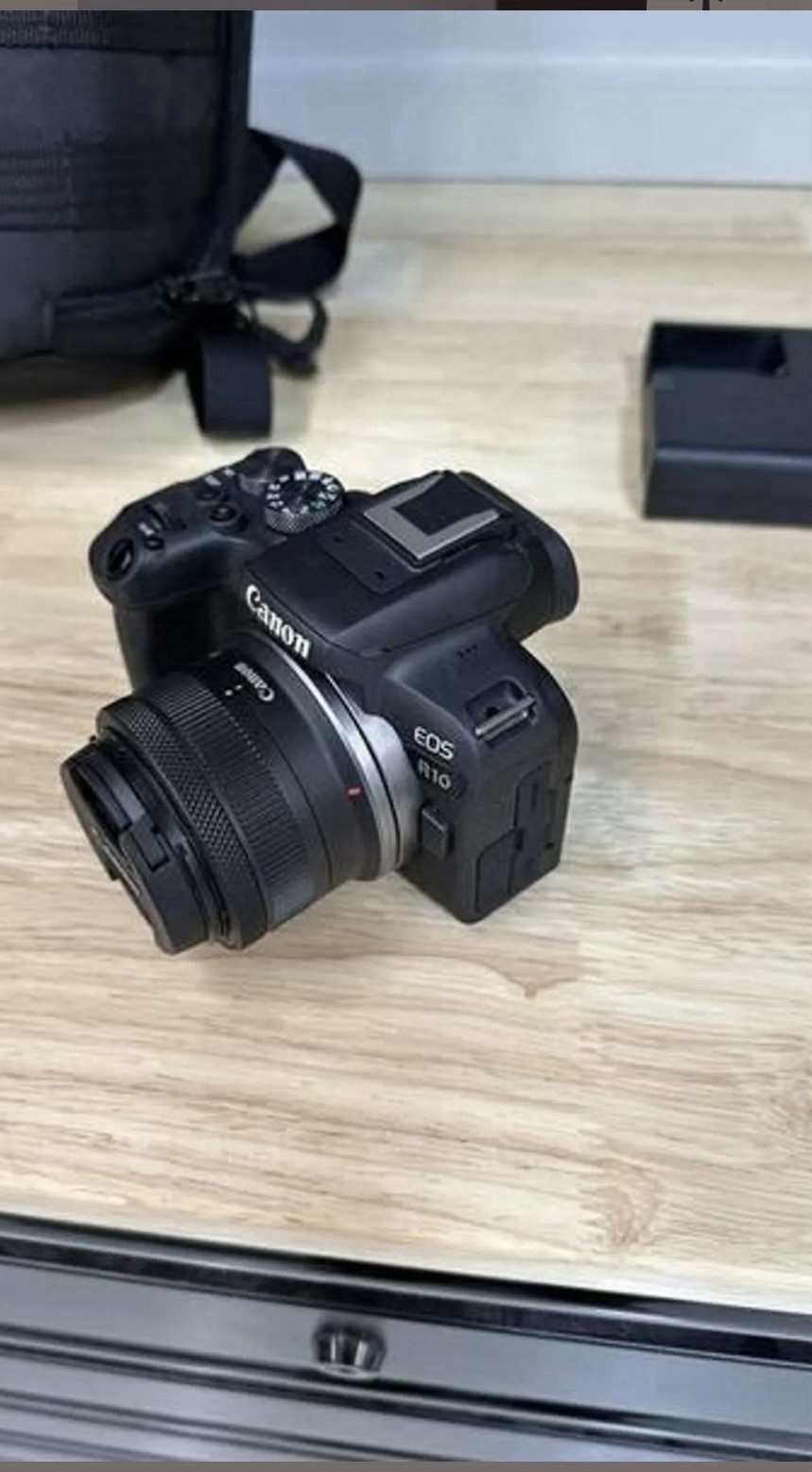
Canon EOS R10
At 429 grams, it balances in the hand like a tool built for speed, not show.
Overview
The Canon EOS R10 emerged as Canon’s push into compact, high-speed APS-C mirrorless territory, announced on May 24, 2022, and released that July. It’s not a DSLR reborn, but a deliberate pivot—designed from the start as an RF-mount successor to both the midrange EOS 90D and the upper-entry-level EOS 850D. This isn’t a bridge camera by accident; it’s a focused evolution, trading optical viewfinders and bulk for rapid shooting, modern video specs, and a smaller footprint. Positioned within Canon’s APS-C mirrorless lineup alongside the R7, R50, R50V, and R100, the R10 slots in as the performance-oriented step-up from entry-level models, though it shares the same sensor size and lens mount across the RF family.
Owners report it delivers sharp photos and video with high sensitivity, nuanced image quality, and fast overall performance—claims backed by its 24.2 MP sensor and aggressive burst shooting. At launch, the body-only price was $999, with kit bundles including the 18-45mm IS lens at $1,069 and the 18-150mm IS lens at $1,449. Today, the used market reflects depreciation common in fast-moving digital categories: the body trades for about $718, while the R10 & 18-150mm IS kit sells for $855 at KEH, typically in lightly used condition with minimal wear.
Yet this is not a flawless transition. Some users have flagged reliability concerns. Error 30, reportedly tied to mechanical shutter failure, has surfaced in forums as a recurring issue. Others describe focus pulsing—where the lens hunts repeatedly during video—while isolated reports mention sudden loss of autofocus, forcing manual-only operation with certain lenses. Perhaps most troubling: one repair analysis concluded a unit was “beyond repair” after minor water exposure, citing internal design choices that prevent servicing. These aren’t widespread failure reports, but they’re persistent enough to give cautious buyers pause.
Specifications
| Manufacturer | Canon |
| Resolution | 24.2 MP |
| Sensor size | APS-C |
| Sensor Size | 22.3 x 14.9mm |
| Pixel Dimensions | 6000 x 4000 |
| Still frame rates | 23/15 FPS stills |
| ISO range | ISO 100-32,000 (expandable to 51,200) |
| Video capability | 4K 30/60 |
| Shutter Speed | Mechanical: 30-1/4000 sec, Bulb, Electronic: 30-1/8000, 1/16000 |
| Aperture priority | Yes |
| Shutter priority | Yes |
| Card slot | one SD card slot |
| Dimensions (W x H x D) | Approx. 122.5 x 87.8 x 83.4mm |
| Weight (including battery, card) | 429g / 15.1 ounces |
Key Features
24.2 MP APS-C Sensor with 6000 x 4000 Pixel Dimensions
The heart of the R10 is its 24.2 MP CMOS sensor, measuring 22.3 x 14.9mm—standard APS-C dimensions that balance resolution and low-light performance. With individual pixels sized at approximately 3.72µm, it strikes a pragmatic middle ground: detailed enough for large prints and cropping, while maintaining clean output up to ISO 32,000, expandable to 51,200. This sensor enables the R10’s headline feature—burst shooting at 23 FPS with electronic shutter or 15 FPS mechanically—making it a favorite for action and wildlife shooters who need speed without stepping up to full-frame.
4K 30/60 Video with Vertical Movie and Live Streaming
Canon positioned the R10 as more than a stills machine. It supports 4K video at both 30 and 60 frames per second, a rarity in its class at launch. The inclusion of Vertical Movie mode caters directly to social media creators, automatically adding portrait-orientation metadata for platforms like Instagram and TikTok. Combined with live streaming capability via USB, the R10 becomes a hybrid tool—capable of feeding a live audience while recording high-bitrate video internally. Reviewers noted it offers a “unique mix of features in an APS-C camera body,” especially for vloggers and hybrid shooters on a budget.
Dual Flash Contacts: Hot Shoe and Multi-Pin Digital
The flash system reveals Canon’s dual audience. The R10 includes a standard hot shoe for legacy flashes, ensuring compatibility with older Speedlites. But it also integrates the newer 21-pin digital contact system, enabling full communication with advanced flashes like the EL-10—supporting high-speed sync, wireless TTL, and precise exposure control. This hybrid approach lets users mix vintage gear with modern accessories, a nod to photographers transitioning from older Canon DSLRs.
Historical Context
The EOS R10 marks Canon’s continued shift from DSLRs to mirrorless, specifically targeting users who valued the 90D’s speed but wanted lighter gear and better video. As an RF-mount camera, it breaks from EF compatibility without an adapter, signaling Canon’s commitment to the new ecosystem. Within the R series, it sits below the R7 in build and weather sealing but matches it in autofocus sophistication and burst rate. Its launch alongside the R50 and R100 created a tiered APS-C strategy: entry-level, mid-range speed, and high-end hybrid—all sharing the same lens mount but diverging in performance and durability.
Collectibility & Value
Despite its 2022 release, the R10 has already settled into the secondary market with predictable depreciation. At $718 for a lightly used body, it’s a compelling option for budget-conscious shooters needing speed and 4K video. The 18-150mm IS kit at $855 offers strong value for travel and walkaround use. However, long-term collectibility seems unlikely—digital cameras of this era rarely appreciate, and the R10 lacks the rarity or cult status to become a future classic. More pressing is its reliability reputation: shutter errors, focus issues, and poor serviceability after moisture exposure could affect resale confidence. Owners are advised to test mechanical functions thoroughly and avoid exposure to the elements.
eBay Listings
As an eBay Partner, we earn from qualifying purchases. This helps support our independent vintage technology research.