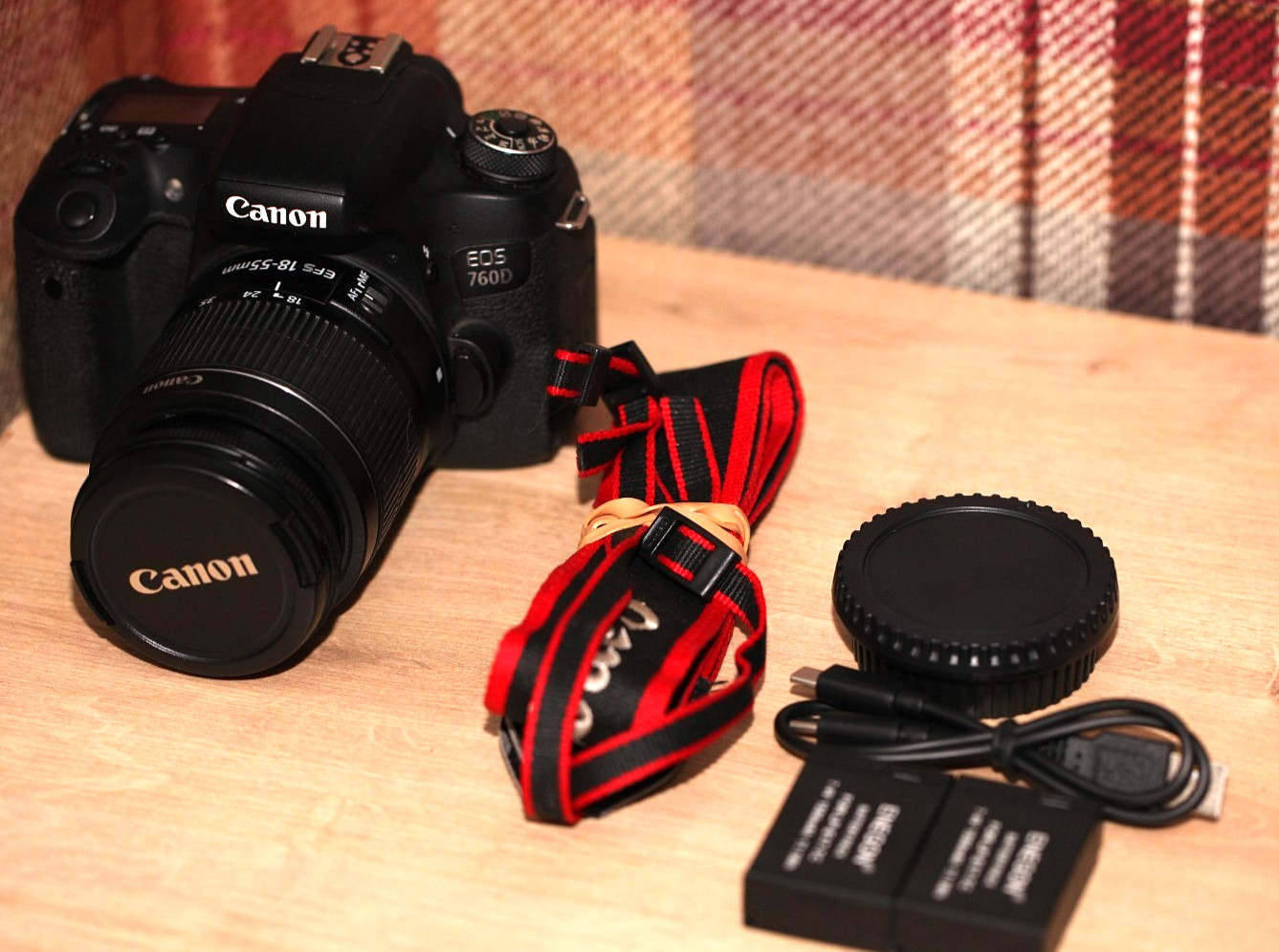
Canon EOS 760D (2015)
At 565g with battery and card, it balances in the hand like a tool built to last—dense, deliberate, and ready for real work.
Overview
The Canon EOS 760D isn't a flagship, nor was it trying to be. Announced in February 2015, this DSLR carved its place as the more refined sibling in a dual launch that included the 750D, stepping up from the 2013 EOS 700D/Rebel T5i platform. Marketed as the EOS Rebel T6s in North America and the EOS 8000D in Japan, the 760D was Canon’s answer to enthusiasts who wanted tactile control and improved ergonomics without jumping into the 7D tier. It’s a mid-range DSLR with a metal body, a rarity in its class, giving it a heft and durability that plastic-bodied peers couldn’t match. Owners report it feels substantial—less like consumer gear and more like a scaled-down pro tool.
At its core is a 22.3 x 14.9mm CMOS sensor, not full-frame, but large enough to deliver clean, detailed images in most lighting. With approximately 24.2 megapixels effective, or 6024 x 4022 in raw resolution, the camera captures enough detail for serious cropping and large prints. The total pixel count clocks in at approximately 24.7 megapixels, feeding data through Canon’s DIGIC6 image processor, which handles noise reduction, color rendering, and autofocus calculations. The combination delivers solid JPEGs straight out of camera and gives RAW shooters plenty to work with in post.
Autofocus is managed by a 19-point system, all cross-type, which was a significant upgrade over the center-point-only cross-type arrays in entry-level models. Coupled with a 7560-pixel RGB + IR metering sensor, the 760D handles complex lighting and moving subjects with confidence, especially when paired with modern EF lenses. The optical viewfinder uses a pentamirror design, not the brighter pentaprism found in higher-end models, but it’s adequately bright and offers 95% coverage. The rear LCD is articulated—a rarity at this level—and touch-sensitive, though its exact size and resolution aren’t documented in the source material.
Specifications
| Manufacturer | Canon |
| Product Type | DSLR |
| Sensor Type | CMOS |
| Sensor Size | 22.3 x 14.9mm |
| Effective Pixels | Approx. 24.2 megapixels |
| Total Pixels | Approx. 24.7 megapixels |
| Resolution | 6024 x 4022 |
| Aspect Ratio | 3:2 |
| Processor | DIGIC6 |
| Photometry Sensor | 7560-pixel RGB + IR photometry sensor |
| Autofocus Points | 19 points |
| ISO Range | 100-12800 |
| Shutter Speed | 30-1/4000 sec (1/2 or 1/3 stop increments), Bulb |
| Dimensions (W x H x D) | Approx. 131.9 x 100.9 x 77.8 mm |
| Weight (Body Only) | Approx. 565g (CIPA standard, including battery and memory card) |
| Viewfinder Type | Optical (pentamirror) |
| Battery Type | One Battery Pack LP-E8 |
| Low-Pass Filter | Built-in/Fixed |
| Sensor Cleaning | EOS integrated |
| Video Recording Frame Rate | 30 frames s-1 |
| Video Recording Dimensions | 1280 × 720 |
| Operating Environment | 0 – 40 °C, 85% or less humidity |
| Tropicalization | Yes |
| Camera Material | Metal |
Key Features
19-Point All Cross-Type Autofocus System
The 19-point AF array isn’t just a number—it’s a usability leap. Every point is cross-type, meaning they’re sensitive to detail in both vertical and horizontal planes, improving accuracy especially off-center. This was a feature previously reserved for Canon’s upper-mid tier, and its inclusion here signaled Canon’s intent to give serious amateurs real tools. In practice, it locks onto subjects quickly in good light and holds focus reliably during continuous shooting, though low-light performance still depends on lens aperture and available contrast.
DIGIC6 Image Processor with 7560-Pixel RGB + IR Metering
The DIGIC6 processor does more than just crunch pixels. It powers Canon’s scene recognition system, using data from the 7560-pixel RGB + IR metering sensor to analyze color, brightness, and even infrared information. This allows for more accurate exposure and white balance decisions, particularly in mixed lighting or backlit scenes. It also enables features like flicker detection for consistent exposures under artificial light—something videographers and sports shooters appreciate.
Metal Body with Top-Plate Control Dial
Unlike most DSLRs in its class, the 760D uses a metal chassis, contributing to its 565g heft. But the real ergonomic win is the dedicated mode dial and top-plate LCD, a feature borrowed from the 7D series. This lets users adjust settings like ISO, shutter speed, and aperture without taking the camera from their eye—something entry-level models lacked. The build feels secure, and the tropicalization means it can handle light rain and dusty conditions, though it’s not fully weather-sealed.
EOS Integrated Sensor Cleaning and Built-In Low-Pass Filter
Dust on the sensor is a constant battle with interchangeable lens cameras, but the 760D fights back with Canon’s EOS integrated cleaning system. On startup and shutdown, the low-pass filter vibrates to shake loose particles, and a static charge helps repel them. The low-pass filter itself is fixed, meaning it can’t be turned off—a limitation for those wanting maximum sharpness at the cost of potential moiré. But for general use, it strikes a practical balance, reducing artifacts without complicating the workflow.
Historical Context
The EOS 760D was positioned as the more advanced option alongside the 750D, both replacing the 2013 EOS 700D/Rebel T5i. Announced in February 2015, it arrived at a time when mirrorless cameras were gaining traction, yet DSLRs still dominated enthusiast photography. Canon used the 760D to offer a bridge—more control and better build than entry-level models, but without the cost or complexity of the 7D line. Its regional naming (Rebel T6s, EOS 8000D) reflects Canon’s long-standing practice of tailoring model names to different markets, though the hardware remained consistent.
Collectibility & Value
There is no documented original MSRP in the fact sheet, and production end year remains unconfirmed. However, a used Canon EOS 760D was listed for $350 in a Facebook marketplace post, and listings for the body-only configuration appear on eBay. A Facebook user noted owning a 760D approximately ten years after its release, suggesting some units remain in active use. Reviews at launch called it “a solid DSLR that represents a good step-up over entry-level models”, a sentiment that holds for shooters who value physical controls and DSLR ergonomics. It’s not a rare collector’s item, but as a well-built mid-tier DSLR from Canon’s peak DSLR era, it holds functional value for those avoiding modern firmware-laden mirrorless systems.
eBay Listings


As an eBay Partner, we earn from qualifying purchases. This helps support our independent vintage technology research.