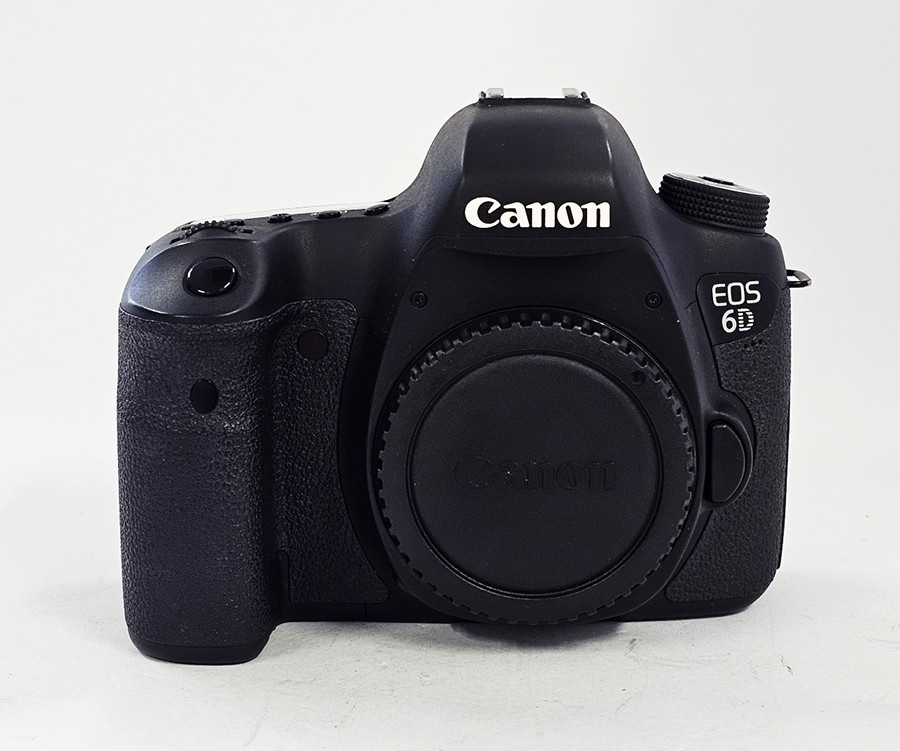
Canon EOS 6D (2012)
At 760g with battery and card, it slips into your hand like a secret — the lightest full-frame DSLR ever made.
Overview
The Canon EOS 6D isn't trying to win a spec sheet war. It’s not the fastest, doesn’t have the most autofocus points, and won’t shoot 4K video. But what it does — it does with quiet confidence. Released in 2012, this full-frame DSLR carved out a niche as Canon’s most accessible entry into full-frame imaging, slotting neatly between the high-end 5D Mark III and the APS-C crop-sensor models. Reviewers at the time called it the world’s smallest and lightest full-frame DSLR, and that distinction still holds weight. It’s a camera built for photographers who value portability without sacrificing sensor size, for those who’d rather carry a single body all day than swap gear every hour.
Despite its "budget" positioning, the 6D doesn’t feel like a compromise in the hand. The magnesium alloy chassis gives it heft where it counts, and the ergonomic grip makes it comfortable even with larger L-series lenses. The 3-inch fixed LCD screen is standard fare, but the real view comes through the optical pentaprism finder — 97% coverage, 0.71x magnification, and a 21mm eyepoint that makes it easy to use with glasses. It’s not as dense or feature-packed as the 5D Mark III, but owners report it shares the same 20.2MP full-frame CMOS sensor and DIGIC 5+ processor, meaning image quality is technically identical. That’s the magic: 95% of the flagship’s performance in a smaller, lighter, and significantly cheaper body.
It was also one of the first full-frame DSLRs to bake in Wi-Fi and GPS as standard — not as add-ons, but built right into the chassis. That connectivity felt forward-thinking in 2012, letting photographers geotag images or transfer files wirelessly without extra dongles. The mono mic and stereo mic jack offer basic audio control for video, though the 1080p recording is limited to 30-minute clips due to file partitioning at 4GB. Still, for documentary shooters, travelers, and event photographers, that blend of compact size, full-frame reach, and built-in networking made the 6D a sleeper hit.
Specifications
| Manufacturer | Canon |
| Model | EOS 6D |
| Type | Full-frame DSLR |
| Released | 2012 |
| Weight | 26.8 oz./760g with battery and card |
| Dimensions | 144.5 x 110.5 x 71.2 mm |
| Sensor | 24 x 36mm (actually 35.8mm x 23.9mm) full-frame CMOS |
| Resolution | 20.2MP |
| Native resolution | 5,472 x 3,648 pixels native |
| Image Processor | DIGIC 5+ |
| Lens Mount | Canon EF mount |
| Crop Factor | 1.0x |
| ISO range | ISO 100 ~ 25,600 (also whacko modes at ISO 50, ISO 51,200 and ISO 102,400) |
| Pixel pitch | 6.55 µm pitch |
| Converters | 14-bit converters |
| Color space | sRGB or Adobe RGB |
| Continuous shooting speed | 4.5 FPS |
| Video resolution | 1,920 x 1,080 at 29.97p, 23.976p or 25p |
| Video resolution | 1,280 x 720 at 59.94p or 50p |
| Video resolution | 640 x 480 at 59.94p or 50p |
| Video ISO | ISOs to ISO 12,800 |
| Video compression | Selectable all I-frame (bigger files for more precise editing) or I-P-B (smaller files) compression |
| Video recording limit | 4 GB automatic file partitioning (continuous recording time 30 minutes) |
| Viewfinder type | Pentaprism |
| Viewfinder coverage | 97% coverage |
| Viewfinder magnification | 71% magnification |
| Viewfinder eyepoint | 21mm eyepoint |
| Viewfinder diopter | -3 to +1 diopters |
| Viewfinder apparent angle | 33.3° apparent angle |
| Autofocus points | 11 AF points |
| Center AF point type | cross-type at f/5.6; vertical line-sensitive at f/2.8 |
| Upper/lower AF points | vertical line-sensitive AF at f/5.6 |
| Other 8 AF points | Horizontal line-sensitive AF at f/5.6 |
| Center AF sensitivity | rated to work from LV -3 ~ 18 at 73°F |
| Shutter speed | 1/4,000 top speed |
| Flash sync speed | 1/180 sync |
| Battery life | rated 1,090 versus 950 shots per charge |
| Storage | UHS-1 SD card compatible |
| Outputs | HDMI output (but no uncompressed live HDMI as do the newest Nikons) |
| Outputs | Analog PAL or NTSC video output |
| Audio (for video) | Mono mic. Stereo mic jack. Auto and Manual audio recording level control. Mono speaker. |
| Features | GPS. Wi-Fi |
| Features | Sensor cleaner |
| Features | Electronic level |
| Features | Interchangeable focus screens: Eg-A II provided. Interchangeable with Eg-D screen (grid) and Eg-S (special super-precision manual-focus screen for fast lenses). |
Key Features
20.2MP Full-Frame CMOS Sensor with DIGIC 5+ Processing
Image quality is where the 6D punches far above its class. The 20.2MP full-frame sensor delivers rich detail, smooth tonal transitions, and a dynamic range that holds up remarkably well even in high-contrast scenes. Paired with the DIGIC 5+ processor, files exhibit Canon’s signature color science — warm skin tones, vibrant greens, and excellent red reproduction. Reviewers noted that technical image quality is identical to the 5D Mark III, and that shots at ISO 25,600 still look usable, a testament to the sensor’s low-light capability. The 14-bit RAW files give post-processing plenty of headroom, especially in the shadows.
11-Point Autofocus System with Cross-Type Center
It’s not a 61-point array, and that’s fine. The 11-point AF system is deliberately simple, with a cross-type center point sensitive down to f/5.6 (and vertical line-sensitive at f/2.8), flanked by two vertical line-sensitive points above and below, and eight horizontal line-sensitive points on the sides. Some users prefer this minimalist layout — less clutter, faster decision-making. The center point works in low light as dim as LV -3, making it surprisingly capable in dimly lit churches or evening events. It won’t track fast sports, but for portraits, street shooting, and general use, it’s fast, accurate, and predictable.
Built-in Wi-Fi and GPS
In 2012, this was rare for a DSLR, especially at this price. The built-in Wi-Fi allowed direct image transfer to smartphones or tablets via Canon’s app, enabling quick social sharing or remote live-view shooting. The GPS module logged location data directly into EXIF, a boon for travel photographers. While the implementation was basic by today’s standards — no Bluetooth pairing, limited range — it eliminated the need for external accessories, keeping the camera’s profile clean and self-contained.
Interchangeable Focus Screens
A feature often stripped from mid-tier bodies, the 6D retains the ability to swap focus screens — a nod to serious photographers and manual focus enthusiasts. The Eg-A II screen comes standard, but owners can switch to the Eg-D grid screen for architectural work or the Eg-S super-precision screen optimized for fast lenses (f/2.8 or brighter). This flexibility is especially valuable for filmmakers or those using vintage glass, where precise manual focus is non-negotiable.
Compact Full-Frame Chassis with Pentaprism Viewfinder
At 144.5 x 110.5 x 71.2 mm and 760g with battery and card, the 6D remains the smallest and lightest full-frame DSLR Canon has ever made. The pentaprism viewfinder delivers a bright, clear optical image — a rarity in this size class, where pentamirrors are more common. Combined with the 21mm eyepoint and -3 to +1 diopter adjustment, it’s comfortable for extended use. The body feels dense, not plasticky, and the shutter sound is a satisfying mechanical thud, not a digital chirp.
Historical Context
The EOS 6D arrived in 2012 as Canon’s strategic answer to a growing demand for affordable full-frame cameras. It filled a gap between the entry-level 60D and the professional 5D Mark III, offering nearly the same image quality at a fraction of the cost. Positioned as the world’s second-best DSLR regardless of price — just behind the 5D Mark III — it was marketed as 95% of the flagship in a lighter, cheaper body. It also went head-to-head with the Nikon D600, which reviewers at the time judged as heavier, less refined in handling, and inferior in color rendition.
Collectibility & Value
Originally priced at about $1,399 after rebate around 2015, the 6D has steadily depreciated, now trading for a few hundred dollars on the used market. While not a collectible in the traditional sense, it remains a functional tool for photographers entering full-frame on a budget. However, Canon has announced that repair support for the EOS 6D will end on October 31, 2025, signaling the end of its service life. Despite rumors of discontinuation, Canon has stated the model remains officially available. Online forums still debate its relevance — “Is the 6D still worth it?” — a testament to its enduring utility, even as newer mirrorless models dominate.
eBay Listings



As an eBay Partner, we earn from qualifying purchases. This helps support our independent vintage technology research.