Canon EOS 5D Mark III (2012)
At 956g, it rests in the hands like a tool built to last—dense, deliberate, and humming with quiet confidence.
Overview
The Canon EOS 5D Mark III isn’t a camera that shouts. It doesn’t need to. Announced on 2 March 2012, it arrived as the direct successor to the legendary EOS 5D Mark II, a camera that had already rewritten the rules for digital cinematography and stills. This wasn’t a reinvention, but a refinement—one forged in magnesium alloy and tuned for photographers who shoot daily, under pressure, in unpredictable light. It carries a 22.3-megapixel full-frame sensor, sized at 36 × 24 mm, delivering resolution that balanced detail with file manageability at a time when pixel counts were beginning to spike. More than the numbers, owners report that the 5D Mark III excelled where it mattered: in its ability to produce smooth, clean, and color-accurate images across lighting conditions, especially at high ISOs.
Its 6 frames per second continuous shooting speed, while not class-leading, proved reliable in practice, particularly when paired with a fast CF card. Autofocus is where the camera truly stepped forward, adopting a 61-point system—41 of them cross-type at f/4, with five dual cross-type at f/2.8—borrowed from Canon’s flagship EOS-1D X. Reviewers at the time called it the most advanced AF system Canon had developed, a claim backed by real-world performance in dynamic scenarios. The ISO range starts at 100 and extends to 25,600 natively, expandable down to 50 and up to 102,800, giving shooters rare flexibility in dim environments. One owner noted shooting handheld at ISO 25,600 with slow f/4 zooms, a scenario that would have been unthinkable just a few years prior.
The 3.2-inch LCD, rated at 1040k dots, earned praise as “the best LCD ever put in a DSLR”—big, bold, bright, and color-accurate, with automatic brightness adjustment. It made reviewing images and live-view shooting a genuinely usable experience. The camera shares battery and charger compatibility with the 5D Mark II, a small but meaningful detail for existing Canon users upgrading their kit. Handling improvements were subtle but significant: a redesigned power switch that no longer accidentally turned off, and repositioned depth-of-field preview and programmable playback buttons within easy reach of the shooting hand. These weren’t flashy upgrades, but the kind of ergonomic tweaks that matter after 10 hours in the field.
Specifications
| Manufacturer | Canon |
| Product type | Full-frame digital SLR (DSLR) Camera Body |
| Sensor | Full-Frame (36 × 24 mm) |
| Sensor Resolution | 22.3 megapixel (5760 × 3840) |
| Continuous shooting speed | 6 FPS |
| Video | HD & HDR (1920 x 1080 at 29.97, 25, 23.976 fps; 1280 x 720 at 59.94, 50 fps) |
| Weight | 956g (33.7 oz) with battery and card |
| ISO range | 100 – 25,600 (expandable to 50 – 102,800) |
| Autofocus System | 61-point autofocus system |
| LCD description | 1040k dot, 3.2" LCD screen; "the best LCD ever put in a DSLR... big, bold, bright, sharp, clear, colorful and accurate, and automatically varies its brightness" |
| Body Materials | Magnesium Alloy body covers |
Key Features
61-Point Autofocus System from the EOS-1D X
The 5D Mark III marked a turning point in Canon’s mid-tier full-frame line by inheriting the 61-point autofocus system from the professional-grade EOS-1D X. This wasn’t just more points—it was smarter coverage, with 41 cross-type sensors sensitive to f/4 and five dual cross-type at f/2.8, enabling precise tracking even with shallow depth of field. Reviewers at the time emphasized that this system made autofocus the most compelling feature of the camera, particularly for action, sports, and event photographers who needed reliability without stepping up to the 1D series.
Lens Aberration Correction in Camera
For the first time in a Canon full-frame DSLR, the 5D Mark III introduced in-body correction for lens color fringes—specifically longitudinal and lateral chromatic aberration. This meant shooters could reduce post-processing time by having the camera automatically compensate for common optical flaws, especially when using older or third-party lenses. It wasn’t a magic fix, but it was a meaningful step toward cleaner out-of-camera files, particularly in high-contrast scenes.
Ergonomic Redesign for Real-World Use
Canon listened to working photographers. The power switch was redesigned to prevent accidental shutdowns—a notorious flaw in earlier models. The depth-of-field preview button was relocated, and a programmable playback button was added within thumb’s reach on the back. These changes may seem minor on paper, but in practice, they reduced fumbling and improved workflow efficiency. Combined with the shared battery system from the 5D Mark II, the Mark III felt like a camera built for continuity and comfort, not just specs.
High-ISO Performance That Changed Shooting Habits
The ISO 100–25,600 range (expandable to 102,800) wasn’t just marketing theater. Users reported successfully shooting handheld in near-dark conditions using older, slower lenses—something that previously required tripods or flash. One owner noted that shooting at ISO 25,600 with f/4 zooms became routine, allowing them to ditch heavier L-series glass in favor of lighter alternatives, reducing overall kit weight and increasing mobility. This level of high-ISO usability made the 5D Mark III a favorite among photojournalists and wedding shooters working in dimly lit venues.
Historical Context
The EOS 5D Mark III was designed to succeed the highly acclaimed EOS 5D Mark II, which had been released in November 2008 and gained fame for its full-frame video capabilities. While the Mark II had revolutionized indie filmmaking, it suffered from autofocus limitations in live view and a relatively slow burst rate. The Mark III addressed these weaknesses head-on, prioritizing stills performance with a faster processor, improved AF, and better high-ISO response. It occupied a critical middle ground—more capable than the 6D, less specialized than the 1D X, and more refined than the 5D Mark II. Though the later 5DS and 5DS R offered higher resolution, they did so at the cost of speed and handling, making the Mark III a preferred choice for many professionals who valued responsiveness over megapixels.
Collectibility & Value
When new, the Canon EOS 5D Mark III carried a body-only price of $3,499, positioning it as a serious investment for working photographers. As of October 2025, new units are listed at $1,249 on Amazon—a sign of discounted overstock rather than active production—while used models range from $299 to $562, depending on condition and included accessories. Battery life remains a practical strength; one owner reported achieving 1,200 shots per charge using a two-year-old spare battery from a 5D Mark II, underscoring the camera’s efficiency and compatibility. While no widespread failure modes are documented in the fact sheet, its robust magnesium alloy construction and conservative design have contributed to long-term reliability in the field.
eBay Listings
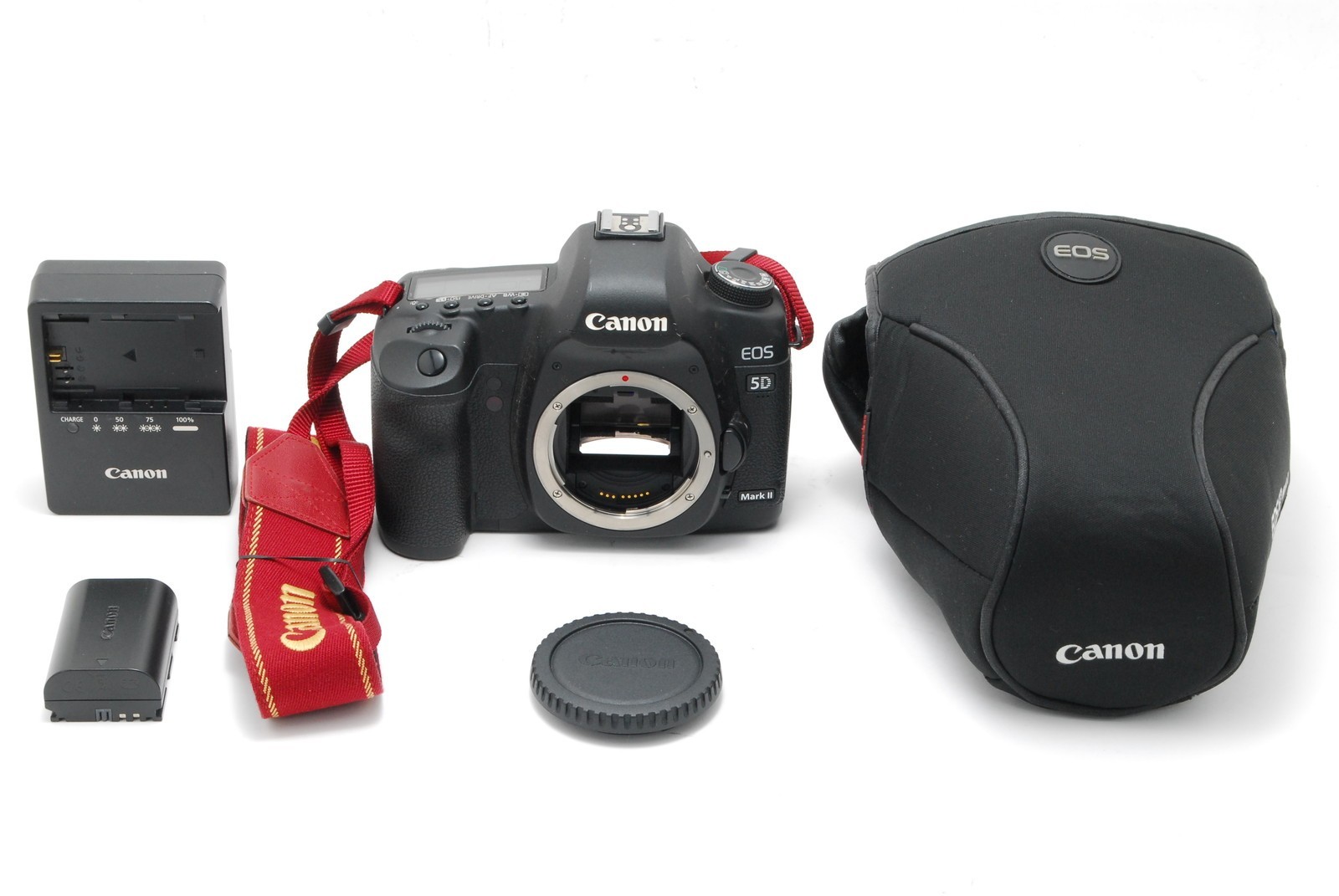
As an eBay Partner, we earn from qualifying purchases. This helps support our independent vintage technology research.