CANON EOS 5
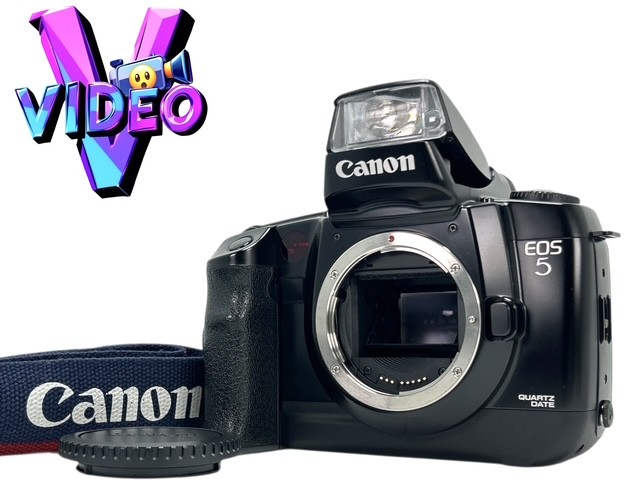
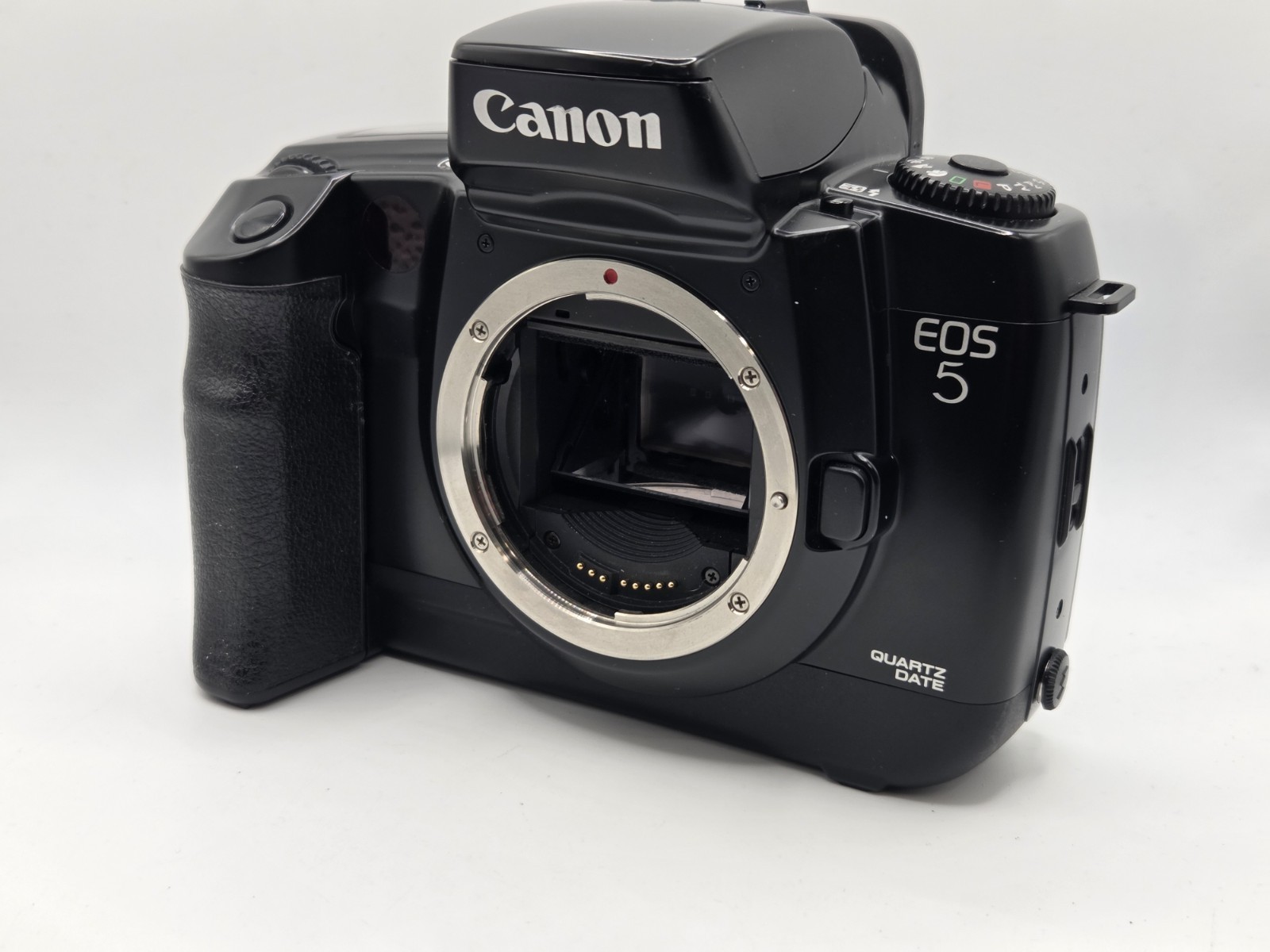
The Canon EOS 5, known as the EOS A2 in North America, is a 35mm advanced semi-professional autofocus single-lens reflex (SLR) camera introduced in 1992. It represents a significant technological leap in Canon’s EOS line, most notably for being the first widely available Canon SLR to feature eye-controlled focusing, a system that allows the photographer to select autofocus points simply by looking through the viewfinder.
Overview
Launched in November 1992, the Canon EOS 5 was positioned between the enthusiast-level EOS 10 and the professional EOS-1, serving as Canon’s flagship autofocus SLR for advanced amateurs and semi-professionals before the release of the EOS 50 (A2e) in 1998. Built around Canon’s EF lens mount and fully electronic EF communication protocol, the EOS 5 offered a robust magnesium alloy chassis with polycarbonate composite construction, delivering durability without the full weight of a professional body. It was designed to appeal to serious photographers seeking advanced features, fast handling, and cutting-edge autofocus technology in a more compact and affordable package than the EOS-1.
The EOS 5’s defining innovation was its eye-controlled focusing system, which used infrared sensors within the viewfinder to detect the direction of the photographer’s gaze and automatically select one of five AF points. This system, derived from Canon’s experimental EOS AEO (1987), was refined for practical use and offered a novel method of AF point selection that reduced the need to take the eye from the viewfinder to manually adjust focus points. The camera also featured predictive AI Servo autofocus, essential for sports and action photography, and supported all EF lenses, including ultrasonic (USM) and macro optics.
With a top shutter speed of 1/8000 second, flash sync at 1/250 second, and a continuous shooting rate of 3.5 frames per second (up to 5 fps with the optional PB-E1 Power Booster), the EOS 5 provided performance close to professional standards. It supported TTL flash metering with Canon’s EX-series Speedlites and offered comprehensive exposure modes, including Program, Shutter Priority, Aperture Priority, Manual, and Depth-of-Field Priority AE. Its pentaprism viewfinder provided 94% coverage with a fixed focusing screen and optional interchangeable screens via the EC series inserts.
Specifications
| Specification | Value |
| Type | Autofocus 35mm SLR |
| Film Format | 35mm (135) |
| Years Produced | 1992–1998 |
| Lens Mount | Canon EF (fully electronic) |
| Shutter | Vertical-travel, electronically controlled focal-plane; 30 seconds to 1/8000 second, plus Bulb |
| Metering | TTL full-aperture metering with 6-zone evaluative, center-weighted average, and partial (9.5% at center) |
| Exposure Modes | Program AE (with shift), Shutter Priority, Aperture Priority, Manual, Depth-of-Field AE, Flash Exposure Lock |
| Viewfinder | Fixed eye-level pentaprism with 94% coverage and 0.75x magnification (with 50mm lens at ∞) |
| Dimensions | 157 × 119 × 72 mm (6.2 × 4.7 × 2.8 in); ~795 g (28.0 oz) with battery |
Key Features
- Eye-Controlled Focusing: Uses infrared sensors to detect the photographer’s gaze and select one of five AF points—revolutionary for its time and a precursor to modern eye-tracking systems.
- 5-Point AF System: Center cross-type sensor for improved accuracy, with selectable single or all-point AF; supports AI Servo predictive tracking.
- High-Speed Performance: 3.5 fps continuous shooting (5 fps with PB-E1 Power Booster Grip), 1/8000 sec shutter, and 1/250 sec flash sync.
- Comprehensive Exposure System: Multiple metering modes and exposure programs, including Depth-of-Field AE for automatic aperture selection based on desired sharpness.
- Customizable Controls: 13 customizable functions (C.Fn), including AF tracking sensitivity, shutter/AE lock behavior, and eye control calibration.
Historical Context
The Canon EOS 5 was released during a pivotal period in SLR development, as manufacturers raced to integrate advanced electronics, faster autofocus, and user-friendly automation into film cameras. Canon had already established leadership with the 1987 introduction of the EF mount and fully electronic lens communication. The EOS 5 built on this foundation by targeting photographers who wanted near-professional performance without the premium cost of the EOS-1. It competed directly with Nikon’s F-801 (N8008), Minolta’s Maxxum 7000i, and Pentax’s SFX/SF7, all of which featured advanced autofocus and automation.
Despite its innovative eye-control system, the technology was met with mixed reception. Some photographers praised its speed and intuitiveness, while others found it unreliable in low light or with eyeglasses. Nevertheless, the EOS 5 was critically acclaimed for its robust build, accurate metering, and fast handling. It served as a technological testbed—many of its features, including refined eye control, later appeared in the EOS 3 (1998) and influenced Canon’s DSLR development into the 2000s.
Collectibility & Value
Today, the Canon EOS 5 is a sought-after model among film photography enthusiasts and Canon collectors, particularly for its historical significance as the first mainstream eye-control SLR. While not as rare as limited editions or professional flagships, well-maintained examples in good working condition typically sell for $150–$300, depending on accessories and included power booster. Units with the PB-E1 grip command a premium due to their enhanced shooting speed and vertical controls.
When purchasing an EOS 5, buyers should verify the functionality of the eye-control system, which can degrade if the infrared emitter or sensor is dirty or damaged. Common issues include worn shutter mechanisms (especially in heavily used bodies), sticky buttons, and degraded light seals. The camera uses a 6V 2CR5 lithium battery (or two AA batteries via adapter), which powers both camera functions and the LCD. Battery compartment corrosion is a known issue if old batteries are left inside. As with all late-1990s Canon SLRs, the internal capacitors may need replacement to ensure reliable operation.
Similar Cameras
- Nikon F-801 (N8008) – Nikon’s high-end amateur SLR with advanced AF and matrix metering.
- Minolta Maxxum 7000i – Feature-rich autofocus SLR with card-based programming.
- Pentax SFX/SF7 – Rugged, weather-sealed SLR with autofocus and TTL flash.
- Olympus OM-4Ti – Professional manual-focus SLR with advanced metering (for enthusiasts preferring mechanical control).
- Canon EOS-1 – Professional counterpart with faster performance and better sealing, but without eye control.
Repair & Maintenance
The Canon EOS 5 uses a 2CR5 6V lithium battery or a BP-5 battery pack with two AA cells. Battery life is approximately 60 rolls of film (24-exposure) under normal use. Common maintenance issues include worn shutter assemblies, degraded light seals (which should be replaced every 10–15 years), and malfunctioning eye-control sensors due to dust or aging components. The camera’s electronic complexity makes DIY repairs challenging; professional servicing by a technician experienced with Canon’s late-1990s SLRs is recommended. The PB-E1 Power Booster Grip adds vertical shutter and AF-ON buttons and improves handling but requires four AA batteries and may develop contact corrosion over time. Regular cleaning of the mirror box, focusing screen, and lens contacts is advised to maintain optimal performance.
eBay Listings


As an eBay Partner, we earn from qualifying purchases. This helps support our independent vintage technology research.
Service Manuals, Schematics & Catalogs
- Catalog (1991) — archive.org
Related Models
- Canon A-1 (1978-1985)
- Canon AE-1 Program (1981-1984)
- Canon AE-1 (1976-1984)
- Canon AL-1 (1982-1985)
- Canon AT-1 (1977-1982)
- Alpa 6 (1948-1953)
- Agfa Agfaflex
- Agfa Ambiflex
- Agfa Easy
- Agfa Futura Af zoom