CANON CANONET QL19
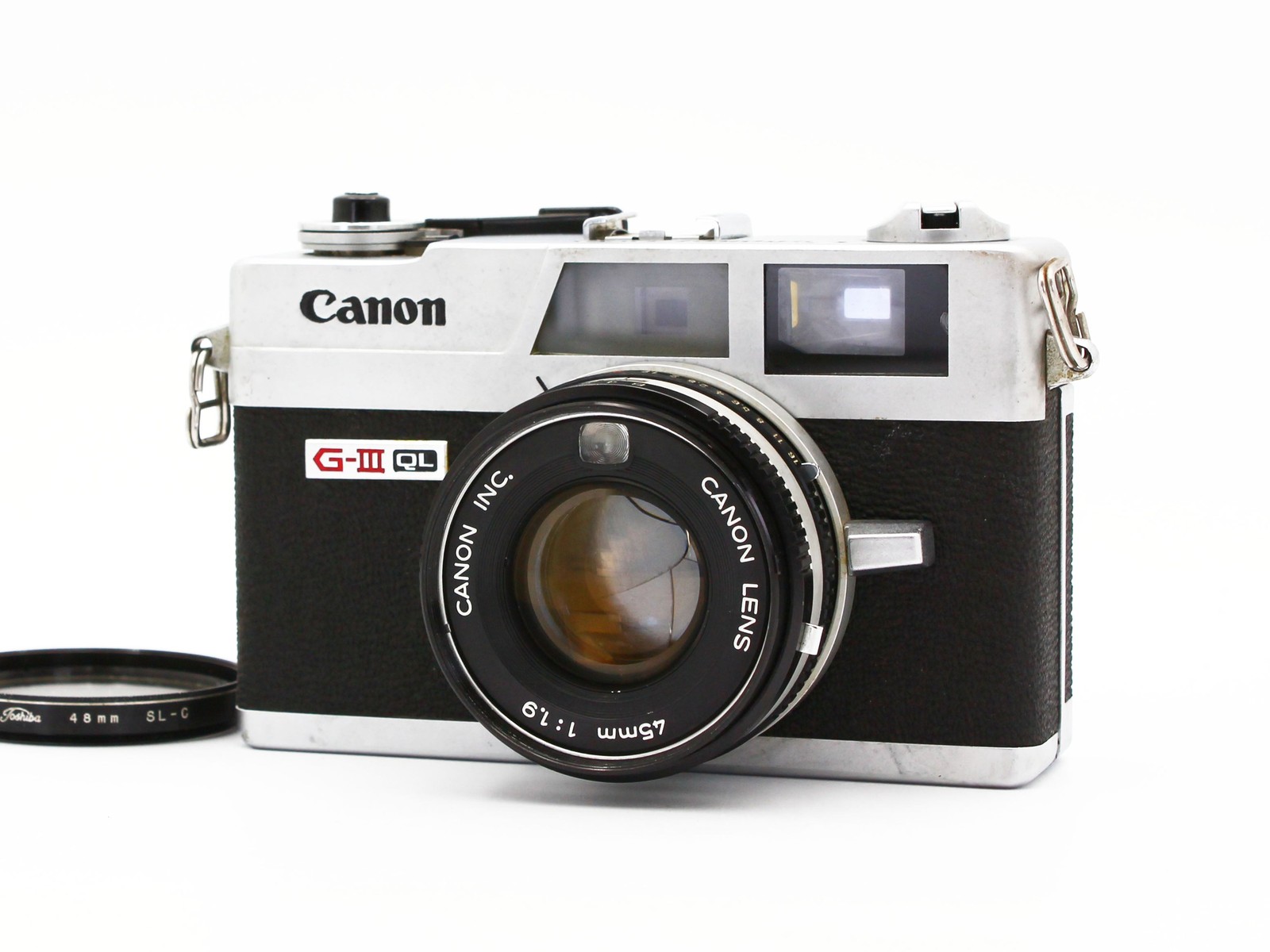
The Canon Canonet QL19 is a compact, fixed-lens 35mm rangefinder camera introduced by Canon in 1965 as part of its mid-tier Canonet series. Designed for advanced amateurs and photo enthusiasts, it combines a fast 45mm f/1.9 lens with a built-in CdS exposure meter and Canon’s proprietary Quick Load film-loading system, offering a balance of automation, optical quality, and mechanical reliability.
Overview
Released in October 1965, the Canonet QL19 was positioned between the entry-level Canonet QL17 and the high-end Canonet G-III QL17, serving as a mid-range option with a faster lens. The "QL" in its name denotes Canon’s Quick Load system, a user-friendly film-loading mechanism that eliminated the need to manually thread the film leader onto the take-up spool—a significant innovation at the time. The QL19 features a fixed, non-interchangeable Canon FL 45mm f/1.9 lens, which provides excellent low-light performance and shallow depth-of-field capabilities, making it particularly appealing for available-light photography and street use.
The camera employs a vertically traveling, focal-plane cloth shutter with speeds from 1 second to 1/500th of a second, plus Bulb mode. Shutter speed and aperture are set manually, but the built-in center-weighted CdS (Cadmium Sulfide) light meter assists in achieving correct exposure via a match-needle system visible in the viewfinder. This semi-automatic exposure guidance was advanced for its class and contributed to the camera’s reputation for precision and ease of use. The QL19 was manufactured until 1972, when declining demand for rangefinder cameras in favor of SLRs led to the discontinuation of the Canonet line.
Specifications
| Specification | Value |
| Type | Rangefinder |
| Film Format | 35mm (135 cartridge) |
| Years Produced | 1965–1972 |
| Lens Mount | Fixed FL 45mm f/1.9 (non-interchangeable) |
| Shutter | Focal-plane cloth shutter; 1 sec – 1/500 sec + B |
| Metering | Built-in CdS (Cadmium Sulfide) center-weighted meter |
| Exposure Modes | Manual with metered assistance (match-needle) |
| Viewfinder | Combined rangefinder viewfinder with brightline frames and exposure needle |
| Dimensions | 139 × 80 × 55 mm; ~650 g (body with lens) |
Key Features
- Canon FL 45mm f/1.9 Lens: A fast, high-quality prime lens ideal for low-light shooting and subject isolation, offering superior performance compared to the f/2.8 and f/3.5 lenses on competing compact rangefinders.
- Quick Load (QL) System: Patented film-loading mechanism allowing users to drop the film cartridge into the chamber and close the back—the camera automatically engages the take-up spool and advances to the first frame.
- Integrated CdS Light Meter: Center-weighted, through-the-lens metering system with a match-needle display in the viewfinder, enabling precise exposure settings under variable lighting.
- Rangefinder Focusing with Parallax Compensation: Manual focus via a coupled rangefinder patch with automatic parallax correction indicated in the viewfinder.
- Compact and Durable Chassis: All-metal body with leatherette covering, designed for portability and long-term mechanical reliability.
Historical Context
The Canonet QL19 was launched during a transitional period in 35mm photography, as compact rangefinders faced increasing competition from emerging single-lens reflex (SLR) cameras. Canon introduced the Canonet series to capture the growing market of amateur photographers who desired high-quality optics and advanced features without the complexity and bulk of SLRs. The QL19 specifically targeted users who needed a faster lens than the QL17’s f/2.8, particularly for indoor or evening photography, while still benefiting from the simplicity of the Quick Load system.
At the time, competitors such as Minolta’s Hi-Matic series, Yashica’s Electro 35, and Olympus’s 35 series offered similar semi-automatic 35mm rangefinders, but few matched the QL19’s combination of speed, metering accuracy, and build quality. The QL19 was particularly popular among photojournalists and street photographers who valued its discreet size and fast lens. However, by the early 1970s, the rise of through-the-lens metering SLRs like the Canon FX and later the AE-1 began to erode the market for rangefinder cameras, leading to the QL19’s discontinuation in 1972.
Collectibility & Value
Today, the Canonet QL19 is a sought-after model among vintage camera collectors, particularly those interested in compact rangefinders with fast lenses. While less common than the QL17, the QL19 commands a moderate premium due to its superior optics and rarity. In good working condition, prices typically range from $250 to $450, with fully serviced examples or those in mint cosmetic condition occasionally exceeding $500. Collectors prioritize cameras with clean viewfinders, accurate shutter speeds, and responsive metering.
When purchasing a QL19, potential buyers should inspect the lens for haze, fungus, or scratches, as the FL 45mm f/1.9 is not easily replaceable. The CdS meter requires a single PX625 (1.35V) mercury battery, now obsolete, though modern equivalents or adapters (e.g., Wein Cell) can be used. Shutter reliability is generally high, but worn shutter curtains or timing inaccuracies at slow speeds are common in untested units. The film advance mechanism and rewind crank should operate smoothly, and the rangefinder alignment must be checked for accurate focusing.
Similar Cameras
- Minolta Hi-Matic 7s: 35mm rangefinder with 45mm f/1.8 lens and CdS meter; comparable speed and build quality.
- Yashica Electro 35 GSN: Compact 35mm rangefinder with 45mm f/1.7 lens and aperture-priority automation.
- Olympus 35 SP: Rangefinder with 42mm f/1.7 Zuiko lens and spot-metering capability.
- Canonet G-III QL17: Higher-end Canonet with 40mm f/1.7 lens and improved viewfinder.
- Konica Auto-S 35: 40mm f/1.8 rangefinder with full-aperture metering and compact design.
Repair & Maintenance
The Canonet QL19 uses a PX625 (1.35V) mercury battery to power its CdS meter, though modern zinc-air replacements (e.g., Wein Cell MRB625) or voltage adapters with 1.5V alkaline batteries can be used with minor exposure compensation. The shutter is mechanically operated and does not require batteries, ensuring continued functionality even with a dead meter. Common issues include sluggish shutter speeds due to dried lubricants, especially at 1/30 sec or slower, and inaccurate meter readings from aging CdS cells.
Servicing typically involves a full CLA (Clean, Lubricate, Adjust) by a technician experienced with vintage Canonets. The rangefinder requires precise calibration, and the film transport mechanism may need cleaning to prevent double-exposures or film jams. The viewfinder can suffer from darkening or haze over time, particularly in humid environments. With proper care, the QL19 remains a reliable and capable film camera, suitable for regular use and capable of producing excellent image quality with modern 35mm films.
eBay Listings



As an eBay Partner, we earn from qualifying purchases. This helps support our independent vintage technology research.
Service Manuals, Schematics & Catalogs
- Catalog (1991) — archive.org
- Catalog (1991) — archive.org