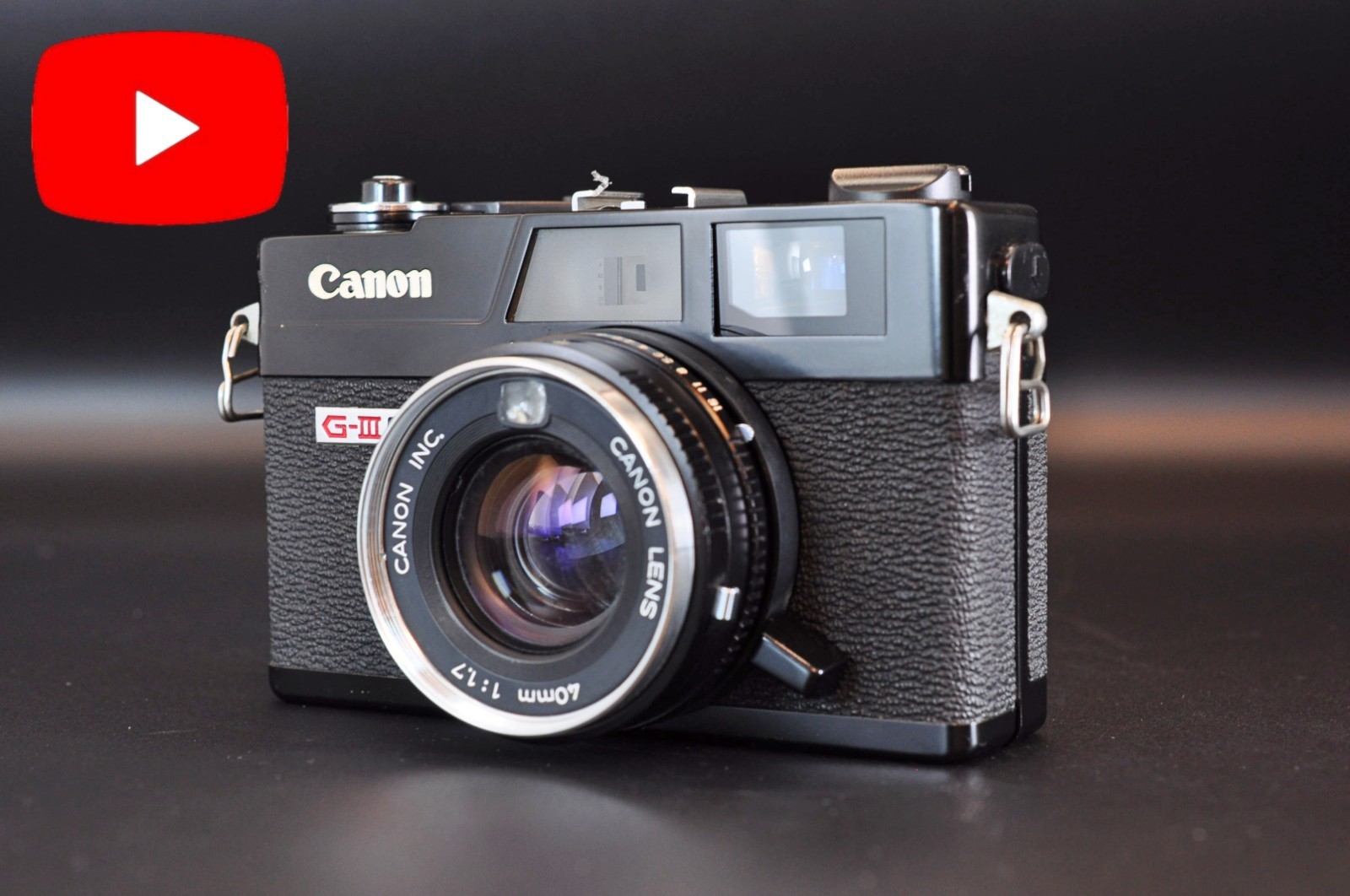
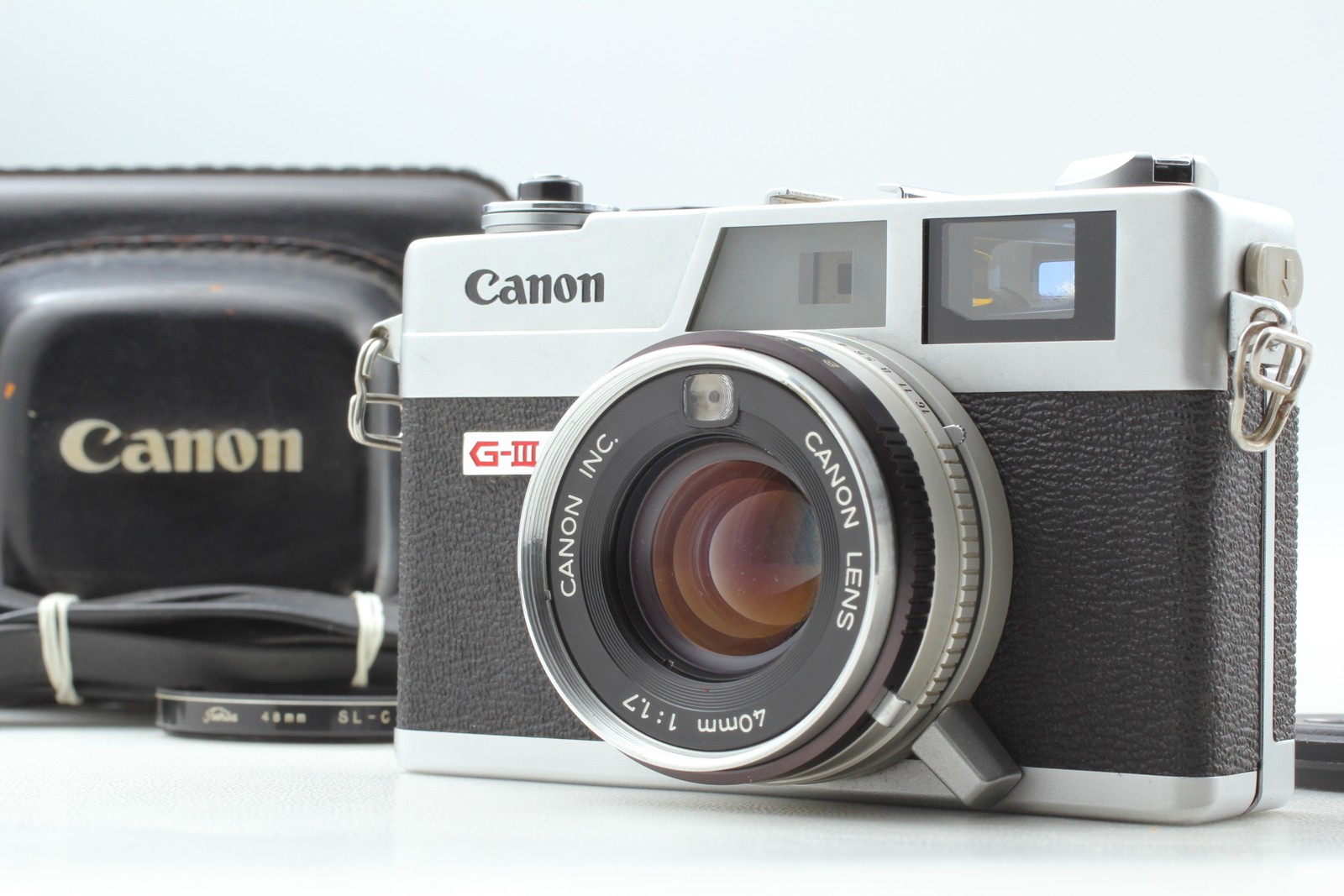
CANON CANONET QL17 GIII
The Canon Canonet QL17 GIII is a compact 35mm rangefinder camera introduced in 1972 as the final and most refined iteration of Canon’s successful Canonet QL17 series. Renowned for its fast 40mm f/1.7 lens, intuitive operation, and robust build quality, it became one of the most popular rangefinder cameras of the 1970s, .
Overview
Released in 1972, the Canonet QL17 GIII represented the culmination of Canon’s efforts to create a high-performance, compact 35mm rangefinder camera for advanced amateur and professional photographers seeking an alternative to bulkier SLRs. Positioned as a premium compact, it combined a fast lens, reliable CdS (cadmium sulfide) center-weighted light meter, and a rapid film-loading mechanism in a sleek, all-metal body. The "QL" in the name stands for "Quick Loading," a proprietary system that allowed users to load film in seconds without threading the leader—a significant usability improvement over contemporary models.
The QL17 GIII succeeded the earlier QL17 GII and incorporated several refinements, including a redesigned shutter speed dial, improved metering circuitry, and a more ergonomic film advance lever. It was marketed as a precision instrument for low-light photography and street photography, thanks to its bright f/1.7 lens and quiet leaf shutter. Despite the rise of SLRs during this period, the QL17 GIII maintained strong sales due to its compact size, optical quality, and ease of use. It was part of Canon’s broader strategy to dominate the rangefinder market before transitioning fully to SLR systems in the late 1970s.
Specifications
| Specification | Value |
| Type | Rangefinder |
| Film Format | 35mm |
| Years Produced | 1972–1982 |
| Lens Mount | Fixed Canon 40mm f/1.7 Lens (not interchangeable) |
| Shutter | Seiko-MXV Leaf Shutter; speeds 1 sec to 1/500 sec + B, with self-timer |
| Metering | CdS (Cadmium Sulfide) Center-Weighted Off-The-Film (OTF) Metering (not TTL) |
| Exposure Modes | Manual with Aperture Priority Auto Exposure (AE Lock via stop-down lever) |
| Viewfinder | Combined Rangefinder and Framing Viewfinder with Parallax Correction, Brightline Frames for 40mm |
| Dimensions | 138 × 80 × 55 mm; Weight: ~580 g (body only, without battery) |
Key Features
- 40mm f/1.7 Canon Lens: A high-speed, six-element, five-group lens (designated "Canon FL 40mm f/1.7") offering excellent sharpness and low-light performance, with a minimum focusing distance of 1 meter.
- Quick Load (QL) System: Allows film insertion by simply placing the leader into a slot—camera automatically advances to the first frame, reducing loading time and risk of film damage.
- Aperture-Priority Auto Exposure: Offers aperture-priority auto exposure; user sets aperture, camera selects shutter speed (indicated by needle in viewfinder).
- Integrated TTL CdS Metering: Center-weighted metering with a selenium cell supplement for low-light accuracy; powered by a single PX625 1.35V mercury battery (now replaced by Wein Cell or adapter).
- Robust Mechanical Construction: All-metal chassis with precision leaf shutter and durable film transport mechanism, designed for long-term reliability.
Historical Context
The Canonet QL17 GIII was launched at a pivotal moment in photographic history. By the early 1970s, SLRs were gaining dominance due to their versatility and interchangeable lenses, yet many photographers still valued the compactness, quiet operation, and zone-focusing capabilities of rangefinders—especially for street and reportage work. Canon, having established itself with earlier Canonet models since 1961, refined the formula with the QL17 series to offer a modern, metered rangefinder that could compete with Leica and Nikon in optical quality while being significantly more affordable.
The QL17 GIII faced competition from models like the Minolta Hi-Matic series and the Yashica Electro 35 line. However, its combination of a faster lens (f/1.7 vs. typical f/2.8 on rivals), accurate metering, and compact size gave it a distinct edge. It was particularly popular among photojournalists, students, and travelers. Canon discontinued the model in 1982 as autofocus compact cameras began to emerge, marking the end of an era for high-end manual rangefinders.
Collectibility & Value
Today, the Canonet QL17 GIII is a sought-after classic among film photography enthusiasts and collectors. While not rare due to its high production volume (over 1.2 million units), well-maintained examples in good working condition command strong prices—typically ranging from $100 to $200 USD on the used market, with fully serviced or mint examples sometimes reaching $250. Cameras with clean lenses, accurate metering, and smooth shutter operation are especially desirable.
When purchasing, buyers should inspect for common issues: cloudy or scratched lenses (especially the front element), fungus, inaccurate or non-functional light meters (often due to obsolete mercury batteries), and shutter timing inconsistencies at slower speeds. The CdS cell can degrade over time, leading to underexposure. Additionally, the film advance mechanism may require cleaning or lubrication after decades of use. Despite these age-related concerns, the QL17 GIII remains relatively serviceable, with many repair technicians familiar with its mechanics.
Similar Cameras
- Minolta Hi-Matic 7s: 35mm rangefinder with f/1.8 lens and TTL metering; comparable size and target market.
- Yashica Electro 35 GSN: Compact 35mm rangefinder with f/1.7 lens and aperture-priority AE; direct competitor with similar specs.
- Nikon L35AF: Late-1980s autofocus compact with 35mm f/2.8 lens; represents the next generation of premium compacts.
- Leica CL: M-mount rangefinder with interchangeable lenses; higher-end alternative for enthusiasts.
- Konica C35 FD: Compact autofocus 35mm with f/1.8 lens; Japanese competitor from the late 1970s.
Repair & Maintenance
The Canonet QL17 GIII uses a single PX625 (1.35V) mercury battery, now obsolete. Modern substitutes include the Wein Cell MRB625 (zinc-air, 1.35V) or alkaline adapters with voltage regulation to prevent meter inaccuracy. The camera’s CdS meter is sensitive to voltage fluctuations, so proper battery replacement is critical. Common mechanical issues include sticky shutter curtains at slow speeds (1–1/30 sec), worn film sprockets, and misaligned rangefinder calibration. Shutter servicing requires disassembly by a technician experienced with Copal Square shutters. Lubrication of the film transport and advance mechanism is recommended during CLA (clean, lubricate, adjust) services. With proper care, the QL17 GIII remains a reliable and enjoyable camera for contemporary film users.
eBay Listings


As an eBay Partner, we earn from qualifying purchases. This helps support our independent vintage technology research.
Service Manuals, Schematics & Catalogs
- Catalog (1991) — archive.org
- Catalog (1991) — archive.org