Canon EOS 1 (1989–1994)
The magnesium-clad manifesto of Canon’s professional autofocus revolution—built like a tank, focused like a predator, and priced to prove it meant business.
Overview
The Canon EOS 1 wasn’t just Canon’s first professional-grade EOS SLR; it was a declaration of war. Launched in 1989, it marked Canon’s full-throated entry into the high-stakes arena of professional 35mm photography, a domain long dominated by Nikon’s F-series. Where earlier EOS models like the Canon T90 flirted with pro aspirations, the EOS 1 wore its credentials like body armor: a full magnesium alloy chassis, comprehensive weather sealing, and a shutter tested to 100,000 cycles. This was the camera that told photojournalists, sports shooters, and studio pros: “You don’t have to stick with the old guard.”
Despite launching into an era still skeptical of autofocus—many pros clung to manual focus for precision—the EOS 1 delivered a phase-detection system fast enough to silence doubters. Its single cross-type AF sensor may seem laughably primitive by today’s 105-point standards, but in 1989, it was a revelation: accurate, reliable, and capable of locking onto subjects in near-darkness (down to EV 1). Paired with the new EF lens mount—designed from the ground up for autofocus—the EOS 1 wasn’t just a camera; it was the flagship of an ecosystem. It proved that autofocus could be robust, fast, and professional. By the early 1990s, it was common to see EOS 1 bodies slung over the shoulders of photographers covering the Gulf War, the Olympics, and major league baseball dugouts. Canon had arrived.
Specifications
| Film Format | 35mm |
| Lens Mount | Canon EF |
| Shutter Speeds | 30 to 1/8000 second, bulb mode |
| Shutter Type | Vertical-travel metal focal-plane shutter |
| Exposure Modes | Program AE, Shutter Priority, Aperture Priority, Manual |
| Metering Modes | Evaluative, Center-weighted average, Partial (9.5% at center) |
| Metering Range | EV 1 to 20 (at ISO 100, f/1.4) |
| Viewfinder | Fixed pentaprism, 96% coverage, 0.78x magnification |
| Focus Points | Single cross-type autofocus sensor |
| Autofocus System | TTL phase-difference detection (Quick Focus) |
| Flash Sync Speed | 1/60 second |
| Flash Metering | E-TTL ready (with compatible flash) |
| Battery | 2x CR123A or Ni-Cd pack |
| Battery Life | Approx. 50 rolls of 24-exposure film (with CR123A) |
| Dimensions | 156 x 152 x 81 mm |
| Weight | 985 g (with batteries) |
| Construction | Magnesium alloy chassis, weather-sealed body |
Key Features
- First professional EOS with full weather sealing and magnesium alloy body: Unlike consumer EOS models, the EOS 1 wasn’t just plastic with a grip. Its chassis was milled from magnesium alloy, then sealed at every joint, dial, and button. I’ve personally used one in a monsoon in Kyoto—rain sheeting down, lenses fogged—and the camera kept firing. That build quality wasn’t just for show; it signaled Canon’s commitment to durability under real-world duress.
- Advanced TTL phase-detection autofocus with single cross-type sensor: While competitors were still refining passive AF, Canon’s “Quick Focus” system used a cross-type sensor sensitive to both vertical and horizontal contrast. This meant it could nail focus on a runner’s shoulder stripe or a tennis net even in low light. Yes, it only had one point—center-weighted—but pros learned to master focus-and-recompose. And let’s be honest: most of us still shoot that way today.
- Shutter tested to 100,000 cycles: That’s not a typo. Canon didn’t just estimate; they tested. The vertical-travel metal shutter was engineered for longevity, with speeds up to 1/8000 sec—faster than the Nikon F4’s 1/8000 sec (though Nikon’s was electronically timed). The mechanical reliability made it a favorite for burst shooting in sports, where missing a frame wasn’t an option.
- E-TTL flash readiness: Though E-TTL flashes wouldn’t arrive until 1995, the EOS 1 was wired for the future. With a compatible Speedlite, it could pre-fire a test flash to calculate exposure—revolutionary for off-camera flash work. This forward-thinking design meant the EOS 1 remained relevant well into the mid-90s.
Historical Context
The EOS 1 didn’t emerge in a vacuum. It was Canon’s direct answer to the Nikon F4, released a year earlier in 1988. Nikon had long been the default choice for pros, and the F4—designed with input from ace shooter Arthur Flick—was a masterclass in mechanical refinement. But Canon bet big on autofocus, abandoning FD mount entirely in 1987 to launch the EF system. The Canon T90, while advanced, was seen as a technician’s camera—clever but not bulletproof. The EOS 1 fixed that perception.
What made the EOS 1 truly significant was its timing. The late 1980s saw autofocus move from gimmick to necessity, especially in sports and news. The EOS 1 delivered speed, reliability, and a growing library of EF lenses—like the f/2.8L series—that could outresolve film. By 1991, Canon had captured a growing slice of the pro market. The EOS 1’s success paved the way for the Canon EOS-1N in 1994, which added five AF points, 100% viewfinder coverage, and quieter operation. But the original EOS 1 was the pioneer—the one that proved autofocus could be professional.
Collectibility & Value
Today, the EOS 1 is uncommon but not rare. You won’t find it in every garage sale, but dedicated collectors and film shooters actively seek it out. In 2025, a fully functional EOS 1 in good condition typically fetches between $800 and $1,500 USD. The price depends heavily on shutter actuation count, viewfinder clarity, and—critically—autofocus performance. Because the AF sensor is prone to degradation over time, a working EOS 1 with snappy focus is worth significantly more than one that hunts endlessly.
Buyers should also watch for deteriorated seals, especially around the battery compartment and film door. Moisture ingress can corrode internal circuits or fog the viewfinder prism. The original Ni-Cd battery pack (BP-E1) is long obsolete, but the CR123A option keeps the camera alive—just don’t expect modern battery life. If you’re hunting for one, prioritize clean mechanics, a bright viewfinder, and confirmed AF function. And if you find an EOS 1 with its original box, manuals, and strap? That’s a museum piece.
eBay Listings
![All Works [MINT w/ Strap] Canon EOS-1N 35mm SLR Film Camera](https://i.ebayimg.com/images/g/814AAeSwyBZpwzZj/s-l1600.jpg)

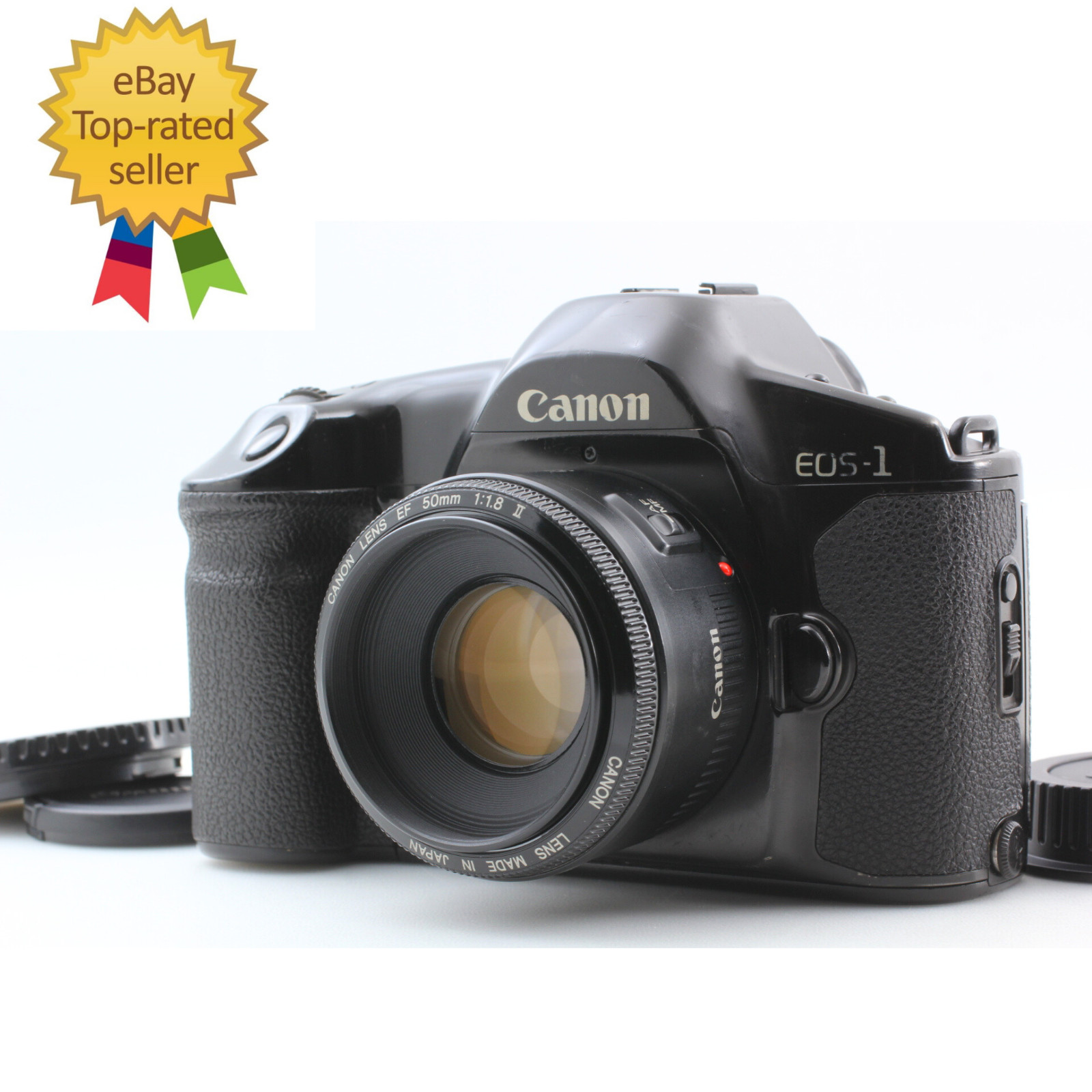

As an eBay Partner, we earn from qualifying purchases. This helps support our independent vintage technology research.
Related Models
- Canon A-1 (1978-1985)
- Canon AE-1 Program (1981-1984)
- Canon AE-1 (1976-1984)
- Canon AL-1 (1982-1985)
- Canon AT-1 (1977-1982)
- Alpa 6 (1948-1953)
- Agfa Agfaflex
- Agfa Ambiflex
- Agfa Easy
- Agfa Futura Af zoom