CANON AV-1
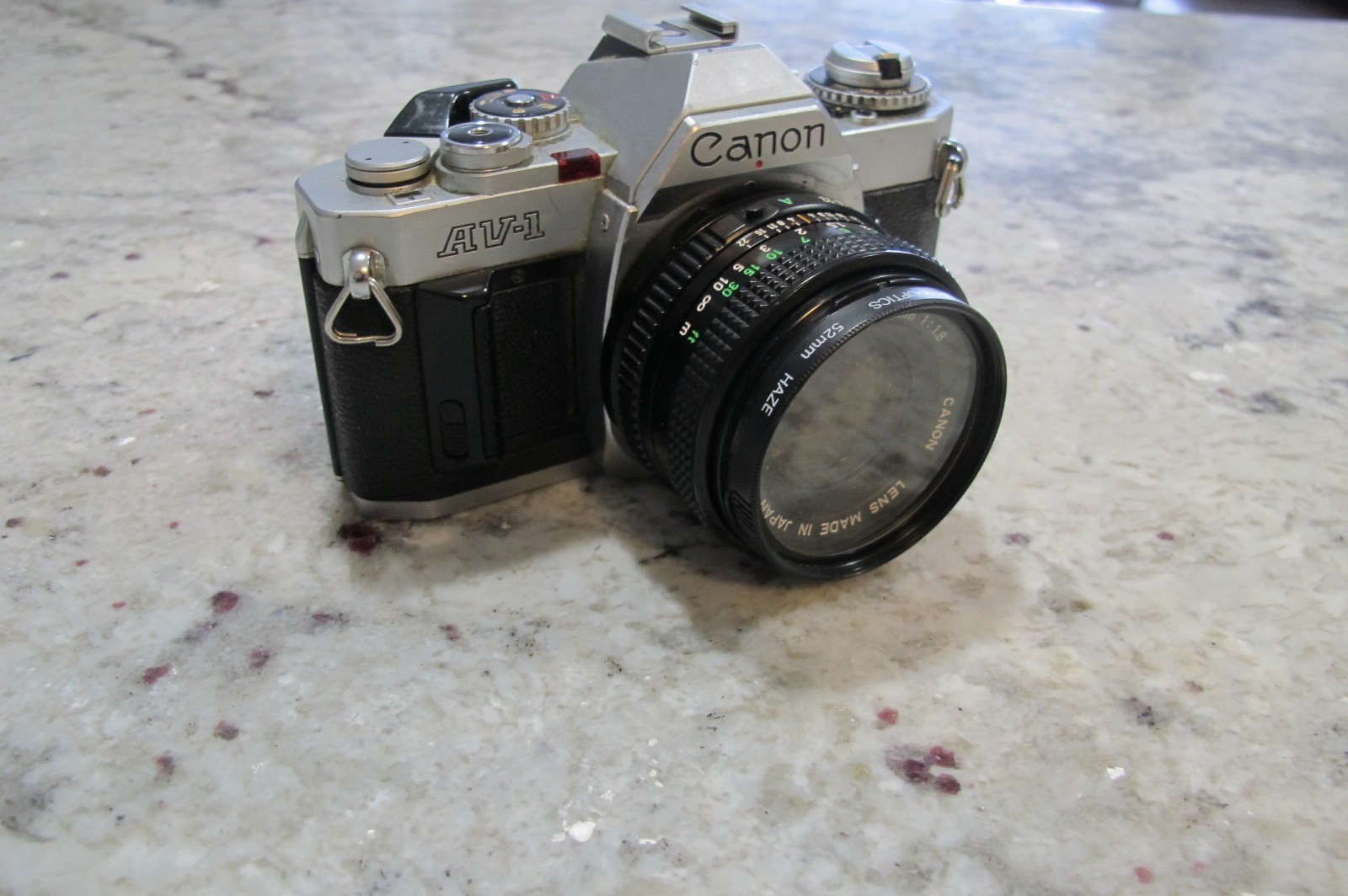
The Canon AV-1 is a 35mm film single-lens reflex (SLR) camera introduced in 1979 as an entry-level aperture-priority automatic exposure model. Designed for amateur photographers seeking ease of use without sacrificing optical quality, the AV-1 was part of Canon’s transition to the improved FD lens mount system and represented a significant step in making advanced photography more accessible.
Overview
Launched in March 1979, the Canon AV-1 was positioned as an affordable, user-friendly SLR within Canon’s expanding FD-mount camera lineup. It succeeded earlier models like the FTb and AE-1 but targeted a less experienced audience than the enthusiast-oriented AE-1. The "AV" in its name stands for Aperture Value, emphasizing its aperture-priority automatic exposure system—Canon’s first dedicated entry-level model with this feature. While lacking manual exposure control, the AV-1 offered shutter speeds from 1 second to 1/1000th of a second and included a bulb mode, all electronically controlled. Its release coincided with a booming consumer SLR market, where brands competed to offer simplified, automated cameras without compromising build quality.
The AV-1 shared design elements with the AE-1, including a compact polycarbonate body shell over a die-cast aluminum chassis, a vertically traveling focal-plane shutter, and a pentaprism viewfinder. However, internal circuitry and exposure logic were simplified to reduce cost. It used the Canon FD breech-lock lens mount (later referred to as "New FD" or "FD II"), ensuring compatibility with the full range of Canon’s high-quality FD and New FD lenses. Despite its budget positioning, the AV-1 maintained robust mechanical shutter operation at 1/90s in the event of battery failure, enhancing reliability. Production continued until 1983, when it was effectively superseded by the more advanced T50 and the broader T-series, which introduced through-the-lens (TTL) off-the-film metering and further automation.
Specifications
| Specification | Value |
| Type | 35mm Single-Lens Reflex (SLR) |
| Film Format | 35mm (135 film) |
| Years Produced | 1979–1983 |
| Lens Mount | Canon FD (breech-lock), compatible with New FD lenses |
| Shutter | Electronically controlled, vertical-travel focal-plane shutter; speeds from 1s to 1/1000s + Bulb |
| Metering | Center-weighted average TTL metering via silicon photodiode |
| Exposure Modes | Aperture-priority automatic exposure only (no manual mode) |
| Viewfinder | Fixed pentaprism, 0.85x magnification, 94% frame coverage |
| Dimensions | 140 × 87 × 50 mm (5.5 × 3.4 × 2.0 in); ~585 g (20.6 oz) with battery |
Key Features
- Aperture-Priority AE System: Allows photographers to set the desired aperture while the camera automatically selects the correct shutter speed for proper exposure, ideal for learning exposure principles.
- FD Lens Mount Compatibility: Fully supports Canon’s FD and New FD lenses (50mm f/1.8 commonly bundled), providing access to a wide range of high-performance optics.
- Electronic Shutter with Mechanical Backup: Shutter operates electronically across all speeds, but retains 1/90s mechanical speed if batteries fail.
- LED Exposure Indicator: Viewfinder displays a center-needle meter with +, 0, and – indicators for precise manual aperture adjustment.
- Compact and Lightweight Design: Polycarbonate body shell reduces weight while maintaining durability, making it suitable for travel and everyday use.
Historical Context
The AV-1 was released during a transformative period in 35mm SLR development, as electronics began to replace mechanical systems in consumer cameras. Canon had already introduced the groundbreaking AE-1 in 1976, which featured shutter-priority automation and an integrated microprocessor. The AV-1 followed this trend but targeted first-time SLR users who wanted automation without complexity. By focusing on aperture-priority mode—more intuitive for controlling depth of field—Canon empowered users to explore creative photography while relying on the camera for technical accuracy.
Competitors at the time included the Nikon EM (1979), a similarly simplified aperture-priority SLR, and the Pentax ME (1976), which also emphasized compact design and automation. However, the Nikon EM was criticized for its limited shutter speeds and build quality, while the AV-1 maintained a more robust shutter range and better ergonomics. The AV-1 was well-received for its balance of affordability, functionality, and compatibility with Canon’s respected FD lens system. It played a crucial role in expanding Canon’s market share among amateur photographers and served as a gateway into the brand’s ecosystem.
Collectibility & Value
Today, the Canon AV-1 is considered a solid vintage SLR for beginners entering film photography. While not as collectible as the AE-1 or more advanced models like the A-1, it remains popular due to its reliability, simplicity, and affordability. In working condition, AV-1 bodies typically sell for $50–$100 USD, often bundled with an FD 50mm f/1.8 lens. Fully functional units with clean viewfinders and responsive shutters are common, though fogged or scratched focusing screens can reduce value.
When purchasing an AV-1, buyers should verify that the shutter fires correctly at all speeds and that the meter responds to light changes. The camera uses two 1.5V SR44 or A76 batteries (equivalent to LR44) to power the meter and shutter control. A common issue is degraded battery contacts or corrosion, which can interrupt power delivery. Additionally, the light seals often deteriorate after decades, requiring replacement to prevent light leaks. While not rare, well-maintained AV-1s with original accessories or special editions (e.g., silver variants) may command slightly higher prices among collectors of Canon’s FD-era equipment.
Similar Cameras
- Nikon EM (1979) – Aperture-priority SLR with compact design, targeted at beginners; limited to 1/1000s max shutter speed.
- Pentax ME (1976) – Aperture-priority 35mm SLR with LED shutter speed display; known for its sleek styling and compact form.
- Minolta X-370 (1981) – Manual and aperture-priority modes, robust build, and compatibility with MC/MD lenses.
- Olympus OM-20 (1979) – Aperture-priority OM-mount SLR with TTL metering and compact OM system compatibility.
- Yashica FR-I (1982) – Aperture-priority SLR with Copal Square shutter, compatible with Contax/Yashica mount lenses.
Repair & Maintenance
The Canon AV-1 operates on two 1.5V SR44 (or equivalent A76/LR44) batteries, which power both the exposure meter and electronic shutter control. Battery life is generally good, lasting several hundred exposures under normal use. Common maintenance issues include corroded battery contacts, which can be cleaned with isopropyl alcohol and a cotton swab. The shutter mechanism is durable but may require CLA (clean, lubricate, adjust) service if sticky speeds or inconsistent metering occur after prolonged storage.
The CdS (cadmium sulfide) meter cell can degrade over time, leading to inaccurate exposure readings—especially in low light. While repairable by specialized technicians, replacement parts are scarce. The self-timer, film advance lever, and rewind crank are mechanical and generally reliable, though worn levers may develop play. Light seals should be replaced every 10–15 years to prevent fogging and light leaks. Overall, the AV-1 is considered moderately easy to repair, with many parts interchangeable with the AE-1 and other FD-mount bodies. Its widespread production ensures a steady supply of donor cameras for parts.
eBay Listings


As an eBay Partner, we earn from qualifying purchases. This helps support our independent vintage technology research.
Service Manuals, Schematics & Catalogs
Related Models
- Canon A-1 (1978-1985)
- Canon AE-1 Program (1981-1984)
- Canon AE-1 (1976-1984)
- Canon AL-1 (1982-1985)
- Canon AT-1 (1977-1982)
- Alpa 6 (1948-1953)
- Agfa Agfaflex
- Agfa Ambiflex
- Agfa Easy
- Agfa Futura Af zoom