CANON AT-1
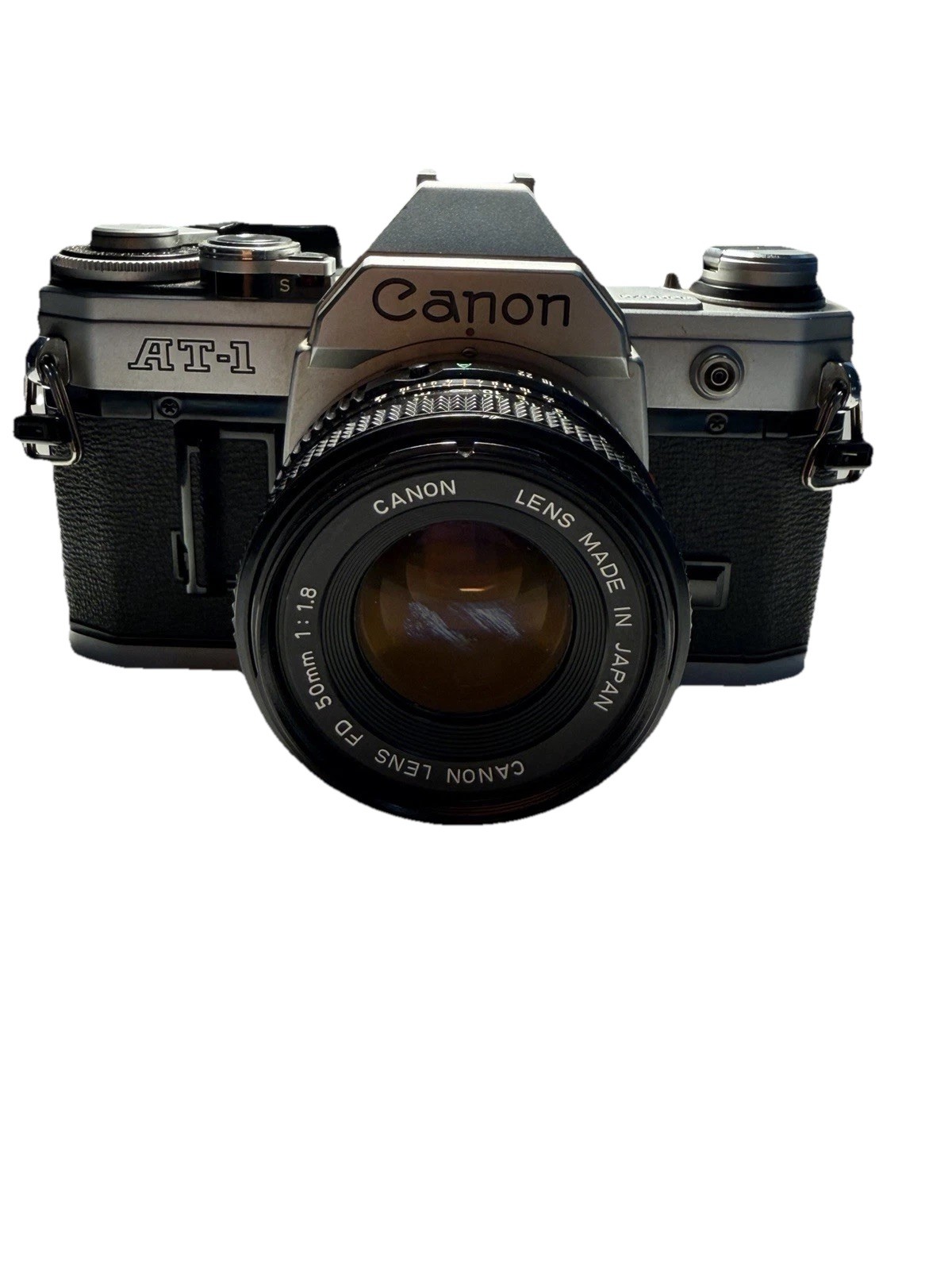
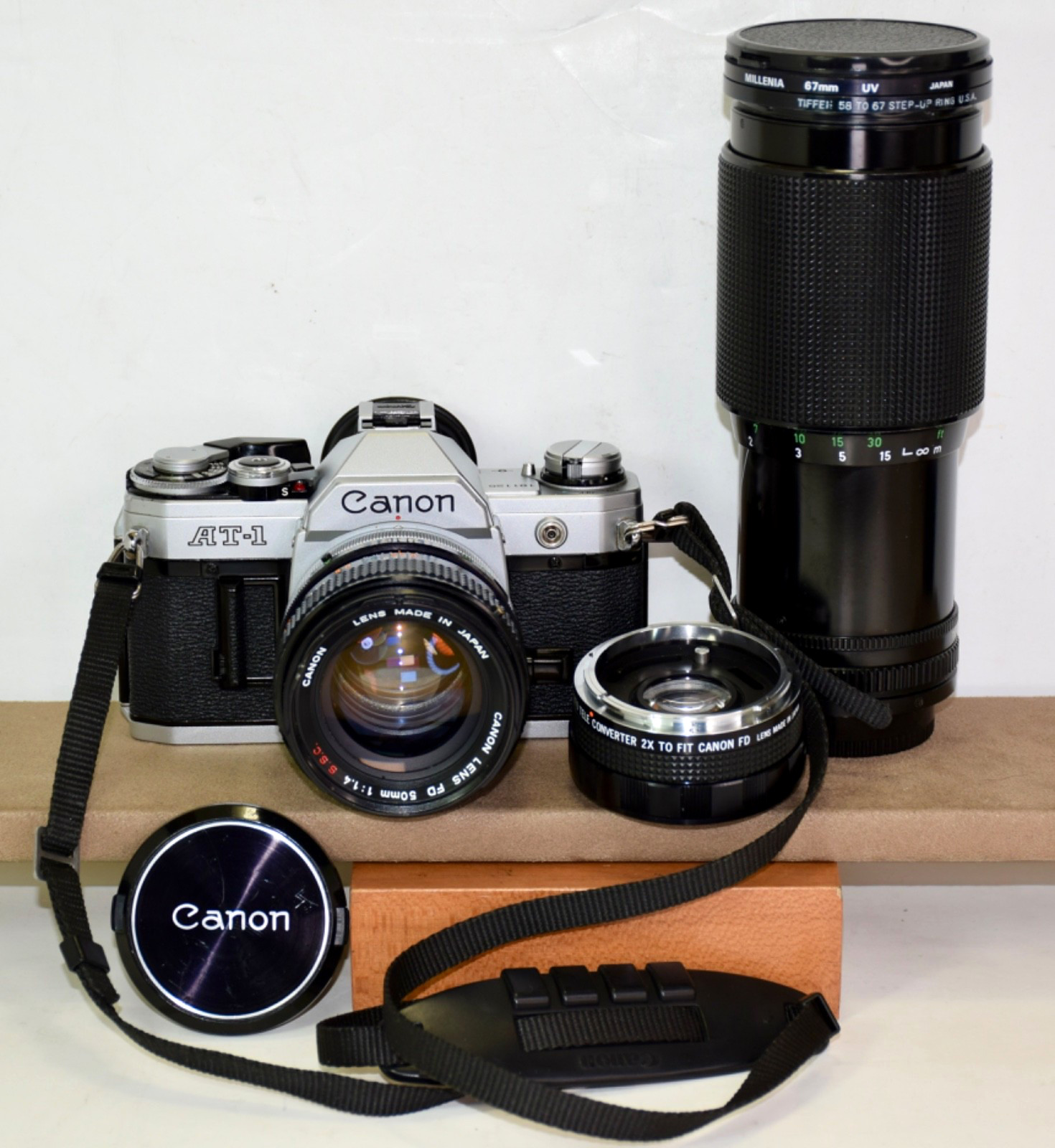
The Canon AT-1 is a fully manual 35mm film single-lens reflex (SLR) camera introduced in 1977 as a simplified, cost-effective variant of the popular Canon AE-1. Designed primarily for educational institutions and photography students, the AT-1 strips away automated exposure systems to focus on teaching fundamental photographic principles through hands-on, manual control.
Overview
Released in 1977, the Canon AT-1 was developed as a stripped-down, manual-only version of the groundbreaking Canon AE-1, which had debuted the same year and featured aperture-priority automatic exposure. While the AE-1 targeted amateur photographers seeking automation, the AT-1 was positioned as a didactic tool for classroom use and technical training. It lacks the AE-1’s microprocessor-controlled automation, instead offering full manual exposure control with a match-needle metering system visible in the viewfinder. This design choice reinforced learning by requiring users to manually adjust both shutter speed and aperture to achieve correct exposure, making it ideal for photography instruction.
Despite its utilitarian purpose, the AT-1 shares much of its internal construction and chassis design with the AE-1, including the same Copal horizontal-travel focal-plane shutter and FD lens mount. It was marketed as a rugged, reliable camera for students, with simplified electronics and reduced service complexity. Though it never achieved the same consumer popularity as the AE-1, the AT-1 became a staple in photography programs across North America and Europe during the late 1970s and early 1980s. Its production run lasted until 1982, after which Canon shifted focus toward more automated models like the A-1 and AE-1 Program.
The AT-1 occupies a unique niche in Canon’s F-1 series lineage. It bridges the gap between the professional-grade F-1 and the consumer-oriented AE-1, offering mechanical reliability without automation. Unlike the AE-1, it does not feature shutter-priority or program modes, nor does it have an LCD exposure display. Instead, it relies on a classic match-needle analog meter in the viewfinder, aligning with Canon’s commitment to intuitive, tactile feedback for learners.
Specifications
| Specification | Value |
| Type | 35mm SLR |
| Film Format | 35mm (135 film) |
| Years Produced | 1977–1982 |
| Lens Mount | Canon FD (bayonet mount, breech-lock mechanism) |
| Shutter | Horizontal-travel, focal-plane cloth shutter; speeds from 1 sec to 1/1000 sec, plus Bulb (B) |
| Metering | TTL full-aperture center-weighted metering with silicon photodiode sensor |
| Exposure Modes | Manual only (shutter speed and aperture set manually) |
| Viewfinder | Fixed pentaprism with 0.92x magnification, 94% frame coverage; split-image rangefinder spot with microprism collar |
| Dimensions | 142 mm (W) × 92 mm (H) × 50 mm (D); approx. 570 g (body only, no battery) |
Key Features
- Manual-Only Exposure Control: Requires user to set both shutter speed (1–1/1000 sec + B) and aperture manually, promoting foundational photography skills.
- Match-Needle Metering System: Analog needle in the viewfinder indicates exposure status; user adjusts settings until needle centers at "0" for correct exposure.
- FD Lens Mount Compatibility: Supports all Canon FD and New FD lenses (50mm f/1.8 commonly bundled), enabling use of a wide range of high-quality optics.
- Mechanical Shutter Operation: At 1/1000 sec and slower, shutter functions mechanically without battery; only meter requires power.
- Educational Design: Simplified circuitry and lack of automation reduce repair costs and increase durability in high-use environments.
Historical Context
The Canon AT-1 was introduced at a pivotal moment in SLR development, when electronics were beginning to transform consumer photography. The AE-1, launched the same year, was one of the first SLRs to incorporate an embedded microprocessor, enabling automatic exposure and setting a new standard for ease of use. In contrast, the AT-1 was conceived as a counterpoint—a tool for learning the mechanics of exposure rather than relying on automation. It was primarily sold in bulk to schools, colleges, and training centers, often in kits with a standard 50mm f/1.8 FD lens.
Competitors in the educational and manual SLR market included the Nikon FM (introduced 1977), Pentax ME (1976), and Olympus OM-1 (1972). While these cameras varied in automation and build, the AT-1 distinguished itself through shared components with the mass-market AE-1, ensuring parts availability and ease of servicing. Despite its limited feature set, the AT-1 benefited from Canon’s reputation for precise engineering and robust shutter mechanisms. Market reception was modest; it was rarely advertised to consumers and received little media attention. However, its durability and straightforward design earned it quiet respect among educators and technicians.
Collectibility & Value
Today, the Canon AT-1 is a niche collectible, valued more for its historical role in photography education than for rarity or performance. Units in working condition typically sell for $50–$100, with fully serviced examples or those including original lenses commanding slightly higher prices. Its collectibility is moderate—while not as sought-after as the AE-1 or A-1, it appeals to educators, Canon historians, and collectors of instructional cameras.
When purchasing an AT-1, buyers should verify the functionality of the shutter across all speeds and check for mirror bounce or lag. The most common issue is a failed meter, often due to degraded selenium cell connections or corroded battery contacts (it uses a single 1.35V PX625 mercury battery or modern equivalent like Wein Cell). The match-needle system is sensitive to electrical resistance, so cleaning contacts and using a stable battery substitute is essential. The shutter remains mechanically functional without power, making the camera usable even with a dead meter. Lenses with the FD mount should be checked for smooth aperture operation, especially on older breech-lock models.
Similar Cameras
- Nikon FM (1977–2001): Fully manual SLR with mechanical shutter, TTL metering, and F-mount compatibility; renowned for durability.
- Pentax K1000 (1976–1997): Iconic manual-only 35mm SLR, widely used in education, with simple design and reliable build.
- Olympus OM-1 (1972–1984): Compact manual SLR with through-the-lens metering and high-quality Zuiko lenses.
- Yashica FR-I (1977–1980): Manual-exposure SLR with Copal shutter and Yashinon lenses, designed for reliability and simplicity.
- Minolta XG-M (1981–1984): Manual-focused SLR with aperture-priority automation but strong manual capabilities, often used in schools.
Repair & Maintenance
The Canon AT-1 uses a 1.35V PX625 mercury battery (original specification), though modern replacements such as the Wein Cell MRB625 or alkaline/zinc-air substitutes are commonly used. Battery power is required only for the light meter; the shutter operates mechanically at all speeds, including 1/1000 sec. This makes the camera functional even with a dead or missing battery, a significant advantage for reliability.
Common maintenance issues include sluggish shutter speeds due to dried lubricants, particularly in cameras stored for decades. The Copal shutter, while robust, may require cleaning and re-lubrication by a qualified technician. The mirror mechanism is generally durable but can develop play over time. The meter circuit is prone to failure due to oxidized contacts or capacitor degradation; servicing often involves contact cleaning and capacitor replacement. Lens mount alignment and film advance mechanism wear should also be inspected, especially in high-use educational units. Overall, the AT-1 is considered repairable with widely available parts from AE-1 service stock, and its mechanical simplicity makes it a forgiving candidate for restoration.
eBay Listings


As an eBay Partner, we earn from qualifying purchases. This helps support our independent vintage technology research.
Service Manuals, Schematics & Catalogs
Related Models
- Canon A-1 (1978-1985)
- Canon AE-1 Program (1981-1984)
- Canon AE-1 (1976-1984)
- Canon AL-1 (1982-1985)
- Canon AV-1 (1979-1983)
- Alpa 6 (1948-1953)
- Agfa Agfaflex
- Agfa Ambiflex
- Agfa Easy
- Agfa Futura Af zoom