CANON AL-1
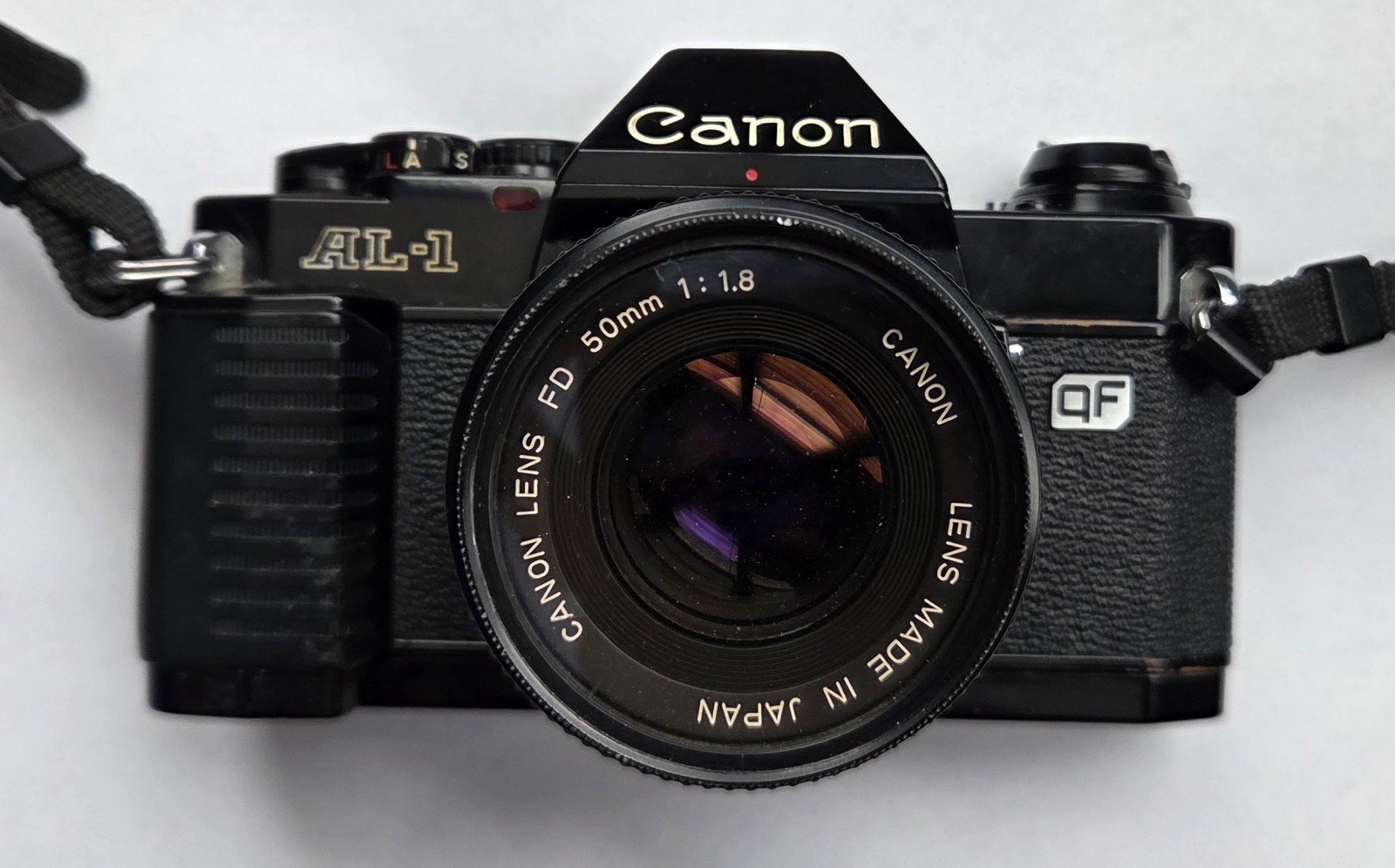
The Canon AL-1, introduced in 1982, was a pivotal 35mm single-lens reflex (SLR) camera in Canon’s FD-mount lineup, notable for being the first Canon camera to feature an electronic focus-assist system. Designed as an advanced amateur model, the AL-1 bridged the gap between fully manual mechanical cameras and the emerging era of electronic automation in photography.
Overview
Released during a transitional period in camera technology, the Canon AL-1 marked a significant step forward in Canon’s evolution toward electronic integration in SLR systems. Positioned between the entry-level AE-1 and the professional-grade New F-1, the AL-1 targeted enthusiasts and semi-professional photographers seeking enhanced focusing accuracy without the complexity or cost of fully automated systems. Its most groundbreaking feature was the "Quick Focus" system—an early implementation of electronic focus assistance that used LEDs in the viewfinder to guide manual focusing, a precursor to modern autofocus indicators.
The AL-1 retained the robust FD lens mount, allowing full compatibility with Canon’s extensive range of FD and New FD lenses. While it lacked aperture-priority or shutter-priority automation, it featured center-weighted TTL (through-the-lens) metering and manual exposure control with shutter speeds from 1 to 1/1000 second, plus Bulb. The camera utilized a vertically traveling, focal-plane cloth shutter with electromagnetic control, ensuring consistent timing accuracy. Power was supplied by two 1.55V SR44 or equivalent silver-oxide batteries, which operated the metering system, LED indicators, and shutter release circuitry.
Historically, the AL-1 represented Canon’s experimentation with electronic aids before the full shift to autofocus, culminating in the 1987 EOS system and the EF mount. Though short-lived in production (1982–1985), the AL-1 played a critical role in user interface development, demonstrating how electronic feedback could improve manual focusing precision—a concept later refined in Canon’s A-series and T-series cameras.
Specifications
| Specification | Value |
| Type | 35mm Single-Lens Reflex (SLR) |
| Film Format | 35mm (135 film) |
| Years Produced | 1982–1985 |
| Lens Mount | Canon FD mount (compatible with FD and New FD lenses) |
| Shutter | Vertically traveling focal-plane cloth shutter; speeds 1 – 1/1000 second in 1/2 stop increments, plus Bulb (B) |
| Metering | TTL full-aperture center-weighted metering with silicon photodiode sensor |
| Exposure Modes | Manual exposure only; stop-down metering via AE lock button |
| Viewfinder | Fixed pentaprism with interchangeable focusing screens; includes split-image rangefinder, microprism collar, and matte field; LED focus-assist indicators (up/down arrows and center dot) |
| Dimensions | 140 mm (W) × 92 mm (H) × 57 mm (D); weight: approx. 590 g (body only, without batteries or lens) |
Key Features
- Quick Focus System: First implementation of Canon’s electronic focus-assist technology, using three LEDs (up, down, center) in the viewfinder to indicate focus direction and achievement relative to the subject plane.
- Interchangeable Focusing Screens: Allowed users to customize the viewfinder for different shooting needs (e.g., split-image for portraits, grid screen for architecture).
- Stop-Down Metering with AE Lock: Enabled accurate exposure metering with lenses that did not transmit aperture data mechanically, using a dedicated AE lock button to stop down the lens manually.
- TTL Center-Weighted Metering: Provided reliable exposure readings using a silicon photodiode sensor with sensitivity optimized for typical lighting conditions.
- Compact and Lightweight Chassis: Constructed with a combination of die-cast metal and engineering plastics, balancing durability with portability.
Historical Context
The Canon AL-1 was launched at a time when camera manufacturers were rapidly integrating electronics into traditionally mechanical systems. In the early 1980s, Nikon had already introduced aperture-priority models like the FE2, and Minolta had debuted the groundbreaking Maxxum 7000 in 1985—the first true autofocus SLR. Canon, still committed to the FD mount, used the AL-1 as a testbed for electronic user assistance rather than full autofocus. The Quick Focus system was a response to the difficulty many photographers faced with precise manual focusing, especially with fast lenses or shallow depth of field.
Despite its innovation, the AL-1 had a relatively short production run and was not widely marketed outside Japan and select export markets. It was succeeded indirectly by the T50 and T70 in 1985 and 1986, which introduced program autoexposure and more advanced electronics. The AL-1’s legacy lies in its role as a transitional model—technologically modest by later standards, but conceptually forward-thinking in its emphasis on user feedback and electronic guidance.
Collectibility & Value
Today, the Canon AL-1 is a niche collectible, valued more for its historical significance than its technical capabilities. It is relatively rare compared to Canon’s more popular AE-1 or A-1 models, and complete examples with functioning focus-assist systems are increasingly difficult to find. In the current collector market (2023–2024), working AL-1 bodies typically sell for $100–$180 USD, depending on condition, included accessories, and screen type. Cameras with the original box, manual, and rare focusing screens (such as the grid or precision matte) command premium prices.
When purchasing an AL-1, collectors should verify the functionality of the LED focus-assist system, as degraded contacts or failed circuitry are common after decades of storage. The shutter mechanism is generally reliable but may require cleaning or lubrication if the camera has been dormant. Battery corrosion in the compartment is another frequent issue, particularly if old silver-oxide cells were left inside. Because the AL-1 lacks mechanical backup, it is entirely dependent on battery power for both metering and shutter operation—making a functional battery compartment essential.
Similar Cameras
- Nikon FM2 (1982–2001): Mechanically controlled SLR with excellent build quality and TTL metering, popular among purists.
- Pentax ME Super (1979–1984): Compact aperture-priority SLR with manual override and LED exposure indicators.
- Minolta X-700 (1981–1999): Fully featured manual-focus SLR with program mode and advanced viewfinder display.
- Olympus OM-2N (1983–1988): Sophisticated OM-series SLR with off-the-film (OTF) metering and aperture-priority automation.
- Yashica FX-3 Super (1982–1988): Budget-friendly manual-exposure SLR with TTL metering and robust mechanical shutter.
Repair & Maintenance
The Canon AL-1 operates on two 1.55V SR44 (or equivalent, such as LR44 or A76) silver-oxide batteries, which power the metering circuit, LED indicators, and electromagnetic shutter release. Alkaline replacements are not recommended due to voltage inconsistency and leakage risk. Common issues include intermittent LED operation, caused by worn PCB traces or oxidized battery contacts, and shutter timing inaccuracies due to aging capacitors or dried lubricants.
Repair complexity is moderate: while the camera lacks the intricate electronics of later autofocus models, its hybrid mechanical-electronic design requires careful handling. Shutter maintenance should be performed by a technician experienced with vintage Canon SLRs. Cleaning the mirror, focusing screen, and viewfinder prism is advisable for long-term storage units. As with all FD-mount cameras, ensuring the lens mount and aperture coupling lever are free of dirt and corrosion is essential for reliable operation with FD lenses. Regular use and periodic battery replacement (even when not in use) help prevent terminal damage and prolong the camera’s service life.
eBay Listings
![[Exc+5] Canon AL-1 SLR 35mm Film camera w/ New FD 50mm F2 Le](https://i.ebayimg.com/images/g/~kQAAeSwGBBpuXmb/s-l1600.jpg)
![New Seal🌸[Near MINT+++] Canon AL-1 35mm Film Camera New FD N](https://i.ebayimg.com/images/g/1wUAAeSwSSBpx6P0/s-l1600.jpg)

As an eBay Partner, we earn from qualifying purchases. This helps support our independent vintage technology research.
Service Manuals, Schematics & Catalogs
Related Models
- Canon A-1 (1978-1985)
- Canon AE-1 Program (1981-1984)
- Canon AE-1 (1976-1984)
- Canon AT-1 (1977-1982)
- Canon AV-1 (1979-1983)
- Alpa 6 (1948-1953)
- Agfa Agfaflex
- Agfa Ambiflex
- Agfa Easy
- Agfa Futura Af zoom