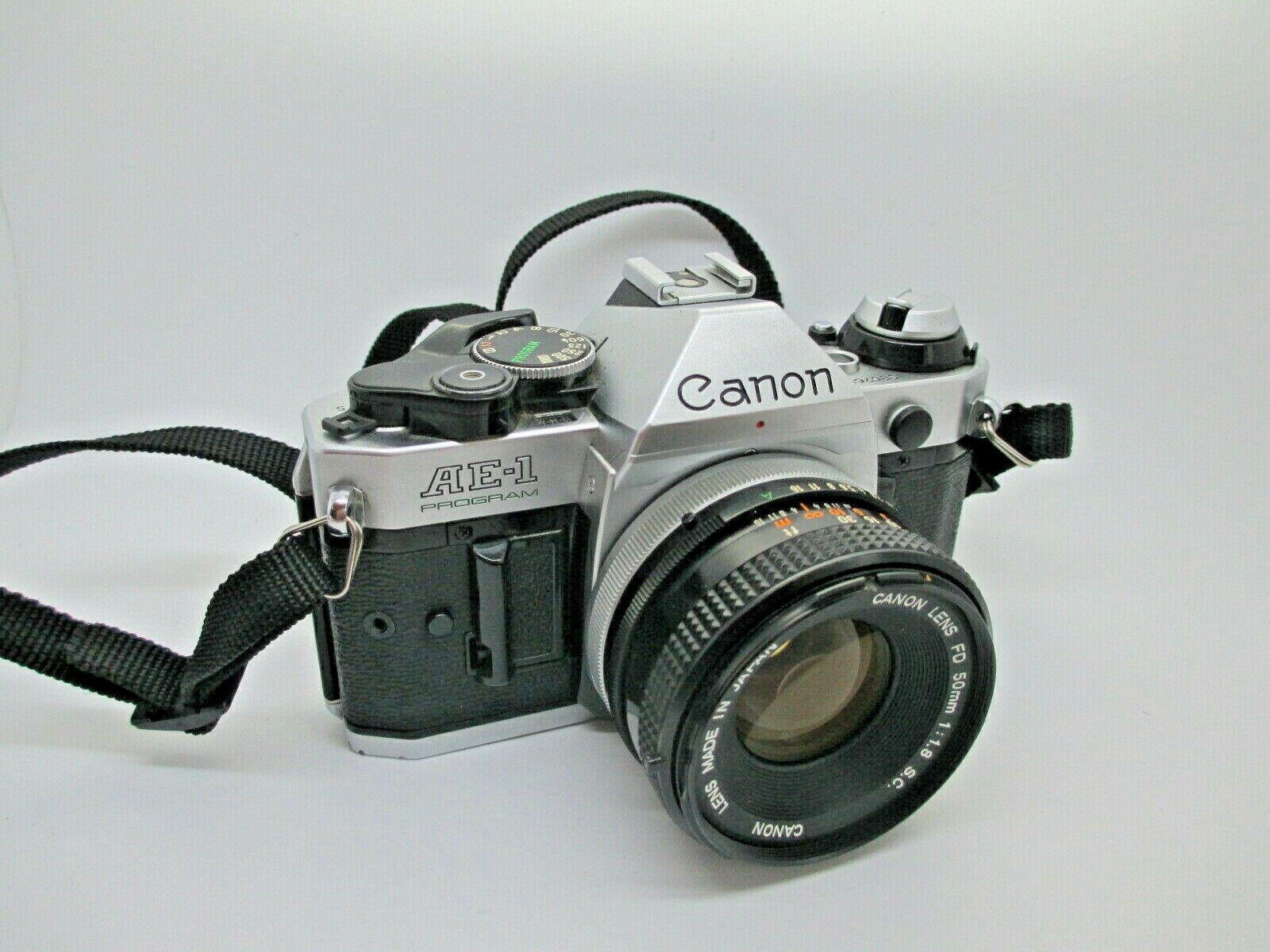
CANON AE-1 PROGRAM
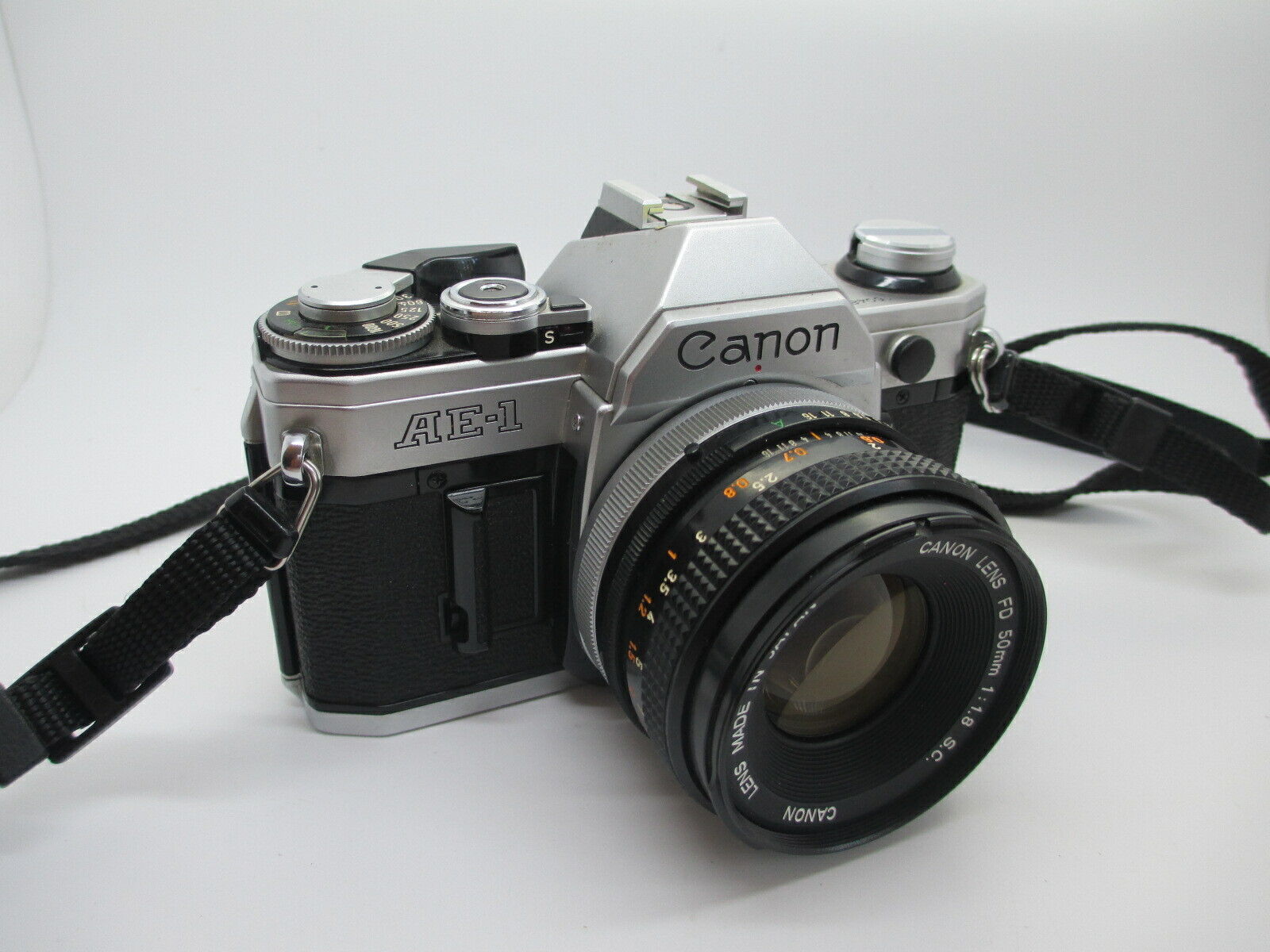
The Canon AE-1 Program is a 35mm film single-lens reflex (SLR) camera introduced in 1981 as an evolution of the highly successful Canon AE-1. It expanded upon its predecessor’s foundation by introducing a fully automatic Program AE exposure mode, combining advanced electronics with reliable mechanical operation to appeal to both amateur photographers and enthusiasts.
Overview
Released in March 1981, the Canon AE-1 Program was developed to meet growing consumer demand for automated exposure control in SLR cameras while maintaining manual exposure options for experienced users. Positioned as a mid-to-upper-tier model in Canon’s FD-mount SLR lineup, it succeeded the original AE-1 (1976) and built upon its electronic shutter-priority AE system by adding a microprocessor-controlled Program mode. This innovation allowed the camera to automatically select both shutter speed and aperture based on scene luminance and lens settings, making it one of the first mass-market SLRs to offer such functionality. The AE-1 Program retained the compact, lightweight design and robust metal chassis of the AE-1 but featured updated internal circuitry and a redesigned top-plate LCD display that showed both shutter speed and selected mode.
Targeted primarily at advanced amateurs and photography students, the AE-1 Program bridged the gap between fully manual operation and full automation. It was marketed heavily through Canon’s established educational outreach and retail partnerships, often bundled with the FD 50mm f/1.8 or f/1.4 prime lenses. The camera remained in production until 1984, when it was succeeded by the more advanced T50 and T70 models in Canon’s transition toward TTL autofocus systems. Despite its relatively short production run, the AE-1 Program became one of the best-selling SLRs of the early 1980s, contributing significantly to the popularization of programmed autoexposure in consumer photography.
Specifications
| Specification | Value |
| Type | 35mm Single-Lens Reflex (SLR) |
| Film Format | 35mm (135 film), 24x36mm frame size |
| Years Produced | 1981–1984 |
| Lens Mount | Canon FD breech-lock mount (compatible with New FD lenses) |
| Shutter | Vertical-travel, focal-plane shutter; speeds from 1 second to 1/1000 second, plus Bulb mode |
| Metering | TTL full-aperture center-weighted average metering using silicon photocell (SPC) |
| Exposure Modes | Program AE (fully automatic), Shutter-Priority AE, Manual |
| Viewfinder | Fixed pentaprism eye-level viewfinder with 0.92x magnification, 94% frame coverage; displays shutter speed and mode via LED/LCD |
| Dimensions | 140 mm (W) × 92 mm (H) × 53 mm (D); weight: approx. 590 g (body only, with battery) |
Key Features
- Program AE Mode: The first Canon SLR to feature automatic program exposure, selecting optimal shutter speed and aperture combinations without user input.
- Silicon Photocell Metering: Provided accurate, full-aperture TTL metering with improved low-light sensitivity compared to earlier CdS cells.
- Dual Exposure Modes: Offered both Shutter-Priority AE and Manual mode, giving users flexibility across skill levels.
- LED/LCD Display in Viewfinder: Unique hybrid display showed selected shutter speed and exposure mode via red LEDs and a segmented LCD.
- Compact and Durable Chassis: Constructed with a die-cast aluminum top and bottom plates, contributing to durability while keeping weight moderate.
Historical Context
The Canon AE-1 Program was launched during a pivotal era in SLR development, as camera manufacturers increasingly integrated microelectronics into mechanical designs. The early 1980s saw a shift from manual and semi-automatic exposure systems toward fully automated solutions, driven by consumer demand for ease of use. Canon, having already established credibility with the AE-1 and A-1 models, sought to extend its market reach by offering automation without sacrificing manual control. The AE-1 Program filled this niche effectively, particularly appealing to users who wanted “point-and-shoot” convenience with the option to learn manual techniques.
Competitors at the time included the Minolta X-700 (1981), which offered a similar Program mode and manual override, and the Pentax ME Super (1979), which focused on aperture-priority automation. Nikon’s equivalent, the Nikon EM (1979), was more limited and targeted entry-level users. The AE-1 Program distinguished itself with its robust build quality, intuitive interface, and compatibility with Canon’s extensive FD lens system. It was widely praised in contemporary reviews for its balance of automation and control, and it became a staple in photography schools and rental fleets worldwide. Its success reinforced Canon’s reputation for innovation in electronic SLRs and laid groundwork for the EOS system introduced in 1987.
Collectibility & Value
Today, the Canon AE-1 Program is a highly collectible and widely available film camera, prized for its historical significance, reliability, and affordability. In the current vintage camera market (as of 2024), working units typically sell for $75–$150 USD, depending on condition, included lens, and shutter accuracy. Fully functional bodies with the original FD 50mm f/1.8 lens are common on secondary markets such as eBay, KEH, and Etsy. The camera’s popularity ensures a steady supply of spare parts and repair services, though original batteries and light seals may require replacement in older units.
When purchasing an AE-1 Program, collectors should verify shutter operation across all speeds, check for mirror slap noise or hesitation, and inspect the light seals around the film door, which often degrade and cause light leaks. The camera uses a single 6V PX28 or 4SR44 battery to power both the meter and shutter control circuitry; modern equivalents or adapters are recommended due to the obsolescence of the original battery. Common issues include capacitor leakage on the circuit board, worn shutter curtains, and sticky aperture levers on older FD lenses. Despite these age-related concerns, the AE-1 Program remains one of the most repairable and user-friendly vintage SLRs, making it an excellent choice for beginners entering film photography.
Similar Cameras
- Minolta X-700 (1981–2001): Offered Program mode, aperture-priority, and manual exposure; renowned for its bright viewfinder and robust build.
- Pentax ME Super (1979–1984): Aperture-priority and manual modes; compact design with excellent K-mount lens compatibility.
- Nikon FE2 (1983–1987): Mechanically timed shutter with aperture-priority AE; known for durability and precision engineering.
- Olympus OM-4 (1983–2002): Advanced aperture-priority and manual SLR with sophisticated metering and titanium shutter.
- Yashica FX-3 Super (1982–1985): Entry-level aperture-priority SLR with compact size and reliable performance.
Repair & Maintenance
The Canon AE-1 Program requires a 6V alkaline or silver-oxide battery (PX28/4SR44) for operation of the light meter and electronic shutter control. Battery leakage is a common issue in long-stored units and can damage the battery compartment and nearby circuitry. Shutter problems—such as inconsistent speeds or failure to fire—are often linked to degraded capacitors or worn shutter blades, which may require professional servicing. The camera’s electronic control system is generally reliable but can be sensitive to moisture and corrosion. Regular maintenance includes cleaning the mirror and focusing screen, replacing light seals, and ensuring the lens mount’s aperture coupling lever moves freely. Due to its modular design and widespread availability of parts, the AE-1 Program is considered moderately easy to repair, with many tutorials and service manuals available online. Routine care ensures decades of reliable film photography.
eBay Listings


As an eBay Partner, we earn from qualifying purchases. This helps support our independent vintage technology research.
Service Manuals & Schematics
- Service Manual — archive.org
- Manual — archive.org
- Manual — archive.org
- Owner's Manual — archive.org
Related Models
- Canon A-1 (1978-1985)
- Canon AE-1 (1976-1984)
- Canon AL-1 (1982-1985)
- Canon AT-1 (1977-1982)
- Canon AV-1 (1979-1983)
- Alpa 6 (1948-1953)
- Agfa Agfaflex
- Agfa Ambiflex
- Agfa Easy
- Agfa Futura Af zoom