CANON AE-1
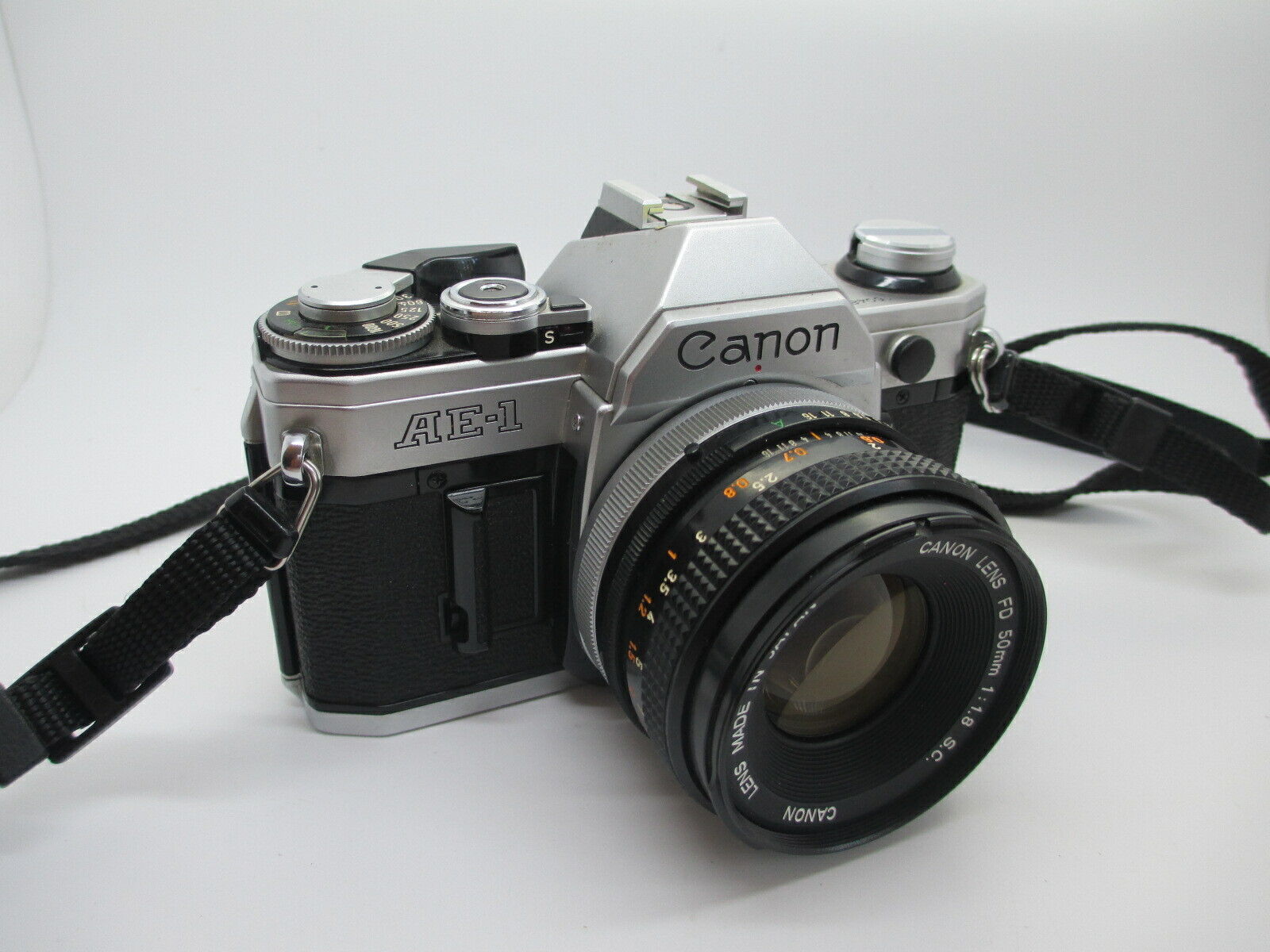
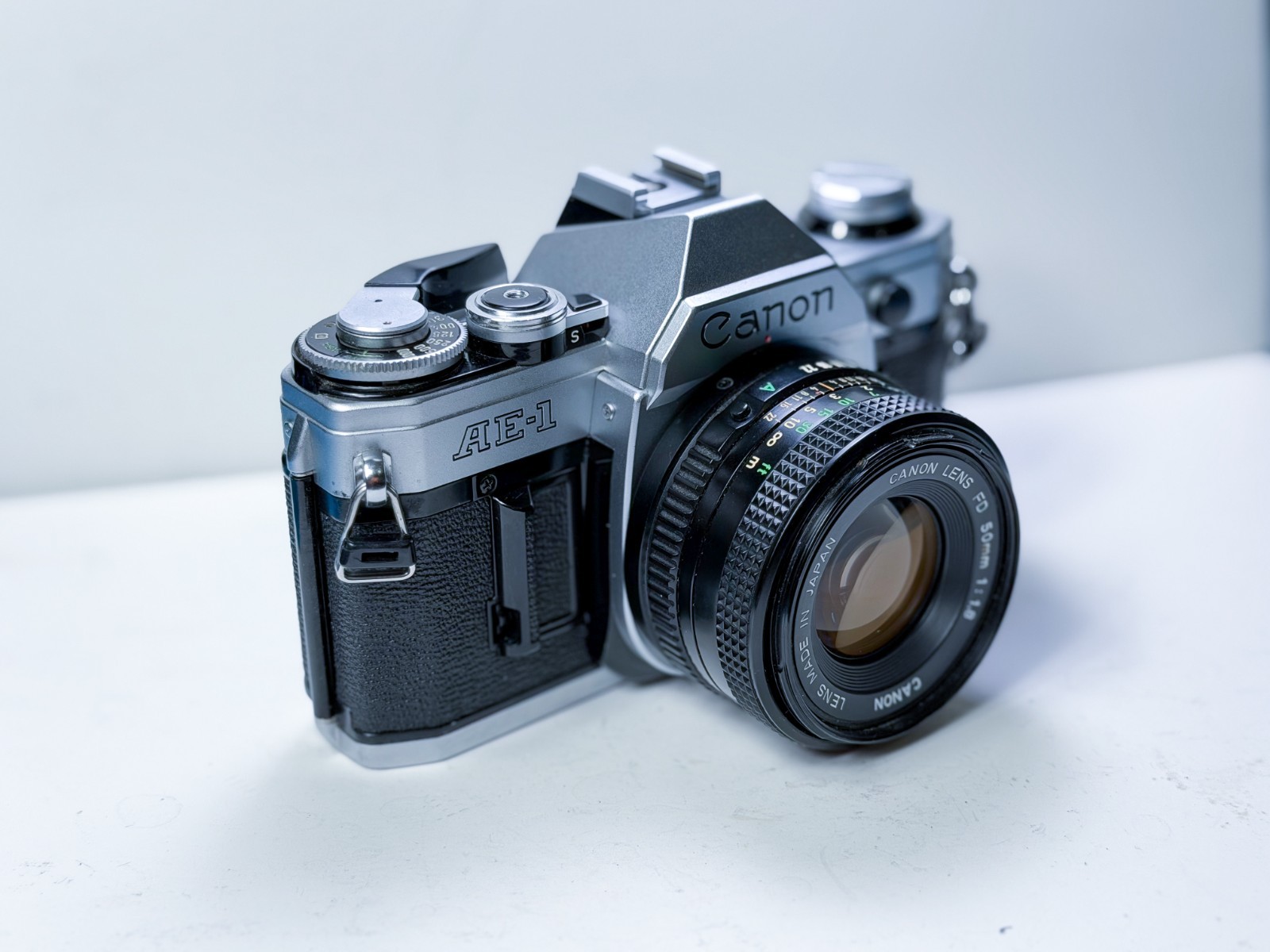
The Canon AE-1 is a 35mm film single-lens reflex (SLR) camera introduced in 1976 as a groundbreaking model that merged microprocessor-based automation with accessible pricing, making advanced photographic technology available to amateur photographers worldwide. It became one of the most popular 35mm SLRs ever produced, renowned for its blend of electronic precision, modular design, and user-friendly operation.
Overview
Launched in March 1976, the Canon AE-1 was a pivotal release in Canon’s transition from mechanical to electronic camera systems. Positioned as an advanced amateur to semi-professional SLR, it was the centerpiece of Canon’s new FD lens mount system and the first mass-market SLR to incorporate an embedded microprocessor. This 8-bit CPU managed exposure calculations, shutter timing, and user interface functions, enabling precise aperture-priority autoexposure—a feature previously found only in higher-end models. The AE-1 was marketed aggressively, including one of the first major television ad campaigns for a camera, famously featuring the slogan “At rest, it’s beautiful. In action, it’s incredible.”
The camera was designed to be modular and serviceable, with a die-cast aluminum top plate and polycarbonate composite body shell that reduced weight while maintaining durability. It accepted Canon’s full range of interchangeable FD and later New FD lenses, with full-aperture TTL (through-the-lens) metering via a silicon photodiode (SPD) sensor. With over 5.7 million units sold by the time production ended in 1984, the AE-1 became the best-selling SLR of its era, instrumental in democratizing SLR photography and establishing Canon as a leader in electronic camera innovation.
Specifications
| Specification | Value |
| Type | Electronic 35mm SLR |
| Film Format | 35mm (135 film) |
| Years Produced | 1976–1984 |
| Lens Mount | Canon FD (supports FD and New FD lenses) |
| Shutter | Vertical-travel focal-plane shutter; speeds 1 sec to 1/1000 sec, plus B (Bulb) |
| Metering | TTL full-aperture center-weighted average metering via silicon photodiode (SPD) |
| Exposure Modes | Aperture-priority autoexposure, manual exposure (with stop-down metering) |
| Viewfinder | Fixed pentaprism, 0.85x magnification, 94% coverage |
| Dimensions | 140 × 90 × 52 mm (5.5 × 3.5 × 2.0 in); ~590 g (20.8 oz) body only (with battery) |
Key Features
- Microprocessor Control: First SLR with an internal 8-bit microprocessor (Canon-developed LSI chip) for exposure calculation and shutter timing.
- Aperture-Priority Automation: User selects aperture; camera automatically sets shutter speed (from 1 sec to 1/1000 sec) for correct exposure.
- TTL Full-Aperture Metering: Enables metering at maximum lens aperture for brighter viewfinder and faster focusing, with automatic stop-down during exposure.
- Programmable Film Speed: ISO range 12 to 3200, set manually via dial on top plate; supports DX-coded films via optional A-series film speed setting adapter.
- Hot Shoe & PC Sync: Integrated hot shoe for Canon Speedlites (e.g., 133B, 199A) and PC terminal for studio flash synchronization.
Historical Context
The AE-1 was released during a transformative period in camera technology, as Japanese manufacturers transitioned from fully mechanical designs to electronically controlled systems. Canon faced stiff competition from Nikon’s FM series and Minolta’s XD series, but differentiated the AE-1 through aggressive automation and mass-market appeal. Unlike Nikon, which maintained a conservative approach favoring mechanical reliability, Canon embraced electronics to offer advanced features at lower cost. The AE-1’s success was amplified by its inclusion in photography school curricula and rental fleets, reinforcing its reputation as a reliable learning tool.
The camera also marked a shift in marketing strategy. Canon invested heavily in consumer advertising, targeting novice photographers with accessible messaging and emphasizing ease of use. This contrasted with the technical, engineer-focused branding of earlier SLRs. The AE-1’s modular construction—designed for automated assembly—allowed for high-volume production and lower prices, undercutting competitors while maintaining build quality. Its success paved the way for the AE-1 Program (1981), which added shutter-priority and program modes, further expanding Canon’s electronic SLR lineup.
Collectibility & Value
Today, the Canon AE-1 is a highly collectible and widely available vintage SLR, valued for its historical significance, robust build, and compatibility with high-quality FD lenses. In the current market (2024), working units typically sell for $75–$150 USD, depending on condition, included accessories, and lens bundle. Fully functional cameras with original leather, clean viewfinders, and accurate metering command premium prices, while units with fogged mirrors, shutter lag, or erratic metering are often sold for parts or repair.
Common issues include capacitor degradation in the electronic circuitry, sticky shutter curtains (especially at 1/1000 sec), and worn shutter speed selector dials. The AE-1 relies on a single 6V 4LR44 or 4SR44 battery to power both the meter and shutter control—failure of which renders the camera inoperable. When purchasing, collectors should verify that all shutter speeds are accurate, the self-timer functions, and the meter needle responds consistently to light changes. Despite its age, the AE-1 remains a favorite among film photography enthusiasts due to its tactile controls, bright viewfinder, and the availability of affordable, sharp FD lenses.
Similar Cameras
- Nikon EM (1979): Compact aperture-priority SLR targeting beginners; lighter build and less rugged than the AE-1.
- Pentax ME (1976): Aperture-priority 35mm SLR with LED shutter speed display; known for compact size and precise electronics.
- Minolta X-700 (1981): Advanced amateur SLR with program mode, bright viewfinder, and robust build; often considered the AE-1’s most direct successor in capability.
- Olympus OM-2 (1975): Competitor with aperture-priority and manual modes, unique off-the-film (OTF) metering, and compact OM mount system.
- Yashica FR-I (1977): FD-mount compatible SLR with similar feature set, often seen as a budget alternative to the AE-1.
Repair & Maintenance
The Canon AE-1 uses a 6V 4LR44 (alkaline) or 4SR44 (silver oxide) battery, located in the base. Silver oxide is recommended for stable voltage and longer life. When the battery is depleted, the camera cannot fire the shutter, as the electronic shutter release requires power. Common maintenance issues include capacitor leakage on the main circuit board, which can corrode traces and cause shutter malfunction. Shutter speeds may drift over time due to lubricant hardening, particularly at the 1/1000 sec setting. The cloth focal-plane shutter is durable but susceptible to wear if stored improperly or used infrequently.
Repair difficulty is moderate: while the camera was designed for factory serviceability, independent technicians can recalibrate shutters and replace capacitors with proper tools. Replacement parts such as shutter curtains, light seals, and foam light trap kits are readily available from specialty film camera vendors. Regular use, proper storage, and periodic battery replacement (removing batteries when not in use) significantly extend the camera’s operational life. With proper care, many AE-1s from the 1970s remain fully functional today.
eBay Listings


As an eBay Partner, we earn from qualifying purchases. This helps support our independent vintage technology research.
Service Manuals, Schematics & Catalogs
- Catalog (1991) — archive.org
- Catalog — archive.org
- Catalog (1991) — archive.org
Related Models
- Canon A-1 (1978-1985)
- Canon AE-1 Program (1981-1984)
- Canon AL-1 (1982-1985)
- Canon AT-1 (1977-1982)
- Canon AV-1 (1979-1983)
- Alpa 6 (1948-1953)
- Agfa Agfaflex
- Agfa Ambiflex
- Agfa Easy
- Agfa Futura Af zoom