CANON A-1
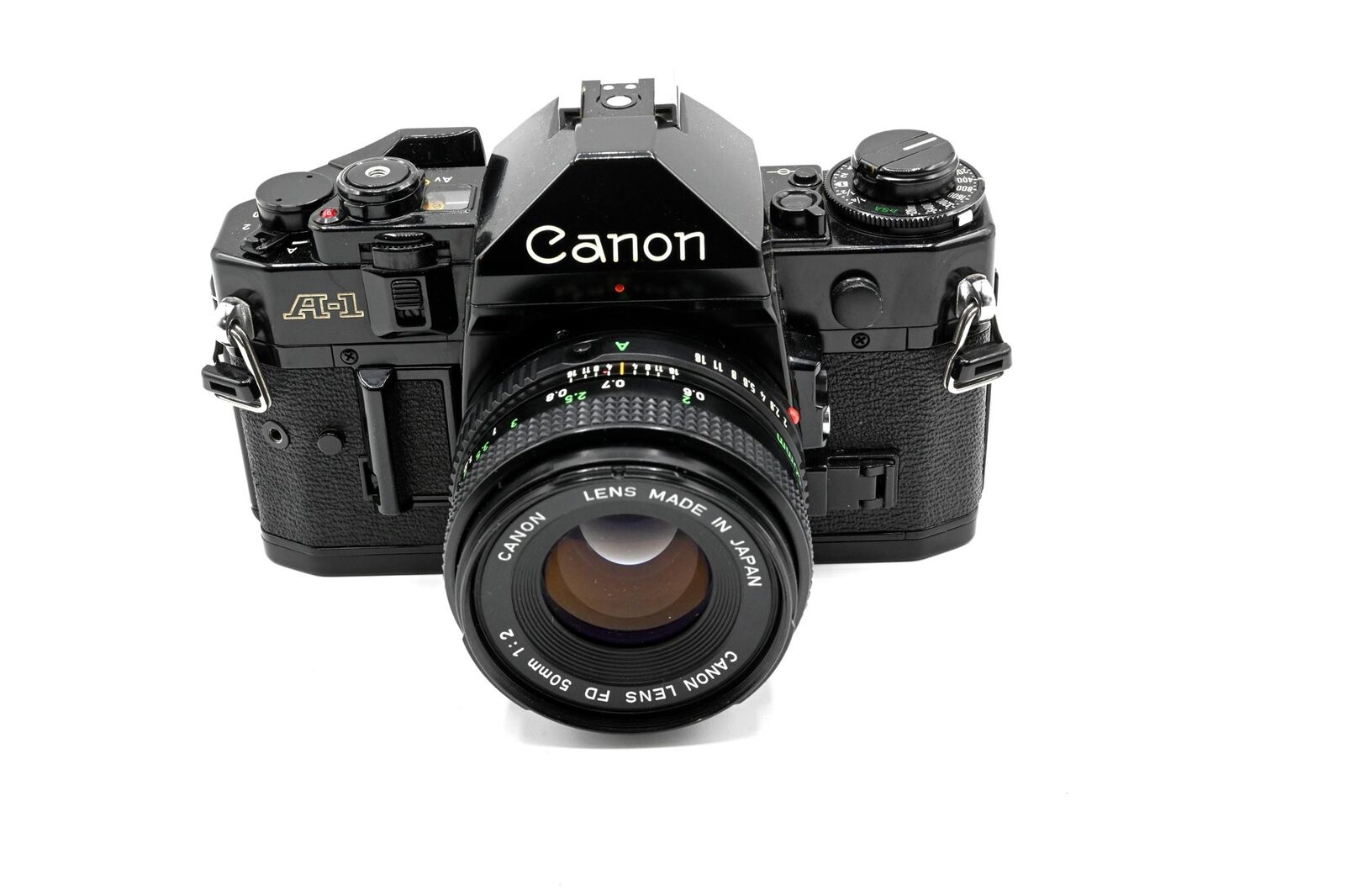
The Canon A-1 is a landmark 35mm film single-lens reflex (SLR) camera introduced in 1978, renowned as the world’s first SLR to offer all four exposure modes—Program (P), Aperture-Priority (A), Shutter-Priority (S), and Manual (M)—in a single body. This innovation cemented its place in photographic history as a pioneering step toward fully automated exposure control in professional-grade SLRs.
Overview
Released at the height of the analog photography era, the Canon A-1 represented a significant technological leap for Canon and the broader SLR market. Positioned between the amateur AE-1 and the professional F-1 in Canon’s FD-mount lineup, the A-1 was designed for advanced amateurs and semi-professional photographers seeking automation without sacrificing manual control. Its introduction coincided with a period of rapid electronic integration in camera design, as manufacturers competed to offer greater ease of use and precision in exposure systems.
The A-1 was built around a microprocessor-controlled system, enabling unprecedented automation for its time. It featured through-the-lens (TTL) metering, an electronically controlled vertical-travel focal-plane shutter, and compatibility with Canon’s full range of FD lenses. Despite its advanced electronics, the camera retained mechanical backup functions—such as a 1/90 sec flash sync speed in manual mode—and maintained robust construction typical of Canon’s high-end models of the era. The A-1’s success helped solidify Canon’s reputation for innovation during the transition from fully mechanical to electronically augmented cameras.
Specifications
| Specification | Value |
| Type | 35mm SLR |
| Film Format | 35mm (135) |
| Years Produced | 1978–1985 |
| Lens Mount | Canon FD (bayonet) |
| Shutter | Electronically controlled vertical-travel focal-plane shutter; speeds from 1 sec to 1/1000 sec, plus Bulb (B), with automatic flash sync at 1/60 sec |
| Metering | TTL full-aperture center-weighted average metering with stop-down capability |
| Exposure Modes | Program AE, Aperture-Priority AE, Shutter-Priority AE, Manual |
| Viewfinder | Fixed pentaprism with 0.92× magnification, 94% coverage; displays shutter speed, aperture, exposure mode, and metering indicators |
| Dimensions | 140 × 90 × 50 mm (5.5 × 3.5 × 2 in); ~590 g (21 oz) body only (with battery) |
Key Features
- World’s first SLR with full PASM exposure modes, offering unprecedented flexibility in exposure control.
- Programmed Auto Exposure mode automatically selects both shutter speed and aperture based on scene luminance and lens used—revolutionary for 1978.
- LED exposure information in viewfinder displays selected shutter speed, aperture, and exposure warning (over/under).
- TTL full-aperture metering allows metering without stopping down, improving viewfinder brightness and enabling predictive depth-of-field preview.
- Compatibility with Canon Speedlite flash units featuring Auto Thyristor, TTL flash metering, and FE (flash exposure) lock.
Historical Context
The Canon A-1 was launched in March 1978, during a pivotal era in camera development when electronics began to supplant mechanical systems in mainstream photography. At the time, most SLRs offered either manual exposure or one form of automation—typically aperture-priority. Competitors like Nikon (with the FE and FM), Pentax (K1000), and Minolta (XD-11) were beginning to integrate electronics, but none offered the comprehensive exposure flexibility of the A-1. The A-1’s Program mode, in particular, was a bold innovation, anticipating the fully automatic cameras that would dominate the 1980s and 1990s.
Canon marketed the A-1 as a technologically advanced yet accessible tool for serious photographers. It was part of the company’s broader “New F-1” generation of FD-mount cameras, which emphasized electronic integration while maintaining compatibility with existing FD lenses. The A-1 received critical acclaim upon release, winning the Camera of the Year award in 1978 from the Japan Camera Press Club. Its success demonstrated strong market demand for automation and influenced subsequent models from Canon and competitors alike, including the Nikon FA and Minolta X-700.
Collectibility & Value
Today, the Canon A-1 is a sought-after classic among film photography enthusiasts and collectors, valued both for its historical significance and practical usability. In good working condition, prices typically range from $150 to $300 USD, depending on shutter functionality, light seals, and cosmetic condition. Fully functional units with clean viewfinders and responsive metering command higher prices, especially when bundled with original accessories or rare Speedlite flashes.
When purchasing an A-1, potential buyers should test the shutter at multiple speeds, verify meter accuracy (often requiring a working PX625 or equivalent 1.35V mercury battery or modern substitute), and check for mirror lag or shutter blackout issues—common in aging electronic SLRs. Light seals should be replaced if deteriorated, and the film advance mechanism should be inspected for smooth operation. While generally reliable, the A-1’s electronic shutter is vulnerable to failure if the battery is left dead inside the camera, leading to capacitor degradation. Units with "chattering" shutters or erratic meter behavior may require professional servicing.
Similar Cameras
- Nikon EM (1979) – Entry-level Nikon SLR with aperture-priority automation, targeted at beginners but lacking manual or program modes.
- Pentax ME-F (1981) – Early autofocus-capable SLR with aperture-priority and program modes, representing Pentax’s push into automation.
- Minolta XD-11 (1977) – Compact dual-priority (shutter and aperture) SLR, predating the A-1’s full program mode but highly regarded for its build and handling.
- Olympus OM-2N (1979) – Advanced OM-series SLR with aperture-priority and manual modes, featuring sophisticated metering but no program mode.
- Canon AE-1 (1976) – Predecessor to the A-1, offering aperture-priority and manual exposure, but lacking shutter-priority and program automation.
Repair & Maintenance
The Canon A-1 operates on a single 6V 4LR44 or 4SR44 battery (originally designed for the 1.35V mercury PX625, now obsolete). Modern users often employ 1.5V alkaline or zinc-air substitutes, though this can affect meter accuracy; voltage regulators or Wein Cell (1.35V lithium) batteries are recommended for precision. The camera’s electronic shutter relies on capacitors that degrade over time, particularly if the battery is left dead in the body. Common issues include shutter speeds becoming inaccurate, especially at slower settings, or complete shutter failure.
Repairing the A-1 requires specialized tools and knowledge, particularly for shutter and circuit board servicing. While some technicians still support the model, parts availability is limited. Routine maintenance includes cleaning the mirror and focusing screen, replacing light seals, and ensuring the film transport mechanism is free of dust and corrosion. Lubrication of the advance lever and shutter cocking mechanism should be performed sparingly to avoid gumming. Given its age, preventive servicing is advisable for regular users. Despite its complexity, the A-1 remains one of the most repairable electronic SLRs of its generation due to its modular design and widespread use.
eBay Listings


![[Near MINT] Canon A-1 35mm SLR Film Camera Body Only From JA](https://i.ebayimg.com/images/g/xnAAAeSwLkJprlyT/s-l1600.jpg)
As an eBay Partner, we earn from qualifying purchases. This helps support our independent vintage technology research.
Service Manuals, Schematics & Catalogs
Related Models
- Canon AE-1 Program (1981-1984)
- Canon AE-1 (1976-1984)
- Canon AL-1 (1982-1985)
- Canon AT-1 (1977-1982)
- Canon AV-1 (1979-1983)
- Alpa 6 (1948-1953)
- Agfa Agfaflex
- Agfa Ambiflex
- Agfa Easy
- Agfa Futura Af zoom