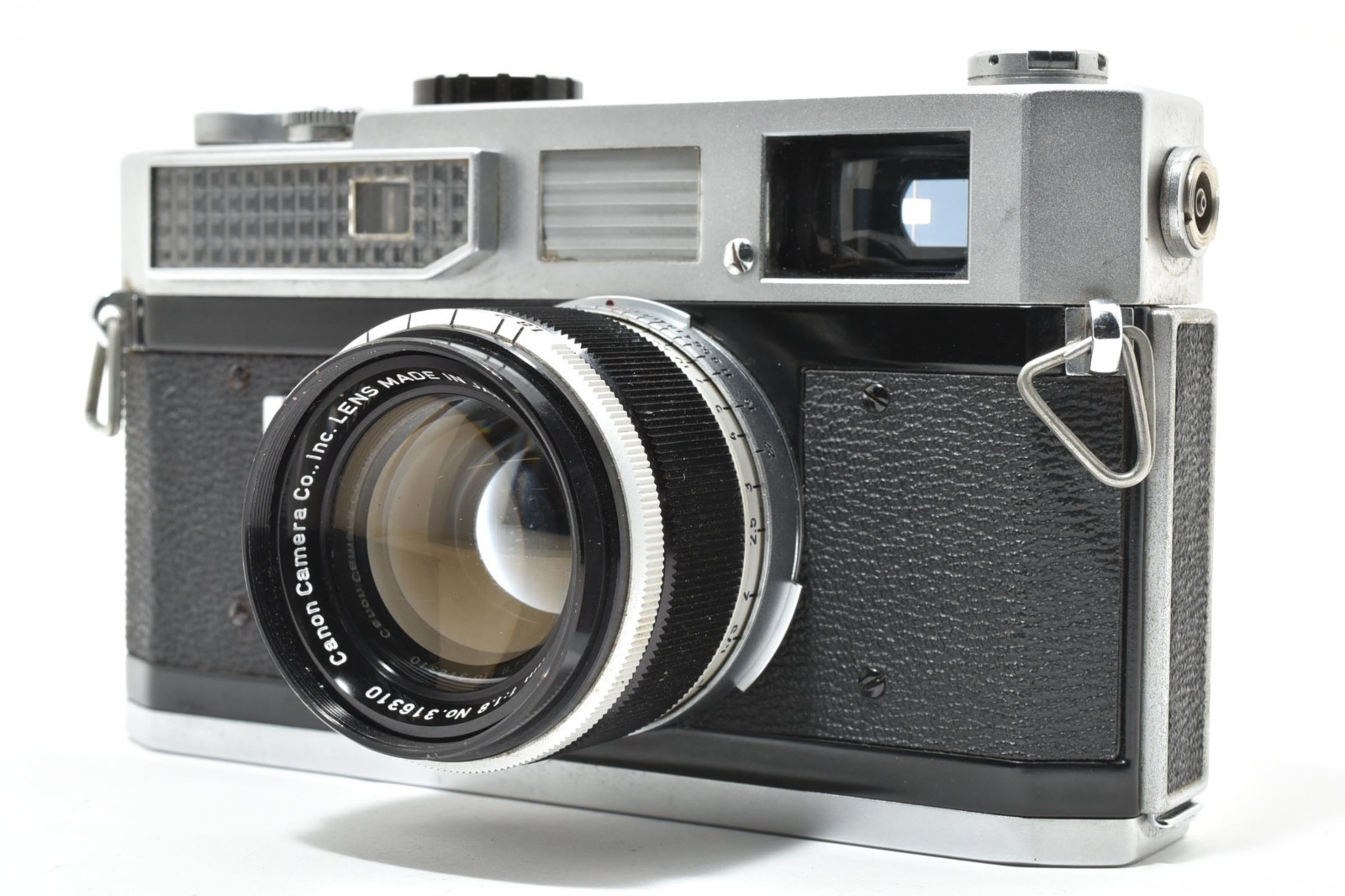
CANON 7
The Canon 7, introduced in 1961, represents the pinnacle of Canon’s 35mm rangefinder development and stands as the final model in the company’s line of screw-mount (Leica Thread Mount, or LTM) rangefinder cameras. It combines advanced mechanical engineering with a built-in selenium-cell exposure meter, offering professional-grade performance and precision in a compact, robust body.
Overview
The Canon 7 was launched at a critical juncture in photographic history, as the industry began transitioning from rangefinder to single-lens reflex (SLR) systems. Positioned as a high-end professional camera, it targeted serious photographers and photojournalists who valued precision focusing, compact design, and reliable mechanical operation. As Canon’s most advanced screw-mount camera, the Canon 7 built upon the foundation of its predecessor, the Canon VT (7S), by introducing a full-frame 28mm–135mm frameline viewfinder, a significantly improved selenium exposure meter with center-weighted averaging, and a redesigned shutter mechanism capable of flash synchronization at all speeds.
The camera was available in both chrome and black finishes, with the black variant being rarer and more collectible. It accepted all standard Leica Thread Mount lenses with focal lengths from 28mm to 135mm, and included an external bayonet mount on the front for attaching Canon’s dedicated wide-angle finders—most notably the Canon 28mm and 35mm supplementary viewfinders—which automatically engaged when mounted. This dual-viewfinder system enhanced composition accuracy for wide-angle work, a feature appreciated by street and architectural photographers.
Historically, the Canon 7 marked the end of an era for Canon’s rangefinder lineage. By 1964, Canon had already introduced the Canon FX, its first 35mm SLR, signaling a strategic pivot toward the SLR market. Production of the Canon 7 continued until 1968, but its relevance waned as SLRs gained dominance due to their through-the-lens viewing and interchangeable lens flexibility. Nevertheless, the Canon 7 remains a benchmark for mechanical rangefinder excellence and is regarded by collectors and historians as one of the finest 35mm rangefinders ever produced.
Specifications
| Specification | Value |
| Type | Rangefinder |
| Film Format | 35mm |
| Years Produced | 1961–1968 |
| Lens Mount | Leica Thread Mount (LTM), 39mm screw |
| Shutter | Cloth focal-plane shutter, speeds from 1 sec to 1/1000 sec + B |
| Metering | Built-in selenium-cell exposure meter, center-weighted |
| Exposure Modes | Manual only; meter aids exposure setting |
| Viewfinder | Combined rangefinder with projected brightlines for 28mm, 35mm, 50mm, 85mm, and 135mm |
| Dimensions | 149 × 89 × 55 mm; ~680 g (body only) |
Key Features
- Built-in Selenium Meter: One of the first rangefinders with a fully integrated, center-weighted selenium meter that required no batteries and provided continuous exposure guidance via a needle visible in the viewfinder.
- Multi-Frameline Viewfinder: Projected brightlines for five focal lengths (28, 35, 50, 85, 135mm), enabling accurate composition across a wide range of lenses.
- External Wide-Angle Bayonet: Dedicated front-mounted bayonet for attaching supplementary viewfinders, improving composition for 28mm and 35mm lenses.
- Flash Sync at All Speeds: Unique among rangefinders of its era, the Canon 7 offered X-sync at every shutter speed from 1 sec to 1/1000 sec, a major advantage for studio and flash photography.
- High-Speed Shutter: Capable of 1/1000 sec, faster than most contemporary rangefinders (e.g., Leica M3 maxed at 1/1000 sec but introduced earlier with 1/1000 as rare), achieved via a dual-travel shutter mechanism.
Historical Context
The Canon 7 was released in 1961 as a direct competitor to the Leica M3, which had set the standard for 35mm rangefinders since 1954. While the M3 offered superior lens coupling and a larger viewfinder, the Canon 7 countered with technological innovations—particularly its advanced metering system and flash synchronization capabilities—that appealed to photographers seeking modern features. Canon aimed to position itself as a technically progressive alternative to Leica, emphasizing reliability, precision engineering, and user-centric design.
Despite its technical merits, the Canon 7 faced an uphill battle in the professional market, where Leica’s brand prestige and extensive lens ecosystem remained dominant. Additionally, the rapid rise of SLRs—offering through-the-lens metering, interchangeable pentaprisms, and superior macro and telephoto capabilities—diminished the appeal of rangefinders by the mid-1960s. Canon itself recognized this shift, investing heavily in SLR development. The Canon 7 thus became a transitional model: the last of the screw-mount line and a swan song for Canon’s rangefinder ambitions.
Collectibility & Value
Today, the Canon 7 is highly sought after by collectors and vintage camera enthusiasts, particularly examples in excellent working condition with original lenses and accessories. Due to its limited production run and the fragility of its selenium meter (which can degrade over time, affecting accuracy), fully functional units command premium prices. Chrome models typically range from $1,200 to $2,000 in good condition, while rare black finishes can exceed $3,000, especially when paired with original Canon LTM lenses like the 50mm f/0.95 or 35mm f/1.8.
When purchasing a Canon 7, collectors should inspect the selenium meter for even darkening or flaking, check shutter speeds with a timing device, and verify rangefinder alignment (critical for sharp focus). Common issues include sticky shutter curtains, worn slow-speed governors, and misaligned rangefinder mechanisms due to impact or aging. Because replacement parts are scarce, repairability is a key consideration. Cameras that have been recently serviced by specialists familiar with Canon’s rangefinder mechanics are significantly more valuable.
Similar Cameras
- Leica M3 (1954–1966) – The benchmark 35mm rangefinder with superior lens coupling and build, but lacking a built-in meter.
- Nikon SP (1957–1962) – Offered multiple framelines and a bright viewfinder, positioned as Nikon’s answer to the M3.
- Contax G2 (1994) – A later, autofocus rangefinder, but shares the precision engineering ethos.
- Canon VT / 7S (1959–1960) – Immediate predecessor to the Canon 7, lacking the full frameline range and advanced meter.
- Minolta 7SII (1962) – A lesser-known Japanese rangefinder with similar feature ambitions but less refined mechanics.
Repair & Maintenance
The Canon 7 requires no batteries for operation—the selenium-cell exposure meter generates its own power from ambient light—but degraded cells are common and cannot be easily replaced or retrofitted with modern alternatives. Shutter maintenance is critical; the 1/1000 sec speed relies on precise tensioning of dual shutter curtains, and misalignment can result in uneven exposure. Common failure points include the slow-speed governor (affecting speeds 1–1/30 sec) and the flash sync mechanism. Rangefinder calibration is essential and requires specialized adjustment tools. Due to the complexity and scarcity of parts, repair should be entrusted only to technicians experienced with vintage Canon rangefinders. Regular use and storage in a dry, temperature-stable environment help preserve functionality.
eBay Listings


As an eBay Partner, we earn from qualifying purchases. This helps support our independent vintage technology research.
Related Models
- Canon P (1959-1961)
- Agfa Optima Sensor 1535
- Argus Argus A
- Argus Argus Autronic (1960)
- Argus Argus C-44R
- Argus Argus C
- Argus Argus C2
- Argus Argus C3 (1939-1966)
- Argus Argus C44R
- Argus C-44R