Canon 1014 XL-S (1978–1983)
The first Super 8 camera with a CPU, and still a benchmark for image precision and mechanical sophistication.
Overview
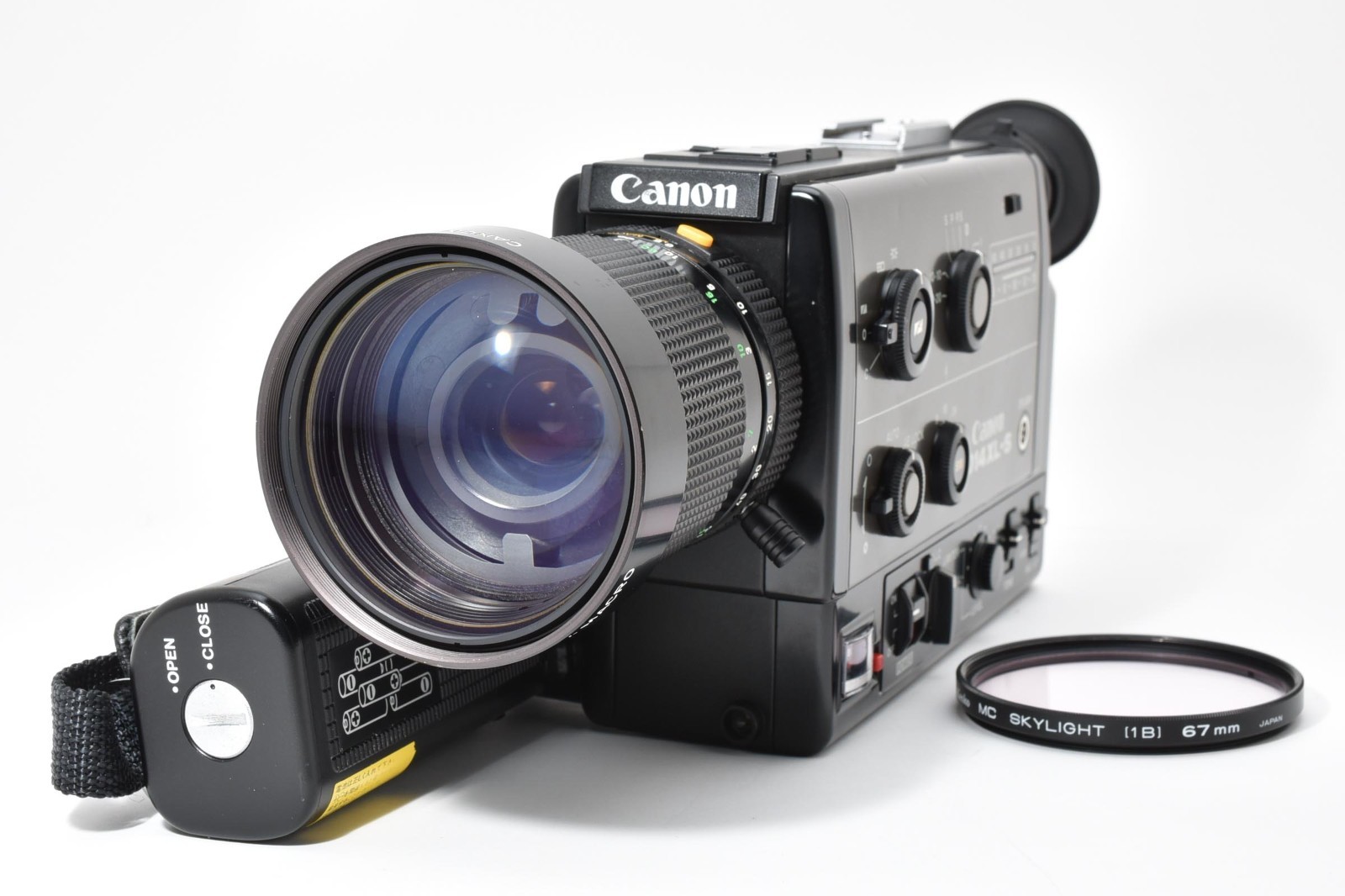
You pick up the Canon 1014 XL-S and immediately understand why some collectors call it the “holy grail” of Super 8. It’s not just heavy—it’s substantial, 2.1 kilograms with batteries, like a well-balanced instrument that means business. This isn’t some plastic toy from the video boom; it’s a precision-engineered film camera built when Super 8 was peaking, just before the digital avalanche. Released in 1978 as Canon’s top-tier model, the 1014 XL-S wasn’t just another step in the lineup—it was a statement. With its 6.5–65mm f/1.4 lens, TTL servo AE, and a CPU managing everything from exposure to zoom timing, it was a technological marvel for its time. And it shows.
Owners report it’s a joy to use—solid, responsive, and built with a mix of high-quality plastics and metal that feels durable without being crude. The single-lens reflex viewfinder is often described as “bright and clear, making it easy to compose shots,” almost like looking through a living room window. That’s no exaggeration: the image is large, sharp, and framed by a built-in eye cup that blocks stray light. You get real-time feedback with a superimposed display that only appears when needed—Canon called it smart, and decades later, it still feels ahead of its time.
It shoots both sound and silent Super 8 film in 50-foot cartridges, with frame rates from 9 to 36 fps, including instant slow motion at approximately 36 fps in silent mode. The camera handles exposure with a Silicon Photo Cell and a five-blade diaphragm, delivering not just accuracy but a pleasing bokeh that many say is a cut above other Super 8 cameras. Whether you’re using auto exposure or diving into manual control via the power-adjustable aperture, the system responds predictably. And if you’re shooting in tricky light, the backlight compensation and six-step exposure compensation give you real creative control.
But make no mistake—this is a machine of its era. It runs on six AA batteries, housed in a folding grip, and while battery life is decent (around 7 sound cartridges under normal conditions), it’s not infinite. The power zoom offers two speeds—high (about 5 seconds) and low (9 seconds)—and can be switched to manual via a clutch system. The lens itself is no slouch: 17 elements in 13 groups, Spectra-coated, with a 10x zoom range. It’s not just sharp; it’s pin sharp, according to users, and the macro mode—engaged by flipping a lever at either zoom extreme—lets you get remarkably close, down to 250 mm from the film plane at wide angle.
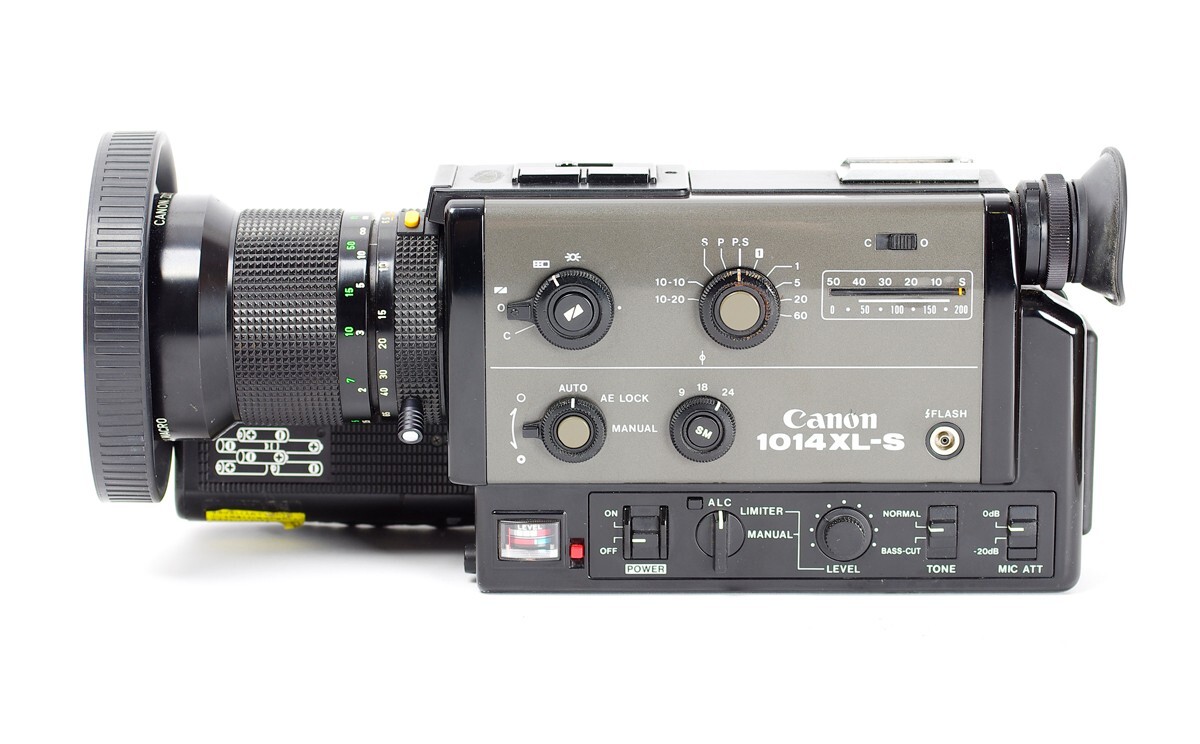
And then there’s the sound. The 1014 XL-S records magnetically on Super 8 film with a frequency response of 150–5000 Hz (±3 dB at 18 fps), a signal-to-noise ratio of at least 43 dBv, and distortion under 4%. For a format where audio was often an afterthought, this is serious. You can monitor levels via an LED in the viewfinder, a meter, or an 8-ohm earphone. There’s ALC, manual recording with limiter, bass cut, and even mixing between the built-in mic and an auxiliary input. It’s not studio quality, but for on-the-go magnetic sound, it’s very good—some say the best in Super 8.
Specifications
| Manufacturer | Canon |
| Production years | 1978–1983 |
| Image Size | 4.2 x 5.7 mm (Projection image size: 4 x 5.4mm) |
| Lens Focal Length/Speed | 6.5 - 65mm f/1.4 (17 elements in 13 groups). Spectra coating. |
| Zooming Ratio | 10x |
| Focusing | Manual (Front lens group rotating method), 1.2 m to infinity. Macro focusing, Split Image Focusing. |
| Macro shooting | Close distance shooting by turning the zooming/macro setting lever to "Macro" at wide-angle or telephoto end. |
| Wide-angle macro | 250 mm from the film plane mark(100 mm from the lens top)/Field of view: 87 x 120 mm |
| Telephoto macro | 720 mm from the film plane mark (560 mm from the lens top)/Field of view: 33 x 46 mm |
| Zooming | Power zooming: 2 speeds of H (Approx. 5 sec.) and L (Approx. 9 sec.). Manual zooming with zooming ring (Clutch-switching system). Rotation angle: 130 degrees. |
| Filter Size | 72 mm (To be attached on the rubber hood.) |
| Viewfinder | Single-lens reflex type (built-in eye cup and eyepiece shutter) |
| Rangefinder | Split-image rangefinder |
| Dioptric Adjustment | -5 to +3 diopter |
| Viewfinder Information | Aperture value, over/under exposure warnings, film end precaution/film end display (END mark)/film jam in the cartridge/battery power too low, manual aperture control (LED), sound recording level (LED) and footage indication needle. |
| Exposure Control | TTL Servo AE with SPC (5 blades diaphragm) |
| Exposure | Manual / Auto Exposure, Backlight Control +/- correction for auto exposure |
| Metering Range | ISO 400, f/1.4, 9 fps, shutter opening at 220 degrees, without CCA filter - ISO 25, f/45, 36 fps, shutter opening at 150 degrees, with CCA filter (Tungsten type film) |
| Film Speed Automatic ISO setting by film cartridge | Tungsten type film: ISO 25, 40, 64, 100, 160, 250 and 400 |
| Film Speed Automatic ISO setting by film cartridge | Daylight type film: ISO 16, 25, 40, 64, 100, 160 and 250 |
| CCA Filter | The CCA filter is automatically cancelled with loading of a daylight type film cartridge. Manual cancellation of the CCA filter is possible with the CCA filter switch. |
| AE Lock | Possible |
| Exposure Compensation | Six steps compensation: -1, -0.6, -0.3, 0, +0.3, +0.6 and +1 stops |
| Manual Aperture Control | Power manual aperture control |
| Film Drive | High performance micro motors (with an AC tachometer generator) |
| Filming Speed | Sound cartridge: (1, 9 in silent shooting modus), 18 and 24 fps |
| Filming Speed | Silent cartridge: 1, 9, 18 and 24 fps, instant slow motion (approx. 36 fps) |
| Frame rates | 9, 18, 24, 36 + single frame |
| Footage Counter | Counts up. Automatic resetting by unloading of a cartridge. Counts up for 0 - 50 ft and counts down for 200 - 0 sec. |
| Shutter Opening | Two steps opening of 150 and 220 degrees (with automatic exposure compensation). |
| Shutter blades | controlled by independent DC micro-motors. |
| Fading | Automatic fading by variable shutter opening (220 - 0 degrees). Fading of both picture and sound, picture only or sound only is possible. |
| Lap Dissolve | Simultaneous picture and sound dissolve with automatic rewinding mechanism (Rewinding approx. 90 frames) and automatic fading mechanism. |
| Flash Synchronization | Synchronizes at single frame shooting. |
| Release System | Magnet release system |
| Sound | Magnetic recording system on Super 8 sound film. Double recording system with pulse signal synchronization is possible using a tape recorder. |
| Microphone | 3.5 mm diameter mini jack. Input impedance: Approx. 5 K ohm. Usable microphone: Low impedance type. Minimum input sensitivity: -80 dB (0 dB=1 V) |
| Accessory Microphone | Omnidirectional dynamic microphone with built-in wind screen. Output impedance: 400 ohm. |
| Aux. Input | 3.5 mm diameter mini jack. Minimum input impedance: Approx 50 K ohm. Usable microphone: Low impedance type. Minimum input sensitivity: -20 dB (0 dB=1 V) |
| Mixing | Mixing of microphone input and aux. input is available. |
| Sound Monitor | Monitoring is possible with the level meter, LED monitor indicator in the viewfinder and an earphone (8 ohm). |
| Audio Level Control | Automatic level control (ALC). Manual recording or manual recording with limiter. The microphone attenuator can be set at 0 dB or -20 dB. |
| Sound Fading | Available |
| Tone Control | Normal or bass cut (100 Hz - 1K Hz -13 dB) |
| Recording Characteristics | Frequency characteristics: 150 – 5000 Hz (+/-3 dB, 18 fps). S/N ratio: Min. 43 dBv (Sound recording with audibility compensation at saturated level). Distortion rate: Max. 4%, Wow and flutter: Max. 0.4% (WRMS). Speed deviation: Max. +/-4%. |
| Earphone Output | Usable earphone impedance: 8 ohm |
| Self-timer | Built-in. Either 10 sec. shooting with 10 sec. delay or 20 sec. shooting with 10 sec. delay. |
| Interval Timer | Built-in. One frame shooting for every 1, 5, 20 or 60 sec. |
| Remote Control | 2.5 mm diameter mini jack. Possible with a remote control switch or a remote switch on a microphone. |
| Power Source | Six AA batteries. External power source can be used. |
| Power requirement | 9V |
| External power socket polarity | The centre pin of the socket is negative ...therefore the sleeve will be positive. |
| Battery Life | Sufficient power for approx. 7 sound cartridges or approx. 10 silent cartridges (Under normal temperature, 18 fps) |
| Battery Check | Battery check with a meter (Works as a level indicator also.) |
| Main Switch | Two way switch of on and off |
| Grip | Folding type. Contains batteries. |
| Others | Cue light (red LED), accessory shoe (for boom microphone), exclusive external power pack jack and pulse-sync (8-pin DIN jack) |
| Film capacity | Standard 50ft film cartridges |
| Compatible wide-angle lens attachment thread size | 67mm |
| Made in Japan | Made in Japan |
| Dimensions (W x H x D) | 59.5 x 113.5 x 264 mm |
| Weight (Body only) | 1990 g |
| Weight (Including batteries) | 2100 g |
Key Features
The First Super 8 Camera with a CPU
The Canon 1014 XL-S wasn’t just advanced—it was pioneering. It became the first Super 8 camera to include a CPU, enabling electronic sequence control over nearly every function. That microprocessor governs the timing circuit with precision, ensuring stable frame rates and accurate exposure transitions. It’s what makes features like lap dissolve, automatic fading, and interval shooting not just possible, but reliable. This isn’t analog guesswork; it’s digital command of a mechanical system, and it shows in the consistency of the footage.
Smart Viewfinder Display
Canon’s superimposed viewfinder display was revolutionary. Instead of cluttering your shot with constant readouts, it only shows critical info—aperture, exposure warnings, film status, audio levels—when needed. The rest of the time, it’s out of your way. Combine that with the split-image rangefinder and dioptric adjustment (-5 to +3), and focusing becomes fast and accurate, even in dim light. The reflex viewfinder gives you exactly what the lens sees, no parallax, no surprises.
Precision Lens and Macro System
That f/1.4 zoom lens isn’t just fast—it’s optically dense, with 17 elements in 13 groups and Canon’s Spectra coating to reduce flare. The manual focus operates via front-group rotation, a method that preserves balance and feel. Flip the macro lever, and you can shoot as close as 250 mm at wide angle or 720 mm at telephoto. It’s not a screw-on adapter; it’s built-in, mechanical, and surprisingly effective. And while there’s a 67mm thread for a wide-angle attachment, one user notes, “You’ll rarely need it. I have one and virtually never use it.”
Power Zoom and Manual Override
The power zoom, controlled from the top plate, offers two speeds—high and low—giving you cinematic zooms with consistent timing. But if you prefer tactile control, a clutch-switching system lets you disengage the motor and zoom manually via the ring. It’s a thoughtful touch that respects both convenience and craft.
Sound Recording That Actually Works
Super 8 sound was often an afterthought, but not here. The 1014 XL-S supports magnetic recording with ALC, manual control, limiter, and even bass cut. You can mix the built-in mic with an auxiliary input, monitor via earphone, and adjust levels on the fly. The specs—43 dBv S/N ratio, under 4% distortion—aren’t studio grade, but for the format, they’re excellent. One user summed it up: “The sound recording is described as very good for a Super 8 camera.”
Advanced Film Handling
The “butterfly” film door makes loading simple and secure. The footage counter runs up from 0 to 50 feet, then counts down from 200 to 0 seconds, resetting automatically when you remove the cartridge. The film drive uses high-performance micro motors with an AC tachometer generator, ensuring stable speed. And with frame rates from 9 to 36 fps—including single-frame and interval shooting—it’s a tool for both home movies and experimental film.
Historical Context
The Canon 1014 XL-S arrived in 1978 as the flagship of Canon’s “XL” line—“XL” standing for “existing light,” a nod to its low-light capabilities thanks to that fast f/1.4 lens. It was the successor to the Canon 1014 Electronic and represented the peak of Super 8 engineering, released just as home video cameras were starting to become practical household gadgets. While formats like Betamax and VHS were emerging, the 1014 XL-S doubled down on film, offering a level of image quality and mechanical sophistication that tape couldn’t match—at least not yet.
It competed directly with high-end models like the Nikon R10 Super 8 camera, but with its CPU, reflex viewfinder, and advanced sound system, the 1014 XL-S stood apart. It wasn’t just one of the finest Super 8 cameras of its time—it was one of the last great ones before the analog film era began its slow retreat.
Collectibility & Value
The Canon 1014 XL-S is consistently described as “one of the best Super 8 cameras ever made,” “extremely popular, solid, and sought-after,” and “a holy grail for many Super 8 enthusiasts.” Its reputation for reliability and workmanship even leads some to prefer it over the Nizo 6080. However, it’s not without quirks: owners note it’s “fairly noisy” during operation, a trade-off for its complex internal mechanics.
While specific resale prices aren’t fully detailed in the fact sheet, listings such as “All Work N Canon 1014xl S Super 8 Bm” suggest active trading on platforms like eBay and Etsy. Given its status, condition is critical—look for clean viewfinders, responsive zoom, and intact rubber components. The circuitry is complex, so functional testing is essential. Battery corrosion in the grip is a known risk, and the external power socket has a non-standard polarity (center negative), so using the wrong adapter can damage the camera.
Still, for those who value precision, build quality, and the tactile joy of film, the 1014 XL-S remains a benchmark. It’s not just a camera—it’s a complete filmmaking system in one body.
eBay Listings


As an eBay Partner, we earn from qualifying purchases. This helps support our independent vintage technology research.
Service Manuals, Schematics & Catalogs
- Catalog (1991) — archive.org
- Catalog (1991) — archive.org
Related Models
- Canon 518 SV (1978)
- Arriflex 16 BL (1965)
- Arriflex 16 SR (1975)
- Arriflex 16 ST (1952)
- Arriflex 35 BL (1972)
- Arriflex 35 IIC (1964)
- Beaulieu 4008 ZM II (1977)
- Beaulieu 5008 S (1976)
- Bell & Howell 134 (1940)
- Bell & Howell 2709 (1912)