BRONICA S2
The Bronica S2 is a mechanically operated, medium format single-lens reflex (SLR) camera introduced in 1965 as an evolution of the original Bronica S. Designed for professional and advanced amateur photographers, the S2 delivers high-quality 6x6cm images on 120 or 220 roll film and features a modular design with interchangeable components. It played a pivotal role in establishing Bronica as a serious competitor to Hasselblad in the medium format market.
Overview
Released in 1965 by the Japanese manufacturer Zenzaburō Yoshino (operating under the Bronica brand), the S2 was developed as a refined successor to the original Bronica S (1959). It targeted photographers seeking a more affordable, yet robust and reliable alternative to the dominant Hasselblad 500 series. The S2 retained the core modular philosophy of its predecessor—featuring interchangeable film backs, viewfinders, and lenses—but introduced significant mechanical improvements, including a redesigned film transport mechanism, enhanced shutter reliability, and a more ergonomic body layout.
The camera was marketed primarily to professional studio photographers, photojournalists, and serious enthusiasts who required the image quality of 6x6cm film without the premium price tag of European systems. Its focal plane shutter design allowed for flash synchronization at all shutter speeds—a critical advantage over leaf-shutter systems that were limited to 1/30s or 1/60s sync. This feature made the S2 particularly popular in studio and event photography where electronic flash was routinely used.
The S2 was part of Bronica’s S-series, which emphasized modularity and precision engineering. It was succeeded in 1972 by the S2A (with a built-in light meter) and later by the S2A with AE finder and the SQ series in the late 1970s. Despite its mechanical simplicity, the S2 remained in production until 1977, a testament to its durability and user satisfaction. Its legacy endures among film photographers who appreciate its straightforward operation, excellent optics, and mechanical reliability.
Specifications
| Specification | Value |
| Type | Single-Lens Reflex (SLR) |
| Film Format | 6x6cm on 120 or 220 roll film |
| Years Produced | 1965–1977 |
| Lens Mount | Bronica Bayonet Mount (S-mount) |
| Shutter | Focal plane shutter; speeds 1 – 1/1000 sec, B, X-sync |
| Shutter Speeds | 1, 1/2, 1/4, 1/8, 1/15, 1/30, 1/60, 1/125, 1/250, 1/500, 1/1000 sec, B |
| Flash Sync | X-sync at all speeds; PC terminal and hot shoe |
| Metering | None (unmetered body) |
| Exposure Modes | Manual only |
| Viewfinder | Interchangeable waist-level or prism finders (no built-in metering) |
| Focusing Screen | Removable, interchangeable ground glass |
| Film Backs | Interchangeable roll film backs (120 or 220) with dark slide |
| Lens Compatibility | Bronica S-mount lenses (e.g., 65mm f/4.5, 80mm f/2.8, 150mm f/3.5, 250mm f/5.6) |
| Aperture Control | Manual, lens-mounted aperture ring |
| Dimensions | Approx. 100mm (W) × 95mm (H) × 75mm (D) without lens or back |
| Weight | Approx. 780g (body only, without lens or film back) |
Key Features
- Focal Plane Shutter with All-Speed Flash Sync: Unlike many medium format SLRs of the era that used leaf shutters, the S2’s focal plane shutter enables X-sync at all speeds up to 1/1000 sec, making it ideal for studio flash and high-speed daylight fill.
- Modular Design: Fully interchangeable film backs, viewfinders, and lenses allow rapid film changes and system customization—critical for professionals shooting multiple rolls or film types.
- Removable Helical Focusing Mount: The lens board uses a helical focusing mechanism that allows precise manual focusing and compatibility with a wide range of S-mount lenses.
- 120 and 220 Film Compatibility: Interchangeable film backs support both 120 (12 exposures) and 220 (24 exposures) film, offering flexibility in shooting volume and development.
- Mechanical Reliability: Entirely mechanical operation (no batteries required) ensures consistent performance in diverse environments and long-term durability.
Historical Context
The Bronica S2 was introduced at a time when medium format photography was transitioning from press cameras and folding models to modular SLRs. The success of the Hasselblad 500C had demonstrated the demand for professional-grade, interchangeable systems, but its high cost limited accessibility. Bronica positioned the S2 as a precision-engineered, Japanese-made alternative that offered comparable functionality at a more competitive price point.
The S2 benefited from Japan’s post-war industrial growth and rising reputation for high-quality optical and mechanical engineering. It competed directly with the Rolleiflex SL66 and early Kowa products, though it was more closely aligned with the Hasselblad in form and function. Its focal plane shutter distinguished it from most contemporaries, which relied on leaf shutters in lenses—a more expensive and less flexible solution. This design choice allowed Bronica to offer faster shutter speeds and universal flash sync, appealing to commercial and portrait photographers.
Market reception was strong, particularly in Asia, Europe, and North America among working photographers who needed reliability and modularity without the Hasselblad premium. The S2’s success laid the foundation for Bronica’s subsequent models, including the metered S2A and the square-format SQ series. It also helped establish the brand as a credible alternative in professional photography circles.
Collectibility & Value
Today, the Bronica S2 is valued by film photography enthusiasts and collectors for its mechanical simplicity, modularity, and historical significance. While not as rare as some limited-production European models, original, fully functional S2 bodies in good condition typically sell for $250–$450 USD, depending on included accessories and cosmetic state. Complete systems with multiple film backs, finders, and lenses—especially the fast 80mm f/2.8 normal lens—can command $800–$1,200 or more.
When purchasing an S2, buyers should inspect for key issues: shutter accuracy (particularly at high speeds), mirror movement smoothness, film back dark slide integrity, and light seals (which often degrade and should be replaced). The focal plane shutter curtains are fabric-based and susceptible to pinholes or uneven tension if stored improperly. Additionally, the film advance mechanism should be tested for double-exposure prevention function and smooth cocking.
The S2’s lack of built-in metering is not a drawback for experienced film users but may deter beginners. However, this also means no battery dependency—enhancing long-term reliability. Original accessories, such as the AE prism finder (used on later models), waist-level finders, and rare lenses like the 50mm f/4.5 wide-angle, significantly increase a system’s value. Well-maintained examples with proven service history are increasingly sought after in the analog revival market.
Similar Cameras
- Hasselblad 500C – The benchmark medium format SLR with leaf shutter lenses, modular design, and high resale value.
- Rolleiflex SL66 – German-engineered SLR with built-in bellows focusing and leaf shutter system, popular in studio work.
- Kowa Six SE – Japanese 6x6 SLR with interchangeable back and prism, less common but similarly priced.
- Pentacon Six TL – East German SLR with focal plane shutter and wide lens selection, known for affordability and character.
- Mamiya C330 – Twin-lens reflex (TLR) system with interchangeable lenses and focusing, though not an SLR, it served a similar market.
Repair & Maintenance
The Bronica S2 requires no batteries for operation, relying entirely on mechanical shutter and manual film advance. This makes it highly reliable but necessitates regular mechanical servicing for optimal performance. Common issues include worn shutter curtains, sticky focal plane shutter blades, and degraded light seals in film backs—replacement of which is essential to prevent light leaks.
The camera’s modular design simplifies maintenance: film backs, finders, and lenses can be serviced independently. However, internal shutter and mirror mechanism repairs should be performed by technicians experienced with medium format focal plane shutters. Lubrication of the helical focusing mount and film transport gears is recommended during CLA (clean, lubricate, adjust) services.
Due to its age, finding original spare parts can be challenging, though third-party suppliers and online communities (e.g., Bronica-specific forums) often provide solutions. Routine care includes keeping the camera dry, storing it with the shutter uncocked, and avoiding extreme temperatures. With proper maintenance, a Bronica S2 can remain functional for decades, making it a durable and rewarding choice for medium format film photography.
eBay Listings
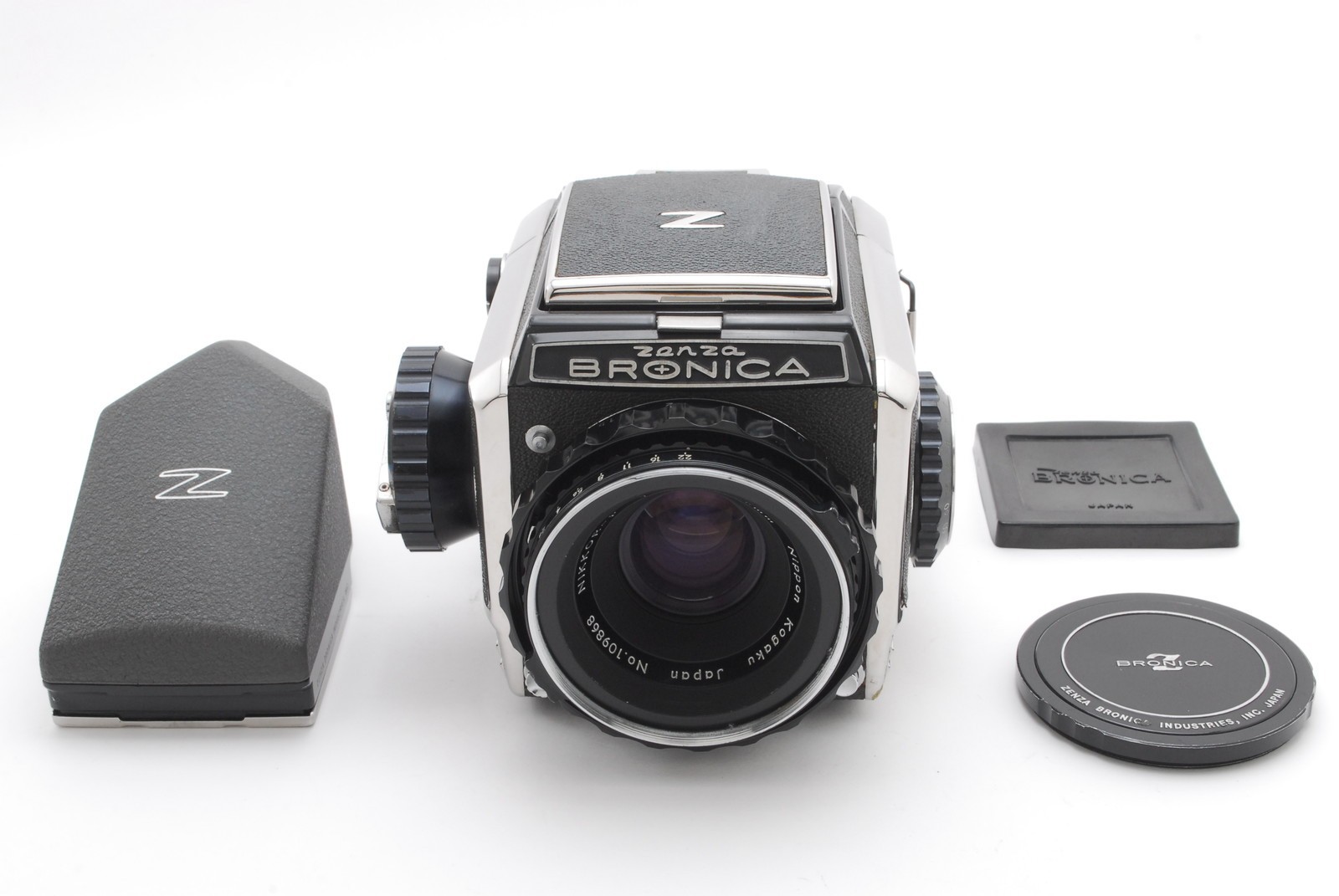
![[Near MINT] Zenza Bronica S2A Film Camera Nikkor P.C 75mm f2](https://i.ebayimg.com/images/g/YVUAAeSwbB9opvNI/s-l1600.jpg)


As an eBay Partner, we earn from qualifying purchases. This helps support our independent vintage technology research.