BRONICA S
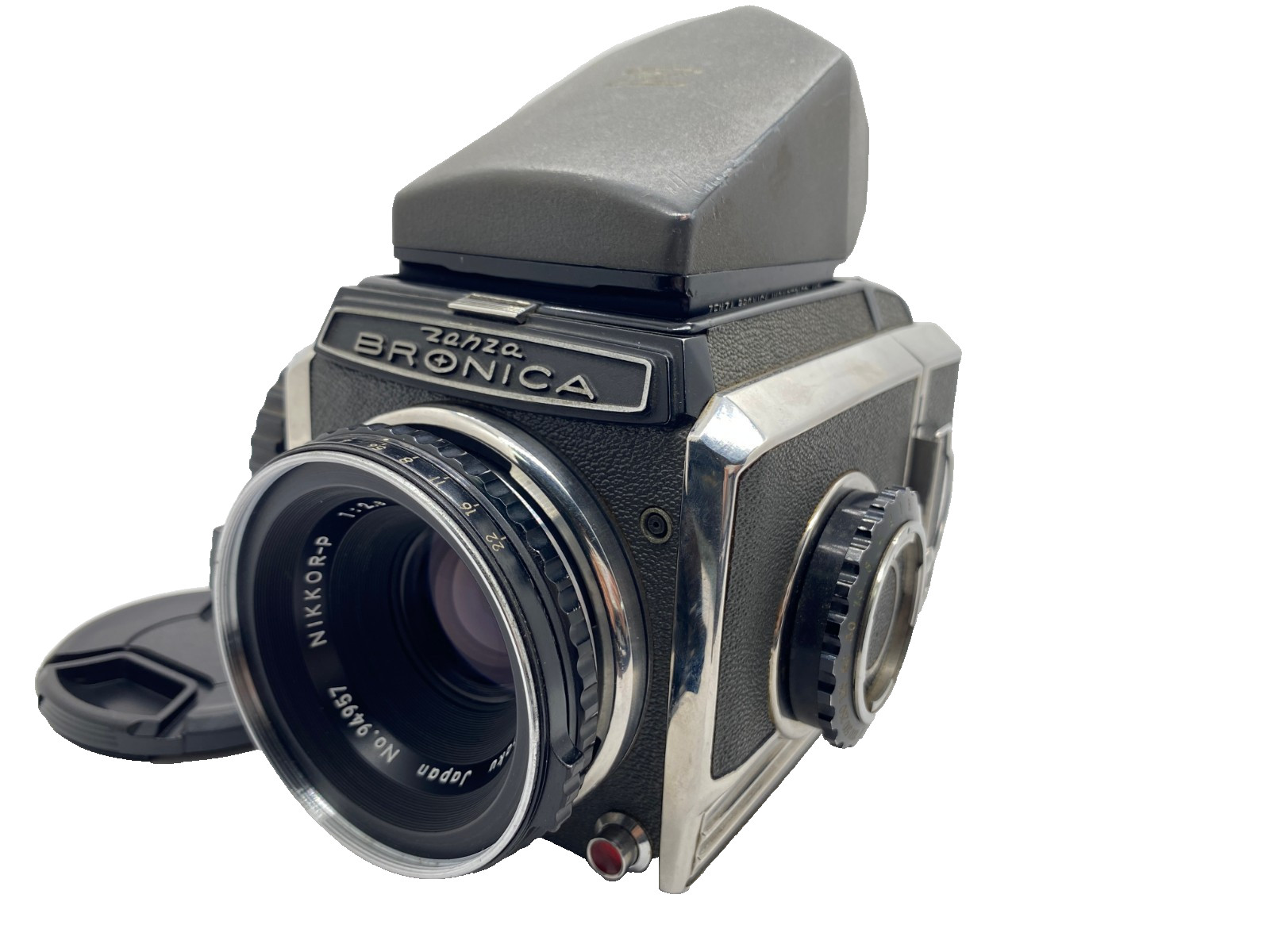
The Bronica S is a medium format single-lens reflex (SLR) camera introduced in 1961 by the Japanese manufacturer Zenza Bronica. It marked the company’s debut into the professional medium format market, offering a modular, interchangeable system camera designed for studio and field photographers seeking a more compact and affordable alternative to the dominant Hasselblad 500C.
Overview
The Bronica S was the first in the S-series, a line of 6×6cm SLRs that established Bronica as a serious contender in the medium format arena. Released in 1961, the camera was engineered to deliver high image quality with a robust yet lightweight aluminum alloy body, targeting professional photographers and advanced amateurs who required reliability and precision without the premium price tag of Swedish competitors. The S was notable for its innovative helical focus mechanism and a newly designed waist-level finder system, both of which contributed to its reputation for sharp focusing and ergonomic handling.
Built around a modular system, the Bronica S allowed for interchangeable lenses, viewfinders, and film backs—though early film backs were not fully interchangeable mid-roll, limiting some of the system’s flexibility compared to later models. Despite this limitation, the S-series laid the foundation for Bronica’s future developments, including the S2 and eventually the highly successful SQ and ETR series. The camera was primarily marketed in Japan and Europe, gaining a loyal following among portrait, commercial, and architectural photographers who valued its mechanical reliability and optical performance.
The Bronica S was produced until 1965, when it was succeeded by the S2, which introduced a more refined shutter mechanism and improved film transport. While the S lacked built-in metering and relied entirely on manual exposure control, its mechanical simplicity has contributed to its longevity and appeal among collectors and film enthusiasts today.
Specifications
| Specification | Value |
| Type | Single-Lens Reflex (SLR) |
| Film Format | 6×6 cm (120 roll film) |
| Years Produced | 1961–1965 |
| Lens Mount | Bronica Bayonet Mount (early variant) |
| Shutter | Focal-plane cloth shutter, speeds 1 sec to 1/500 sec + B |
| Metering | None (manual exposure only) |
| Exposure Modes | Manual only |
| Viewfinder | Interchangeable waist-level finder with pop-up magnifier; optional prism finders |
| Dimensions | Approx. 105 × 95 × 185 mm (body only); Weight: ~850 g (body only, without film back or lens) |
Key Features
- Helical Focus Mechanism: The Bronica S employed a helical focusing system integrated into the lens standard, allowing for precise manual focus with smooth action—uncommon in medium format SLRs of the era, which often used rack-and-pinion focusing.
- New Finder System: Introduced a proprietary, detachable waist-level finder with a high-quality ground glass screen and pop-up magnifier, improving composition and focusing accuracy.
- Interchangeable Components: Supported lens interchangeability and optional viewfinders (waist-level and prism), establishing Bronica’s modular system philosophy.
- Focal-Plane Shutter: Enabled flash synchronization at all shutter speeds via PC terminal, a significant advantage over leaf-shutter systems limited to X-sync at slower speeds.
- Compact Build: Constructed from lightweight aluminum alloy, the S was significantly smaller and lighter than contemporaries like the Hasselblad 500C, enhancing portability.
Historical Context
The Bronica S was launched at a time when medium format photography was dominated by a few high-end European manufacturers, particularly Hasselblad and Rollei. These systems offered excellent image quality but came with correspondingly high prices and complex servicing requirements. Zenza Bronica, originally a manufacturer of rangefinder camera parts and accessories, seized the opportunity to introduce a more accessible system camera aimed at professionals seeking a cost-effective alternative without sacrificing modularity or build quality.
The S-series was Bronica’s first major foray into system camera design, and its release in 1961 positioned the company as an innovator in Japanese medium format engineering. The camera competed directly with the early Rolleiflex SL66 and Hasselblad 500 series, though it lacked certain refinements such as interchangeable film backs that could be swapped mid-roll. Nevertheless, its use of a focal-plane shutter allowed for flash sync at all speeds—a feature not available on many leaf-shutter-based systems—and its bayonet lens mount facilitated faster lens changes than screw-mount alternatives.
Market reception was positive, particularly in Japan and parts of continental Europe, where photographers appreciated the camera’s mechanical robustness and optical compatibility with high-quality lenses from Nippon Kogaku (Nikkor) and other Japanese optics firms. While it never achieved the global prestige of Hasselblad, the Bronica S carved out a niche and demonstrated that Japanese manufacturers could produce sophisticated, modular medium format systems.
Collectibility & Value
The Bronica S is considered a collectible item among medium format enthusiasts and vintage camera collectors, though it remains less sought-after than later Bronica models such as the ETR or GS-1. Due to its production period of only four years and relatively limited export volume, original, fully functional units in good condition are increasingly rare. As of 2024, a complete Bronica S kit (body, lens, finder, and film back) in working order typically sells for $400–$700 USD, depending on condition and included accessories.
When purchasing a Bronica S, collectors should inspect several critical components: the focal-plane shutter for consistency across all speeds (common issues include uneven travel or light leaks due to aging cloth), the film back for dark slides that seat properly and film pressure plate tension, and the lens mount for wear or misalignment. The helical focusing mechanism should operate smoothly without play or binding. Because the camera lacks built-in metering, light meter compatibility is not a concern, but original finders—especially prism variants—are desirable and can significantly increase value if present.
Common issues include light leaks from deteriorated film back seals, shutter curtain degradation, and lubricant hardening in older units that have not been serviced. However, the mechanical simplicity of the S makes it relatively easier to repair than later electronically controlled models. Replacement parts are scarce, but dedicated repair technicians and niche suppliers still support the Bronica community.
Similar Cameras
- Hasselblad 500C (1957–1970) – The benchmark medium format SLR, offering superior build and full modularity, but at a higher cost and weight.
- Rolleiflex SL66 (1966–1992) – Introduced after the Bronica S, but shared similar professional aspirations with built-in bellows focusing and lens reversibility.
- Koni-Omega Rapid Pro (1960s) – A press-oriented medium format SLR with interchangeable backs and a focal-plane shutter, though less refined optically and ergonomically.
- Plaubel Makina 67 (1962–1966) – A high-end 6×7cm folder with superb optics, but not modular like the Bronica S.
- Minolta Autocord (TLR, 1958–1967) – Though a twin-lens reflex, it competed in the same market segment for professional 6×6cm imaging.
Repair & Maintenance
The Bronica S requires no batteries, as it is fully mechanical—making it reliable and simple to operate with minimal maintenance. However, regular servicing is recommended for long-term use. The focal-plane shutter should be checked for uniform speed accuracy, particularly at 1/30 and 1/60 sec, where timing inconsistencies are common in un-serviced units. Lubrication of the film transport and shutter cocking mechanisms is essential if the camera has been in storage.
Common repair challenges include sourcing replacement shutter curtains and dark slide components, as original parts are no longer manufactured. However, specialized camera technicians in Japan and North America continue to service Bronica gear, and community-driven resources provide schematics and repair guides. Keeping the camera stored in a dry, temperature-stable environment prevents fungus growth in lenses and preserves the integrity of leatherette and foam seals.
eBay Listings


As an eBay Partner, we earn from qualifying purchases. This helps support our independent vintage technology research.
Service Manuals & Schematics
- Owner's Manual — archive.org
- Owner's Manual — archive.org