BRONICA ETRSI
The Bronica ETRSi is a 6×4.5cm medium format single-lens reflex (SLR) camera produced by the Japanese manufacturer Zenza Bronica from 1984 to 1995. As an advanced evolution of the earlier ETR series, the ETRSi incorporates improved electronics, TTL (Through-The-Lens) flash metering, and enhanced reliability, positioning it as a compact and capable option for professional and advanced amateur photographers seeking high image quality in a modular system format.
Overview
Released in 1984, the Bronica ETRSi was designed as a refinement of the successful ETR and ETRs models, addressing user feedback and integrating advancements in electronic control systems. It belongs to Bronica’s line of modular medium format SLRs that emphasized interchangeability of film backs, viewfinders, and lenses, while maintaining a relatively compact and lightweight body compared to larger 6×6 or 6×7 systems. The ETRSi was specifically engineered for the 6×4.5cm format, which offered ten exposures per standard 120 roll film, balancing image size with shooting efficiency—ideal for photojournalism, event photography, and travel applications.
The ETRSi retained the core mechanical integrity of its predecessors while introducing significant electronic upgrades. Most notably, it was the first in the ETR series to feature TTL flash metering, enabling accurate automatic flash exposure when used with compatible dedicated flash units such as the Bronica Auto Flash ETR or external TTL-capable strobes. This advancement made the ETRSi particularly appealing to studio and on-location photographers who required precise flash control without manual calculations. The camera also featured a redesigned circuit board and improved battery efficiency, contributing to more reliable operation in varied environmental conditions.
Within Bronica’s product hierarchy, the ETRSi occupied a mid-tier position between the simpler SQ series and the more advanced GS-1. It shared lens compatibility with the earlier ETR models via the Bronica E mount but improved upon their electronic integration. Despite its relatively modest size, the ETRSi supported a full suite of professional accessories, including multiple focusing screens, interchangeable winders, polarizing prisms, and data backs. Its release coincided with a period of strong competition from Hasselblad, Mamiya, and Pentax in the medium format SLR market, and the ETRSi distinguished itself through affordability, modularity, and ease of use.
Specifications
| Specification | Value |
| Type | Single-Lens Reflex (SLR) |
| Film Format | 6×4.5cm (120 roll film) |
| Years Produced | 1984–1995 |
| Lens Mount | Bronica E Mount |
| Shutter | Focal-plane cloth shutter; 1 sec to 1/1000 sec, B, X-sync at 1/60 sec |
| Metering | TTL open-aperture center-weighted metering via CdS cell |
| Exposure Modes | Manual exposure only; stop-down metering via AE Coupling Pin |
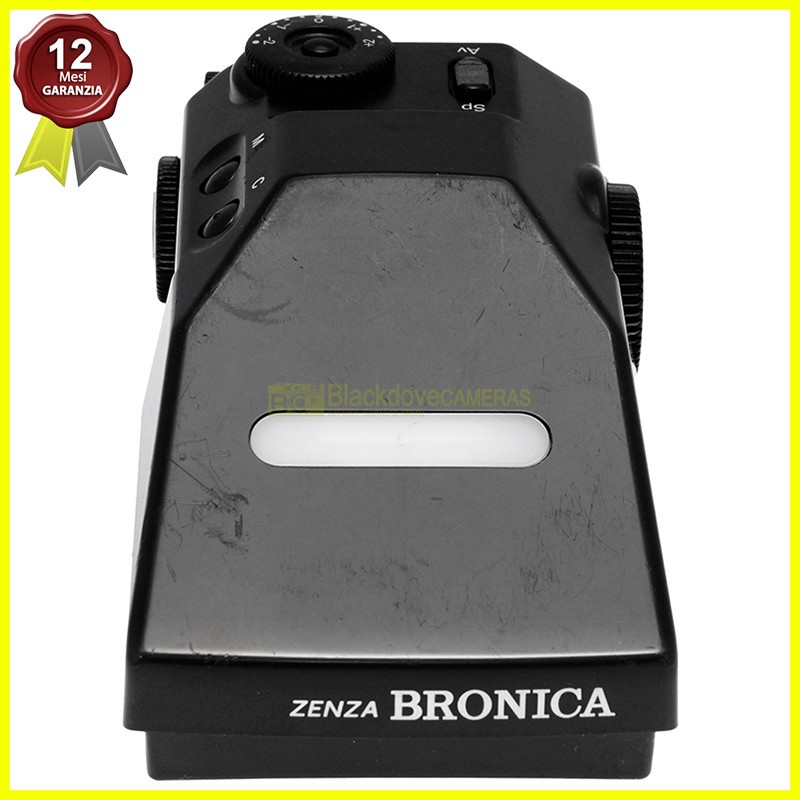
| Viewfinder | Interchangeable pentaprism and waist-level finders; standard prism with split-image rangefinder and microprism collar |
| Dimensions | 105 mm (W) × 95 mm (H) × 100 mm (D); approx. 790 g (body only, no battery) |
Key Features
- TTL Flash Metering: First in the ETR line to support through-the-lens flash automation, allowing precise exposure with dedicated flash units.
- Modular Design: Fully interchangeable film backs, viewfinders, and focusing screens enable rapid film type switching and customization.
- Electronic Shutter Control: Microprocessor-controlled shutter with improved accuracy and consistency across all speeds.
- Stop-Down Metering with AE Coupling: Enables accurate exposure with lenses of varying maximum apertures via mechanical linkage.
- Compact 6×4.5 Format: Offers 10 exposures per 120 roll film with minimal bulk, ideal for extended shooting sessions.
Historical Context
The Bronica ETRSi was introduced at a time when medium format photography was transitioning from fully mechanical systems to electronically augmented designs. Competing primarily with the Mamiya C330 and Pentax 6×7, but more directly with the Hasselblad 2000FC and later 203FE, the ETRSi carved a niche by offering a cost-effective, modular system with modern electronic features. Its 6×4.5cm format provided a practical compromise between the square 6×6 frame and larger formats, appealing to photographers who needed portability without sacrificing resolution.
Market reception was generally positive, particularly among wedding photographers, photojournalists, and studio shooters who valued the camera’s reliability and TTL flash capability. The ETRSi’s affordability relative to Hasselblad systems made it a popular choice in rental fleets and educational institutions. However, by the early 1990s, increasing competition from Mamiya’s 645 series—particularly the Mamiya 645AF—began to erode Bronica’s market share. The ETRSi remained in production until 1995, outlasting the original ETR by over a decade, a testament to its robust design and user appeal.
Collectibility & Value
Today, the Bronica ETRSi is considered a capable and collectible medium format SLR, particularly among analog photography enthusiasts and those seeking an affordable entry into modular medium format systems. On the secondary market, bodies typically sell for $200–$400 in working condition, with prices increasing significantly when paired with original lenses, film backs, or rare accessories like the Polaroid back or data imprinting unit. Fully functional kits with a prism, waist-level finder, and multiple backs can command $600–$900.
When purchasing an ETRSi, collectors should verify the functionality of the shutter across all speeds, the integrity of the light seals, and the condition of the mirror and focusing screen. Common issues include degraded foam light traps (which should be replaced to prevent light leaks), sticky shutters due to dried lubricants, and battery compartment corrosion (it uses a single 6V 4SR44 or PX28 battery). The camera’s electronics, while generally reliable, can fail if exposed to moisture or long-term storage without power. As with all vintage electronics, a professional CLA (Clean, Lubricate, Adjust) is recommended for cameras that have been dormant.
Similar Cameras
- Mamiya 645 Super – Comparable 6×4.5cm modular SLR with interchangeable film backs and TTL metering; known for durability and wide lens selection.
- Pentax 6×7 – Larger format SLR with exceptional optics; less compact but favored for portrait work.
- Hasselblad 203FE – 6×6cm modular system with built-in meter and later TTL flash; significantly more expensive but industry standard.
- Bronica SQ-Ai – Bronica’s 6×6cm counterpart with similar electronics and modularity.
- Konica Hexar RF – Not a direct competitor, but a high-end medium format alternative with fixed lens and rangefinder design.
Repair & Maintenance
The Bronica ETRSi operates on a single 6V 4SR44 or equivalent PX28 battery, which powers the shutter speed control, metering circuit, and TTL flash logic. These batteries are still available but can be costly; some users substitute with modern 4LR44 alkaline packs (though voltage regulation may affect meter accuracy). The camera’s electronics are housed on a replaceable circuit board, simplifying repairs when faults occur.
Common maintenance issues include shutter blade lubrication degradation, which may cause inconsistent speeds or complete failure at slower settings. The mirror mechanism is generally robust but can develop play over time. The film transport system relies on a mechanical linkage that should be inspected for wear, especially in high-use examples. Due to the camera’s modular nature, ensuring compatibility between film backs, winders, and the body is essential—older ETR backs are compatible, but proper electrical contact alignment is critical for frame counting and metering. Professional servicing is recommended for shutter calibration and electronic diagnostics, as specialized tools and knowledge are required.
eBay Listings



As an eBay Partner, we earn from qualifying purchases. This helps support our independent vintage technology research.
Service Manuals & Schematics
- Owner's Manual — archive.org
- Manual — archive.org
Related Models
- Bronica SQ-A (1982-1997)
- Bronica D (1960-1965)
- Bronica EC (1972-1978)
- Bronica ETR (1976-1980)
- Bronica ETRS (1978-1984)
- Alpa 6 (1948-1953)
- Agfa Agfaflex
- Agfa Ambiflex
- Agfa Easy
- Agfa Futura Af zoom