BRONICA ETRS
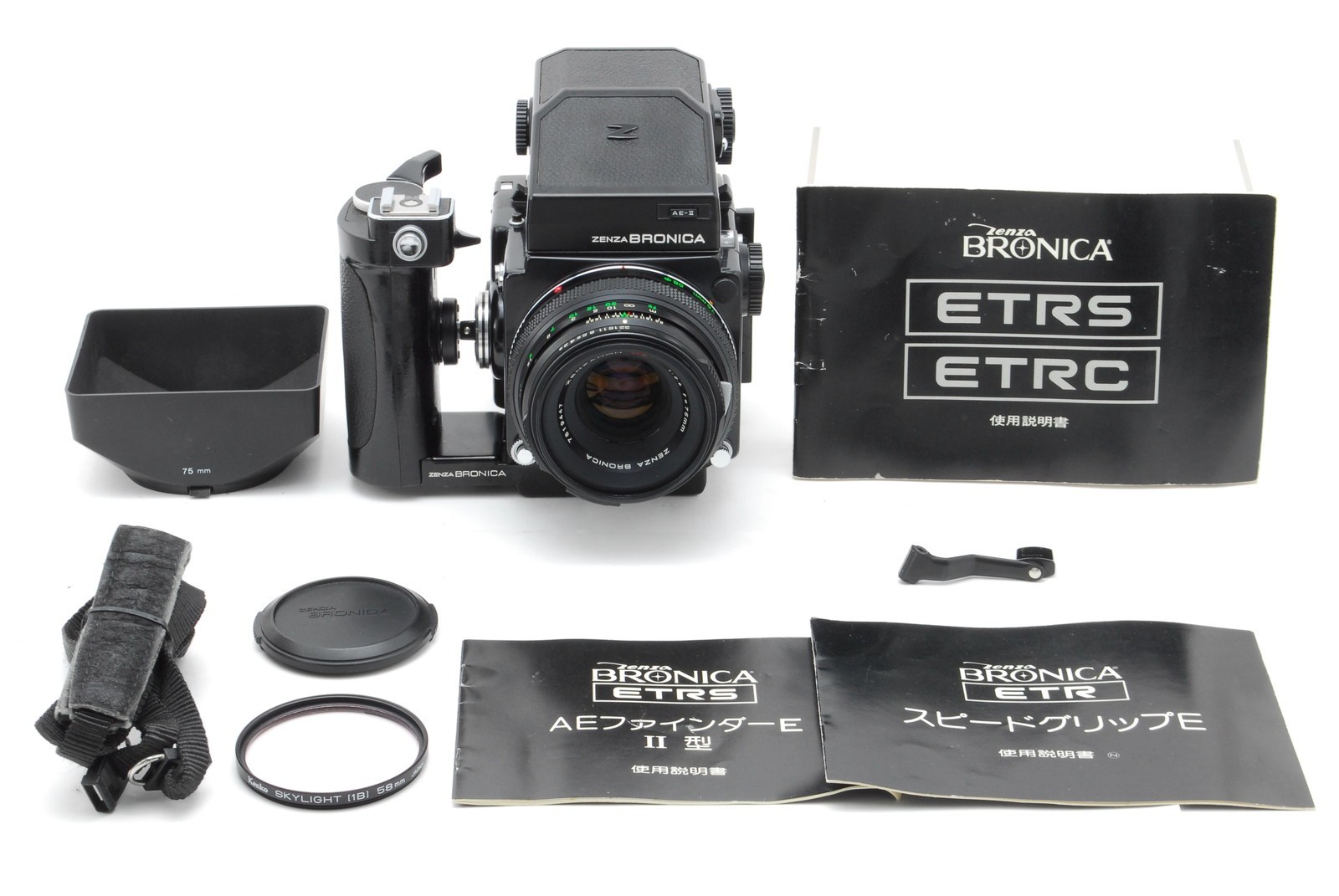
The Bronica ETRS is a modular 6x4.5cm medium format single-lens reflex (SLR) camera produced by the Japanese manufacturer Zenza Bronica from 1978 to 1984. An updated version of the ETR, the ETRS introduced several mechanical improvements and a redesigned winder grip, enhancing usability and reliability for professional and advanced amateur photographers.
Overview
Introduced in 1978, the Bronica ETRS served as a direct successor to the popular ETR model, incorporating user feedback and mechanical refinements to improve ergonomics and operational consistency. It was designed primarily for photographers seeking a compact, lightweight medium format system with interchangeable components—lenses, viewfinders, and film backs—offering flexibility without the bulk of larger 6x6 or 6x7 systems. The ETRS retained the core electronic focal-plane shutter mechanism of its predecessor but featured a revised film advance system with an integrated winder grip, which improved handling and enabled faster shooting cycles.
Targeted at photojournalists, event photographers, and studio professionals who required high image quality in a portable format, the ETRS competed in a growing market for modular medium format SLRs. It was part of Bronica’s broader strategy to offer affordable yet reliable alternatives to Hasselblad’s 500 series, emphasizing ease of use and system expandability. The camera’s compatibility with the Bronica SQ lens mount (via adapter) and extensive range of accessories, including multiple focusing screens and AE finders, solidified its position as a serious photographic tool. Though it lacked some of the automation found in later models like the GS-1, the ETRS remained a purely manual-exposure camera with TTL metering, appealing to photographers who preferred full control over exposure parameters.
Specifications
| Specification | Value |
| Type | Single-Lens Reflex (SLR) |
| Film Format | 6x4.5 cm on 120 roll film (15 exposures per roll) |
| Years Produced | 1978–1984 |
| Lens Mount | Bronica ETR bayonet mount (compatible with ETR lenses) |
| Shutter | Electronically controlled vertical-travel focal-plane shutter; speeds 1–1/1000 sec, B, X-sync at 1/60 sec |
| Metering | TTL full-aperture center-weighted CdS metering via viewfinder |
| Exposure Modes | Manual only (shutter speed and aperture set manually) |
| Viewfinder | Interchangeable pentaprism and waist-level finders with Fresnel focusing screen |
| Dimensions | 108 mm (W) × 95 mm (H) × 100 mm (D); weight approx. 790 g (body only, without battery) |
Key Features
- Integrated Winder Grip: The ETRS introduced a redesigned right-hand winder grip with improved ergonomics and smoother film advance, reducing cocking effort and enabling faster sequential shooting.
- Electronic Focal-Plane Shutter: Precise electronically timed shutter with speeds from 1 second to 1/1000 second, offering greater accuracy than mechanical shutters of earlier models.
- Interchangeable Components: Fully modular design with interchangeable lenses, viewfinders, focusing screens, and film backs, allowing rapid format and composition changes.
- TTL Metering System: Through-the-lens CdS metering provides accurate exposure readings at full aperture, viewable via match-needle indicator in the viewfinder.
- Flash Synchronization: X-sync terminal with 1/60 sec sync speed; supports both electronic flash and bulb modes (M/X setting).
Historical Context
The ETRS was released during a period of rapid innovation in medium format photography, as manufacturers sought to balance professional-grade image quality with increased portability and ease of use. By the late 1970s, the 6x4.5 format had gained popularity among working photographers who needed more resolution than 35mm film offered but required faster handling than square-format systems like the Hasselblad 500C/M. Bronica capitalized on this demand with the ETR series, positioning the ETRS as a refined, user-focused upgrade.
Compared to contemporaries such as the Mamiya RB67 and Pentax 6×7, the ETRS was significantly more compact and lighter, though it sacrificed some lens availability and maximum image size. Its main competitor in the modular 6x4.5 segment was the Mamiya C330, though that camera used a leaf shutter twin-lens reflex (TLR) design, limiting lens interchangeability and high-speed flash sync. The ETRS also faced indirect competition from the Fujica G690/GS645 series, which offered fixed-lens convenience. Despite these rivals, the ETRS carved a niche for itself among photographers who valued modularity, precise metering, and rapid handling. It was particularly popular in portrait, wedding, and documentary photography, where its quick film advance and quiet operation were advantageous.
Collectibility & Value
Today, the Bronica ETRS is considered a vintage professional camera with moderate collectibility. While not as sought-after as the iconic Hasselblad 500 series or the later Bronica GS-1, the ETRS maintains a loyal user base among film photographers and medium format enthusiasts. In the used market, working ETRS bodies typically sell for $250–$400 USD, depending on condition, shutter functionality, and inclusion of the original winder grip and viewfinder. Fully functional kits with lenses (such as the 75mm f/2.8 or 45mm f/4) and film backs can command $600–$900.
When purchasing an ETRS, buyers should verify that the electronic shutter is operational across all speeds, as capacitor degradation and circuit failure are common in long-stored units. The CdS meter requires an obsolete PX625 (1.35V) mercury battery, though modern adapters or voltage regulators can allow use of 1.5V substitutes with exposure compensation. Other common issues include light seals deterioration, mirror slap noise, and film advance mechanism wear—particularly in the winder gear assembly. Cameras stored in humid environments may exhibit fungus in viewfinders or corrosion in electrical contacts. Despite these age-related concerns, the ETRS is generally repairable by specialists familiar with vintage Japanese electronics.
Similar Cameras
- Mamiya C330 Pro – TLR system with interchangeable lenses and 6x4.5/6x6 compatibility
- Pentax 6×7 – Large-format SLR with 6x7 capability and high-quality optics
- Hasselblad 500C/M – Modular 6x6 SLR with superior build and global service support
- Fuji GX680 – Advanced 6x8cm SLR with tilt/shift capabilities (later model)
- Koni Omega Rapid – Rangefinder press camera for 6x9cm, favored for photojournalism
Repair & Maintenance
The Bronica ETRS uses a single 5.6V PX27 battery (or modern equivalent such as 4SR44 or 5.6V alkaline with voltage regulator) to power both the shutter and TTL metering system. Battery compartment corrosion is a frequent issue in older units, requiring cleaning or replacement of contacts. The electronic shutter relies on a capacitor that may fail after decades of inactivity; recalibration or replacement by a technician is often necessary. Regular maintenance should include cleaning of the mirror box, inspection of the focal-plane shutter curtains for pinholes or tears, and lubrication of the film transport mechanism. Due to its mixed mechanical-electronic design, repairs are more complex than fully mechanical cameras but are feasible through specialized medium format repair services. Users are advised to avoid forcing the film advance if resistance is felt, as this may damage the winder gears.
eBay Listings


As an eBay Partner, we earn from qualifying purchases. This helps support our independent vintage technology research.
Service Manuals & Schematics
- Owner's Manual — archive.org
- Manual — archive.org
- Owner's Manual — archive.org
- Owner's Manual — archive.org
Related Models
- Bronica SQ-A (1982-1997)
- Bronica D (1960-1965)
- Bronica EC (1972-1978)
- Bronica ETR (1976-1980)
- Bronica ETRSi (1984-1995)
- Alpa 6 (1948-1953)
- Agfa Agfaflex
- Agfa Ambiflex
- Agfa Easy
- Agfa Futura Af zoom