Braun Colorette Super II B (1957–1959)
A precision German rangefinder that married Dieter Rams’ minimalist vision with advanced DKL-mount flexibility—rare, finicky, and unmistakably Braun.
Overview
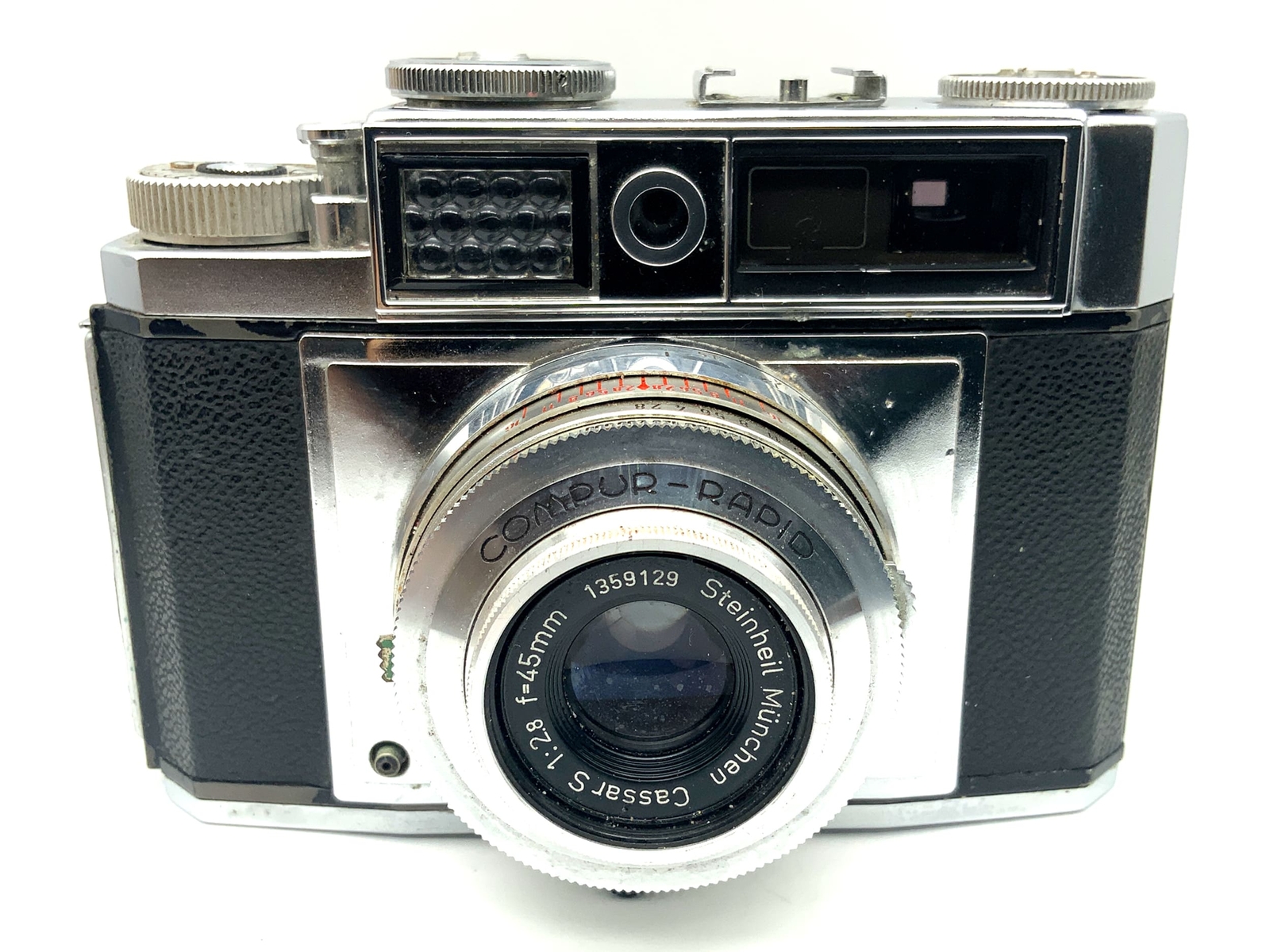
The Braun Colorette Super II B isn’t a camera that shouts. It doesn’t need to. From the moment you see its clean faceplate and balanced proportions, it’s clear this is a machine designed by someone who believed excess was a failure of thought. That someone was Dieter Rams, though he’d never put his name on it. At a time when cameras were still dressed like engineering textbooks—with knurling, dials, and cluttered top plates—this 35mm rangefinder arrived with the quiet confidence of a well-considered sentence. Produced from 1957 to 1959, the Super II B stood at the intersection of optical ambition and industrial restraint, using the short-lived but technically capable DKL mount to enable interchangeable lenses. It wasn’t the first of its kind, but in the context of Braun’s design philosophy, it was a statement: precision tools didn’t need ornamentation.
This was a rangefinder with a brightline viewfinder and a coupled rangefinder mechanism, making focus both fast and accurate for its time. The body housed a Synchro-Compur shutter, a leaf shutter system known for its reliability—when it wasn’t gummed up. And therein lies the rub: owners report that even in well-preserved examples, the Compur mechanism can seize over time, especially if the camera sat unused for decades. The wind lever, too, is a known weak point; collectors note it often fails to reset automatically, requiring manual intervention. These aren’t dealbreakers, but they’re the kind of quirks that turn a “buy and shoot” dream into a “buy and restore” project.
Despite its technical capabilities, the Colorette Super II B never achieved the fame of its contemporaries. Part of that was timing. The DKL mount, introduced in 1956 with the Voigtländer Vitessa T, was a bold move—an attempt to standardize leaf-shutter lens integration across brands. Braun jumped in early, adopting the same 44.7 mm flange focal distance and electronic coupling. But DKL never caught on widely. Lenses were expensive, compatibility was limited, and by the mid-1960s, the system was all but dead. Today, finding a working DKL lens—let alone a spare—is a hunt.
Still, the Super II B has presence. It’s not just the Dieter Rams connection, though that adds undeniable pedigree. It’s the way the controls are laid out: minimal, logical, almost surgical. The shutter speed dial sits on the camera body, not the lens, which meant exposure settings were centralized. That was part of the DKL logic—electronic linkage between shutter and lens—but it also meant you couldn’t mix and match with other systems. As one owner put it, “It’s a closed ecosystem. You’re all in, or you’re out.”
Specifications
| Manufacturer | Braun |
| Model | Colorette Super II B |
| Type | 35mm rangefinder camera |
| Production years | 1957–1959 |
| Lens mount | DKL mount |
| Flange focal distance | 44.7 mm (1.76 in) |
| Shutter | Synchro-Compur |
| Exposure mode | Shutter-priority auto-exposure, with full manual override |
| Metering | Tracking light meter |
| Viewfinder | Brightline viewfinder with coupled rangefinder |
| Flash synchronization | Yes |
| Interchangeable lenses | Yes |
Key Features
DKL Mount with Interchangeable Lenses
The Colorette Super II B used the DKL (Deckel) mount, a proprietary bayonet system developed for leaf-shutter lenses with electronic shutter speed coupling. This allowed for interchangeable lenses without mechanical linkages—shutter speed was set on the camera body and transmitted electrically to the lens. It was advanced for 1957, but also fragile. The system required precise alignment and clean contacts, both of which degrade over time. Lenses like the Schneider Kreuznach Braun Xenar f/2.8 50mm were built specifically for this system, but today, they’re scarce and often command high prices. Because the shutter speed dial is on the body, no other lenses—even from Voigtländer or Wirgin—can be used unless they’re DKL-compatible and properly coupled.
Synchro-Compur Shutter with Electronic Coupling
At the heart of the camera is the Synchro-Compur shutter, a leaf shutter known for its flash sync at all speeds—a major advantage in an era when focal-plane shutters often topped out at 1/30s. The “Synchro” designation refers to the electronic connection between the camera body and the lens, allowing the selected shutter speed to trigger the lens shutter via contact points. While elegant in theory, the system is prone to failure if the contacts corrode or the shutter mechanism dries out. Owners report that a gummed-up Compur shutter is a common issue, often requiring disassembly and cleaning. Once working, however, the shutter is smooth and quiet, with a satisfyingly precise action.
Shutter-Priority Auto-Exposure with Manual Override
The Colorette Super II B offered shutter-priority auto-exposure—a rarity in the late 1950s. The tracking light meter measured scene brightness and adjusted aperture automatically based on the selected shutter speed. But it wasn’t fully automatic; users could also switch to full manual mode, setting both shutter speed and aperture independently. This dual-mode flexibility was ahead of its time, giving photographers control without sacrificing convenience. The meter itself is coupled to the lens via the DKL interface, so it only functions with compatible lenses. No exposure compensation dial is present, which limits flexibility in high-contrast situations.
Brightline Viewfinder with Coupled Rangefinder
Framing and focusing are handled through a brightline viewfinder with a central rangefinder patch. The brightlines are generous, showing a clear 50mm frame with parallax correction marks. The rangefinder is fully coupled, so as the lens is focused, the patch aligns automatically. Focus accuracy is excellent when the mechanism is in tune, but like all mechanical rangefinders, it can drift over time. Calibration requires specialized tools, and parts are not readily available. The viewfinder glass is clean and large by period standards, but there’s no frameline switching—this is a 50mm-only system unless adapted.
Historical Context
The DKL mount was introduced in 1956 alongside the Voigtländer Vitessa T, a forward-thinking camera that aimed to simplify interchangeable lens photography with electronic coupling. Braun followed quickly, releasing the Colorette Super II in 1957, with the Super II B variant arriving shortly after. The system was also used by Wirgin and Wittnauer, with the Braun Colorette Super IIL considered a sibling to the Wittnauer Professional. Despite the technical promise, DKL failed to gain widespread adoption. By the early 1960s, manufacturers had shifted toward simpler mechanical mounts or embraced SLR systems. The Colorette line, though well-designed, was caught in the collapse of its ecosystem.
Collectibility & Value
The Braun Colorette Super II B is a niche collectible—sought after more for its design pedigree than its practical utility. The Super II L variant is described as “rare,” and while the II B is slightly more common, working examples are still scarce. Most units on the market are sold “untested” or with noted issues, particularly the wind lever failing to reset automatically. The gummed-up Compur shutter is another frequent problem, often requiring professional servicing. A repair manual exists and is referenced in collector forums, but sourcing replacement parts is difficult. There is no documented original price, and current market value varies widely depending on condition and lens inclusion. Fully functional sets with a Schneider Xenar lens can command several hundred dollars, but non-working bodies are often listed for under $100.
eBay Listings



As an eBay Partner, we earn from qualifying purchases. This helps support our independent vintage technology research.