Bolex H16 SBM (1970)
That satisfying clunk of the wind lever, the silent whir of the reflex shutter, and a viewfinder that shows you exactly what’s going to hit the film—this is the Bolex you learn on, fall in love with, and never really let go.
Overview
The Bolex H16 SBM isn’t just a camera—it’s a rite of passage. Released in 1970 by Bolex International SA (formerly Paillard-Bolex), it marked a turning point in the evolution of the H16 line, ditching the old turret lens system for a modern bayonet mount. That change alone made it a radical departure from everything that came before. This is a professional 16mm motion picture camera, spring-wound and clockwork-driven, utterly mechanical, and gloriously self-contained. No batteries, no external power—just you, a wound spring, and the film threading its way through a reflex viewing system that lets you see exactly what the lens sees. It’s no exaggeration to say this is considered by many to be the best 16mm camera Bolex ever made. It’s a tool that balances precision with rugged simplicity, capable of delivering excellent picture quality and remarkable versatility. Whether you’re shooting experimental film, documentary, or just learning the craft, the SBM is a masterclass in hands-on cinematography. And if the names Steven Spielberg, Ridley Scott, David Lynch, or Andy Warhol mean anything to you, they all cut their teeth on a Bolex—often this very model or its close siblings.
Weighing in at about 5.5 lbs without a magazine and measuring 8.5" x 6" x 3", the SBM is compact but dense, built like a Swiss timepiece with a sturdy metal body that laughs at rough handling. It’s reflex through and through, with a viewfinder that’s both functional and surprisingly bright. The camera runs on a spring-wound clockwork motor, so you can shoot anywhere—jungles, mountains, rooftops—without worrying about power. But it’s not just for survivalists: it accepts a 400-foot magazine via the “M” version’s top-mounted saddle, or you can stick with the classic 100-foot daylight spool loaded internally. And if you want electronic precision, there’s a drive shaft for an external ESM motor that brings crystal-sync stability to your frame rates. This isn’t a camera that corners—it’s built to grow with you, from student projects to professional work.
Specifications
| Manufacturer | Bolex International SA (formerly Paillard-Bolex) |
| Film format | 16mm |
| Weight | ~5.5 lbs (no mag) |
| Dimensions | 8.5" x 6" x 3" |
| Viewing system | reflex viewing system |
| Viewfinder | reflex viewfinder |
| Power | spring-wound clockwork motor (mechanical), does not require batteries to operate |
| Lens mount | Bolex bayonet lens mount |
Key Features
Bayonet Mount & Lens Flexibility
The switch to a Bolex bayonet lens mount in 1970 was a big deal. For decades, Bolex shooters had wrestled with turret systems and fixed lenses. The SBM changed that, giving cinematographers the freedom to swap optics quickly and securely. The bayonet mount has a focal flange distance of 23.22 mm, and Bolex included a bayonet-to-C-mount adapter in many packages, reducing the distance to 17.52 mm and opening the door to a world of affordable C-mount lenses. While PL-mounts don’t fit directly, adapters exist, and the camera’s mechanical simplicity means you’re not locked into any one ecosystem. Typical lenses bundled with the SBM included the 16mm Switar or Yvar, 25mm Switar or Yvar, and often a 75mm Yvar or 50mm Switar—glass known for its sharpness and character. And yes, there was even a package that came standard with a Kern-Switar zoom lens, though that seems to have been a special configuration rather than the norm.
Mechanical Precision & Film Handling
At the heart of the SBM is a special double-function claw that handles both film transport and registration—a clever bit of engineering that ensures steady, precise framing. The camera is backwindable, which means you can reverse the film for retakes or inspection, and it includes a frame counter so you never lose track of your footage. An audible signal lets you know when the spring is about to run out, a small but crucial detail when you’re deep in a shot. The film capacity is 100 feet on a daylight spool internally, but the “M” version adds a 400-foot magazine mount on top—ideal for longer takes or professional shoots. The version using 100-foot magazines relies on a spring mechanism, while the M variant supports external motor drives via a protruding 1-to-1 shaft, a feature added in the 1960s and carried forward.
Reflex Viewing & Shutter Control
The reflex viewing system is where the SBM truly shines. You’re not guessing at focus or composition—you’re seeing it in real time, through the lens, on a ground glass. Modified versions even feature an upgraded S-16 ground glass overlay for Super 16 framing. There’s a douser (lever) on the viewfinder to close the eyepiece, preventing light leaks during exposure. The shutter is variable, with a maximum angle of 130°, giving you control over motion blur and exposure. At 24fps, the effective shutter speed is around 1/65th of a second (108° equivalent when accounting for viewfinder light loss), which delivers that classic filmic motion. The camera also supports behind-the-lens filters, a rare and useful feature that keeps filtration stable regardless of lens changes.
Frame Rate & Operation
Frame rate selection is handled via a dial offering 12, 16, 18, 24, 32, 48, and 64 fps, plus a Single Frame setting for time-lapse or animation work. There’s a side release with a lock that lets you switch between continuous and single-frame exposures on the fly. While some sources claim an 8-64 fps range, the most consistent and authoritative listings confirm the discrete steps listed above. Hand-cranking is possible, and the camera can be used with the ESM self-regulating multi-speed auxiliary motor for electronically stabilized, multi-speed operation—ideal for sync sound or smooth variable-speed shots. The SBM also includes automatic film threading and a cut-off turret disc, small touches that make loading faster and safer.
Historical Context
The Bolex H16 story begins in 1935, when the original H16 camera hit the market and quietly revolutionized independent filmmaking. By the 1940s, it had become a staple of avant-garde and documentary filmmakers, prized for its portability and reliability. The H16 Standard remained in production until the end of 1969, and in 1966, Bolex introduced the 16 Pro to compete with the Arriflex 16 BL—a sign that the company was pushing into more professional territory. Then came the SBM in 1970, a model that embodied the culmination of decades of refinement. The bayonet mount wasn’t just a convenience—it was a declaration that Bolex was embracing modern lens standards and professional workflows. While competitors like Bell & Howell offered alternatives, the Bolex remained the go-to for experimental, educational, and low-budget cinema. It’s no stretch to say that a high percentage of famous directors learned their craft on a Bolex, and the SBM was right there in film schools and indie kits well into the 1970s.
Collectibility & Value
Today, the Bolex H16 SBM remains a sought-after piece, both as a working tool and a collector’s item. Rental houses still list it at a day rate of $200, a testament to its enduring utility. On the resale market, prices vary. One auction recorded a hammer price of €1,320 (including buyer’s premium) for a B+ condition unit, with an estimate of €1,500–1,800 and a starting bid of €900. A separate report from March 2024 noted a sale of “2.5K in USD” ($2,500) for a 1971 SBM package that included an ESM motor, three magazines, and MM-motors—but no lenses. Original pricing has not been confirmed.
Common issues include a viewfinder showing a blue tint or obscured image, often due to strong reflections or improper filters. Film fogging or scratching can occur if the camera is loaded or unloaded carelessly, and sand or dust ingress can damage the mechanism. Owners have reported that some units struggle to maintain consistent speed, with the motor stalling before the spring fully unwinds—a potential sign of worn gears or dried lubricants. Maintenance is straightforward but essential: keep the film drive mechanism spotless, clean the gate, pressure pad, and reflex prism regularly, and protect lenses from dust and fingerprints. Store it dry to avoid condensation, and wind it occasionally if it’s been idle. With care, this camera will run for another 50 years.
eBay Listings
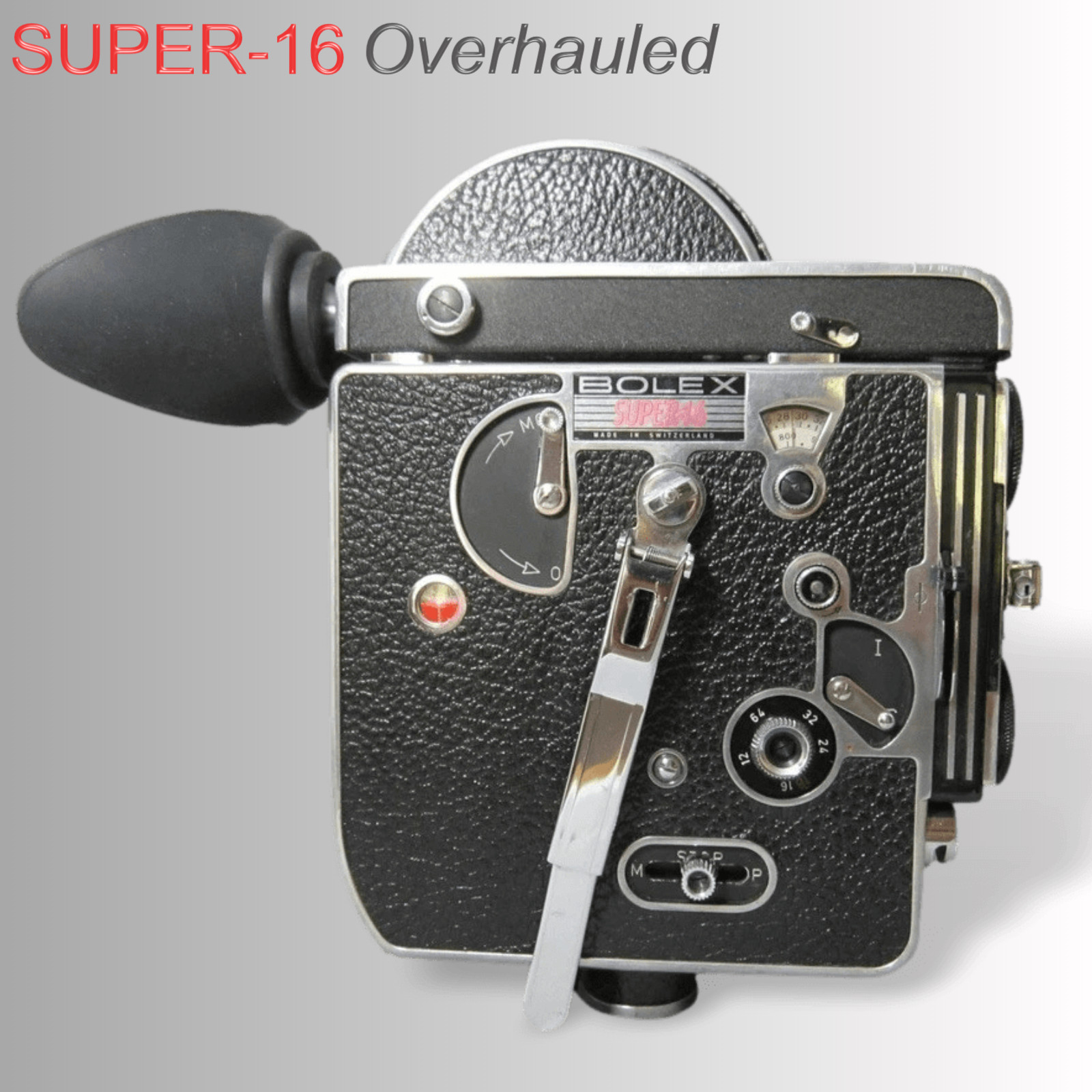
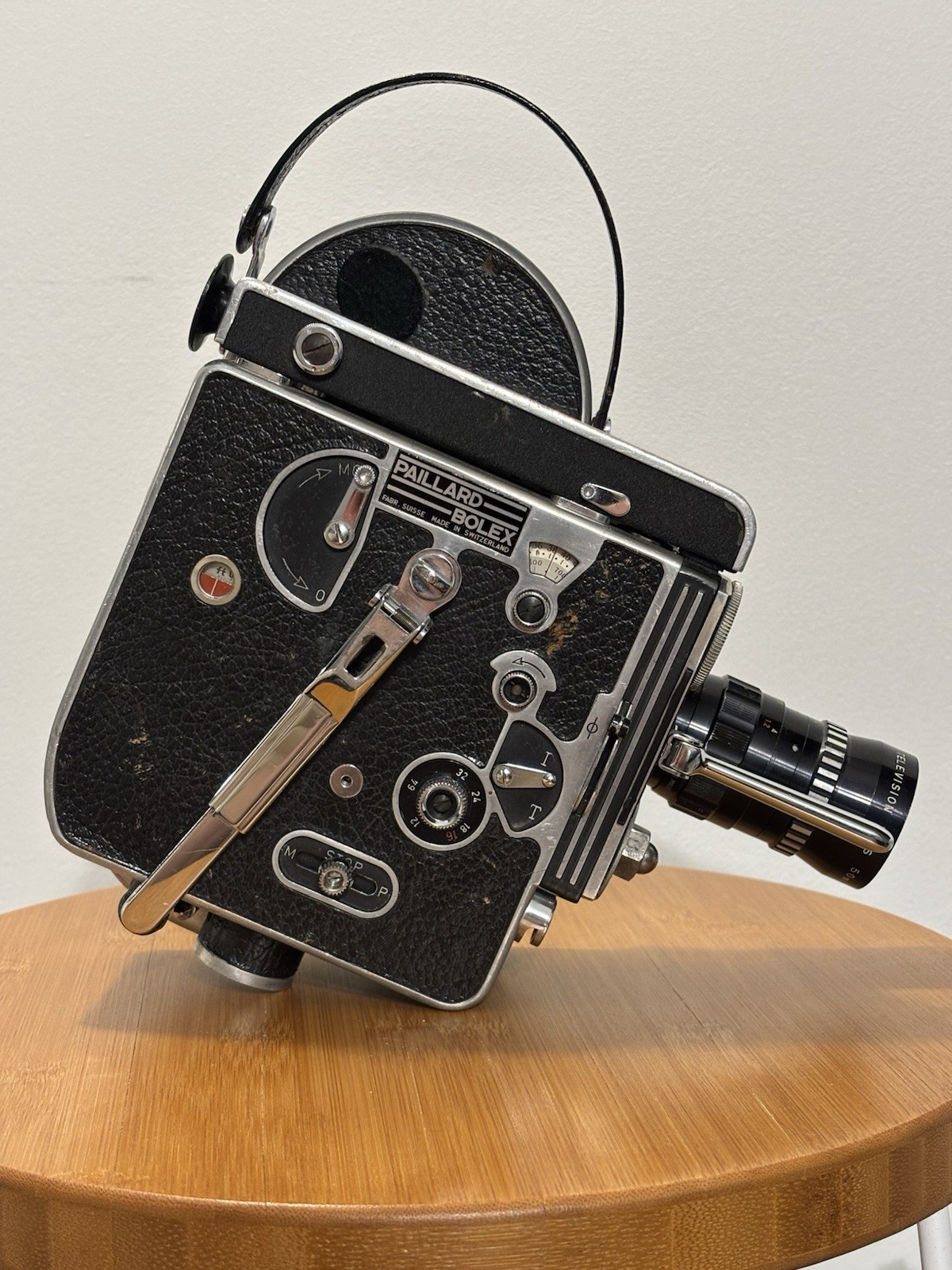
![CLA'd [N MINT] Bolex H16 SB 16mm Movie camera Switar 16-100m](https://i.ebayimg.com/images/g/4sgAAeSwWu5pwR60/s-l1600.jpg)

As an eBay Partner, we earn from qualifying purchases. This helps support our independent vintage technology research.
Service Manuals, Schematics & Catalogs
- Owner's Manual — archive.org
- Catalog — archive.org
Related Models
- Bolex H16 Reflex (1956)
- Bolex H16 RX-5 (1966)
- Arriflex 16 BL (1965)
- Arriflex 16 SR (1975)
- Arriflex 16 ST (1952)
- Arriflex 35 BL (1972)
- Arriflex 35 IIC (1964)
- Beaulieu 4008 ZM II (1977)
- Beaulieu 5008 S (1976)
- Bell & Howell 134 (1940)