Bolex H16 Reflex (1956)
That satisfying click of the frame counter, the buttery resistance of the focus knob, the quiet whir of a spring motor winding down — this is the sound of control.
Overview
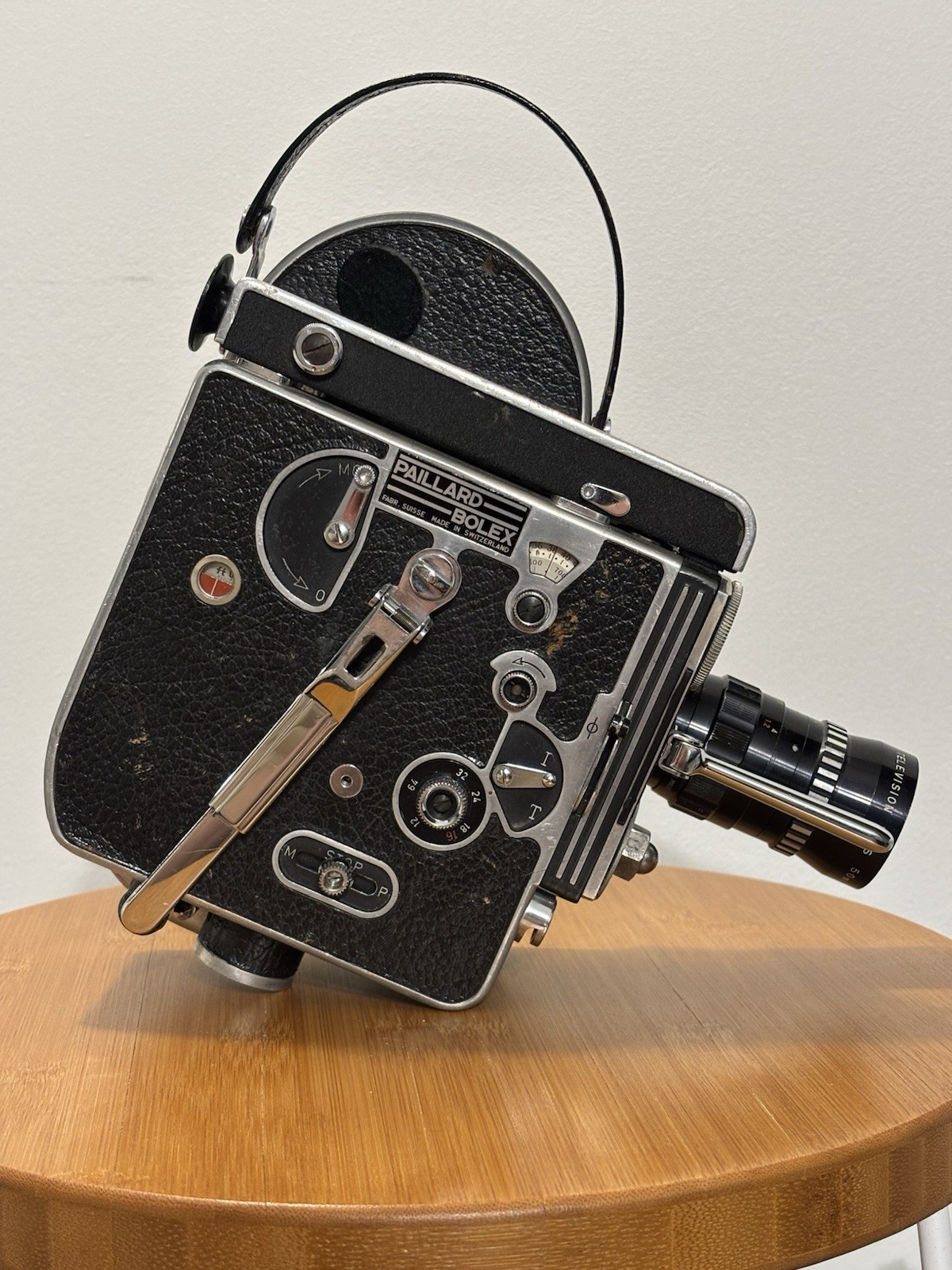
The Bolex H16 Reflex isn’t just a camera; it’s a rite of passage. If you ever shot 16mm film in a college basement, a guerrilla documentary, or a midnight animation session, chances are you wrestled with one of these polished duraluminium bricks. Introduced in 1956 as the reflex-viewing evolution of the original H16 that debuted in 1935, this Swiss-engineered workhorse became the go-to for filmmakers who needed precision without the bulk of studio rigs. It’s not flashy — no batteries, no electronics, no auto-exposure — just a governor-controlled spring motor, a reflex prism, and a triple-lens turret that clicks into place with the kind of mechanical finality that makes you want to do it again just to hear it.
Bolex International S.A. of Yverdon, Switzerland built the H16 Reflex to be reliable, portable, and utterly dependable. And they succeeded. Weighing in at approximately 5.5 lbs (2.5 kg), it’s hefty enough to feel serious in your hands but light enough to run handheld for extended takes. The polished duraluminium body wrapped in Morocco leather and chrome-plated fittings gives it a tool-like dignity — this isn’t a gadget, it’s a precision instrument. It runs on clockwork, with a fully wound motor delivering about 28 seconds of filming at any speed between 12 and 64 fps. That’s right: variable speed, mechanical, no servos, no chips — just gears and springs calibrated to governor-controlled perfection.
And then there’s the viewfinder. Through-the-lens reflex viewing was revolutionary for its time, and the H16 Reflex made it accessible. No more guessing focus with a parallax finder — here, what you see is what you get, thanks to a semi-reflecting prism that directs 20–25% of the light to your eye while letting 75–80% hit the film. That’s a loss of roughly a third to half an f-stop, sure, but the trade-off is worth it: critical focus at all times, 6x magnification, groundglass focusing, and an adjustable eyepiece so you can ditch your glasses if you want. It’s not bright — and more on that in a minute — but it’s accurate.
You load it with a 100ft (30m) daylight spool, and the threading is automatic: pop the back, drop in the spool, close it, and the camera forms the loops for you. Elegant. If you need more film, you can attach a 400ft magazine — but only on Rex 5 models or converted units. The film transport lacks a registration pin, which some pros criticized back in the day, yet countless users report exceptional image steadiness in practice. Whether that’s due to the precision of the claw mechanism or just Swiss over-engineering, it works.
It’s a camera built for filmmakers who care about control. The front fingertip release lets you start and stop with surgical precision, while the side release locks it for continuous run or enables single-frame animation. The twin dial frame counter tracks individual and total frames — essential when you’re counting exposures for time-lapse or stop-motion. And every 10 inches of film, you get an audible click from the footage indicator, like a metronome reminding you time is passing. The clutch disengages the motor for manual rewind, forward or back, so you can reposition film without wasting a frame. There’s even a built-in slot for gelatin filters behind the lens — a small thing, but one that shows how every detail was considered.
Specifications
| Manufacturer | Bolex International S.A. (Yverdon, Switzerland) |
| Film gauge/format | 16mm |
| Speed control | Variable speed, 12–64 fps |
| Single frame filming | Yes |
| Shutter | Variable angle, 133°–145° |
| Effective shutter speed (at 24 fps) | ~1/80 second |
| Film loading | Automatic threading and loop forming for 100ft (30m) daylight spools |
| External film capacity | 400ft magazine attachable (on Rex 5 or converted models) |
| Lens mount | Triple-lens rotating turret for C-mount lenses |
| RX lens requirement | Lenses 50mm and shorter must be "RX" corrected for reflex viewing |
| Common lens set | Often included 16mm, 25mm (standard), and 75mm or 50mm lenses |
| Reflex prism light loss | Diverts 20-25% to viewfinder; 75-80% reaches film, a reduction of ~1/3 to 1/2 f-stop |
| Motor | Constant-speed, spring-wound (clockwork) motor, governor controlled |
| Run time (fully wound) | ~28 seconds |
| Viewfinder | Reflex with semi-reflecting prism, 6x magnification, groundglass focusing, adjustable eyepiece |
| Film transport | No registration pin |
| Filter slot | Built-in for gelatin filter behind lens |
| Release | Front fingertip button; side release for locked run or single frame |
| Footage counter | Adds/subtracts, resets on reload |
| Audible footage indicator | Clicks every 10 inches of film |
| Frame counter | Twin dial for individual and total frames |
| Manual rewind | Clutch disengages motor for forward/backwind |
| Tripod socket | 3/8" thread |
| Construction | Polished duraluminium body, Morocco leather covering, chrome-plated metal parts |
| Weight | Approximately 5.5 lbs (2.5 kg) |
| Dimensions | 8.5" x 6" x 3" (216 x 152 x 76 mm) |
Key Features
Through-the-lens reflex viewing
Before digital live view, there was the Bolex H16 Reflex. The semi-reflecting prism gives you real-time, parallax-free composition and critical focus — a game-changer in 1956. No more racking focus blind or relying on distance markings. You see exactly what the lens sees, magnified 6x on groundglass, with an adjustable eyepiece to suit your vision. Yes, the prism steals 20–25% of the light, dimming the image by about a third to half a stop, but that’s the price of precision. And in practice, it’s manageable — just open up your lens a bit. The viewfinder is dark by modern standards, and over time, the prism can deteriorate or misalign, leading to even dimmer viewing, but a clean, well-aligned unit still delivers a sharp, usable image.
Triple-lens rotating turret
The rotating turret holds three C-mount lenses, and the way it indexes into place is deeply satisfying — a solid, metallic click that tells you you’re in position. But here’s the catch: lenses 50mm and shorter must be “RX” corrected to avoid vignetting in the viewfinder. Standard C-mount lenses of that focal length will show a darkened corner when you look through the viewfinder, even if the film gate is fully illuminated. So if you’re collecting or using one today, make sure your wide angles are RX-compatible. The common set often included a 16mm, a 25mm (standard), and a 75mm or 50mm — a practical range for most shooting scenarios.
Spring-wound clockwork drive
No batteries, no power supply — just a wind-up motor. Fully wound, it runs for about 28 seconds at any speed from 12 to 64 fps, regulated by a governor to maintain constant speed. It’s not infinite, but it’s reliable. The mechanical simplicity means fewer points of failure, and the governor ensures consistent exposure across frames. You can lock the motor for continuous run or use the side release for single-frame animation. And when you need to back up a few frames, the clutch disengages the motor so you can manually rewind or advance the film without damaging the mechanism.
No registration pin
This is the elephant in the room. The H16 Reflex doesn’t have a registration pin — the tiny metal peg that locks each frame in place during exposure to prevent jitter. Some professionals dismissed the Bolex for this reason, arguing it compromised image steadiness. Yet in practice, countless films — including professional work — were shot on H16s with rock-solid registration. The precision of the claw mechanism and film loop control seems to compensate well enough. That said, if you’re scanning at 4K or doing heavy VFX, you might notice slight frame-to-frame wobble. For most purposes, it’s not a dealbreaker — just know it’s there.
Historical Context
The H16 model line began in 1935, but the 1956 introduction of the reflex viewfinder version marked a turning point. Suddenly, independent filmmakers, students, and artists had access to a camera that offered professional-level control in a portable, mechanical package. It played a central role in avant-garde, experimental, documentary, ethnographic, and animation filmmaking from the 1940s through the 1970s — decades that shaped modern cinema. It was a popular introductory camera in film schools, where generations of directors cut their teeth on its unforgiving, frame-by-frame discipline. Many renowned filmmakers used the Bolex early in their careers, drawn to its reliability and hands-on operation.
Collectibility & Value
Today, the Bolex H16 Reflex remains a sought-after tool and collectible. It’s still used by enthusiasts, students, and professionals who value its tactile control and mechanical purity. The most common issue reported is a dark viewfinder, usually due to prism deterioration or misalignment — a known weakness over time. Super 16 conversions are available, both factory and aftermarket, expanding its utility for modern shooters. The 10mm Switar lens is particularly prized and highly sought after on the used market. As for pricing, it varies widely based on condition and configuration; one 2024 listing noted a mint, serviced unit with three lenses selling for approximately 1990 euros. Unserviced or non-functional units will, of course, go for less — but given its build quality and repairability, even a tired Bolex can often be brought back to life.
eBay Listings

![[Near MINT] BOLEX H16 Reflex REX-2 Cine Nikkor 13mm 25mm 50m](https://i.ebayimg.com/images/g/xIsAAeSwYippc2rX/s-l1600.jpg)
![[Lens MINT] BOLEX H16 Reflex REX-2 kinotar 12.5mm F1.4 Lens](https://i.ebayimg.com/images/g/72sAAeSwjR1pZ5ov/s-l1600.jpg)
As an eBay Partner, we earn from qualifying purchases. This helps support our independent vintage technology research.
Service Manuals, Schematics & Catalogs
- Manual — archive.org
- Owner's Manual — archive.org
- Catalog — archive.org
Related Models
- Bolex H16 RX-5 (1966)
- Bolex H16 SBM (1972)
- Arriflex 16 BL (1965)
- Arriflex 16 SR (1975)
- Arriflex 16 ST (1952)
- Arriflex 35 BL (1972)
- Arriflex 35 IIC (1964)
- Beaulieu 4008 ZM II (1977)
- Beaulieu 5008 S (1976)
- Bell & Howell 134 (1940)