Bell & Howell Filmo 134 (c1937)
It hums to life with a spring-wound snarl—no batteries, no electronics, just pure mechanical will.
Overview
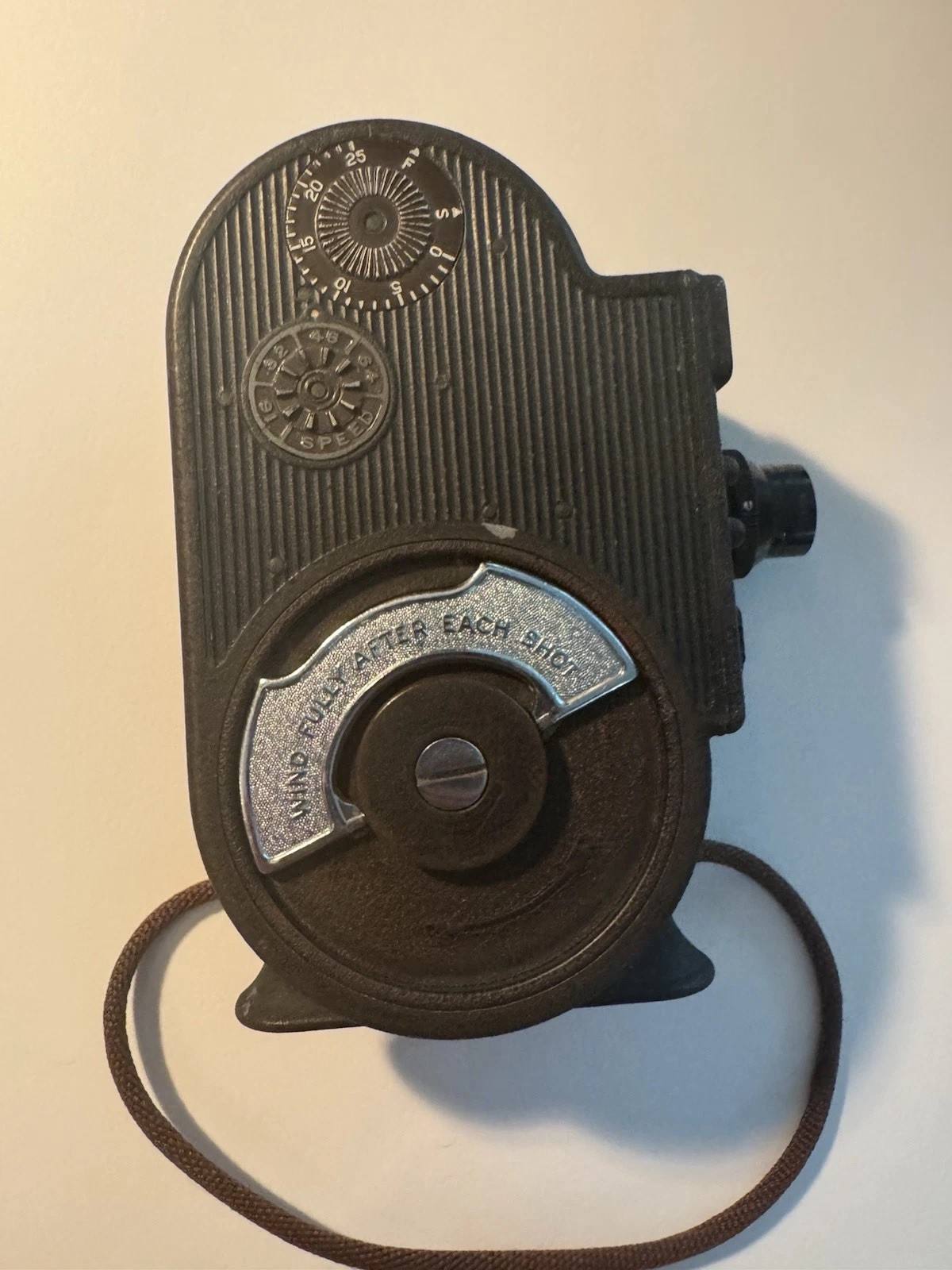
The Bell & Howell Filmo 134 isn’t some delicate relic—it’s a compact beast of a double 8mm movie camera built to run on muscle and precision. Released around 1937, it belongs to the golden era of home filmmaking, when families documented birthdays and vacations on real film, not memory cards. This isn’t Super 8; it’s double 8mm, the format that required you to shoot on one half of the film, flip it, and run it through again to expose the other side. The Filmo 134 handles 25 feet per run, giving you 50 feet of total shooting time across two passes. That’s about three and a half minutes of footage at 16 frames per second—enough for a short scene, but not a feature.
What stands out immediately is its all-mechanical design. No batteries, no circuits, no weak points where modern electronics might fail. You wind it, set your frame rate, and crank it into action. Owners report it “still works” decades later, though sometimes with a bit of a squeak—more character than flaw. One user called it “Great solid camera, runs almost flawless,” which says a lot for something nearly 90 years old. The motor spring carries “a fair amount of tension in it,” so winding requires some effort, but that’s part of the charm. You feel connected to the machine, not just operating it.
It’s small—just 5.5 inches—but dense, built like a tool rather than a toy. The three-lens turret lets you switch optics without fumbling, though the specific lenses aren’t detailed in the records. One known example used an Anate 12.5mm F3.5 lens, but that’s not guaranteed to come with any given unit. The aperture range is solid: f/2.5 to f/22, giving decent control over exposure in varying light. And the footage counter? Simple: 0 to 25, with S (start) and F (finish) markings. No guesswork, no digital display—just a dial you can trust at a glance.
Specifications
| Manufacturer | Bell & Howell |
| Film format | Double 8mm (not Super 8) |
| Film capacity | 25 feet per run, for a total of 50 feet of 8mm shooting in two 25 foot runs. |
| Frame rate | Adjustable from 16 to 64 frames per second. |
| Lens aperture range | f/2.5 to f/22. |
| Lens turret | Three lens turret |
| Lens (example used with camera) | Anate 12.5mm F3.5 |
| Power source | All mechanical, no batteries. |
| Footage counter dial | Goes from 0-25, with markings for S (start) and F (finish). |
| Size | 5.5" |
Key Features
Adjustable Frame Rate: From Real-Time to Slow Motion
The Filmo 134 gives you control over frame rate, from 16 to 64 frames per second. Most owners recommend sticking to 16 fps for normal playback—anything higher eats through your 25-foot run fast. But that top end isn’t just for show: shoot at 64 fps and project at 16, and you’ve got smooth slow motion. It’s a simple trick, but effective, and one that still works exactly as intended. No digital interpolation, no software—just physics and timing.
Three-Lens Turret: Quick Switching, Solid Build
The three-lens turret is a standout feature for its time. You’re not swapping lenses between shots or carrying extras in your pocket. Mount three, rotate as needed. It’s a mechanical solution to a real problem, and it works reliably. The turret’s build quality matches the rest of the camera—tight, precise, no wobble. Given the age, that’s impressive.
Film Counter with Start/Finish Marks
The footage counter isn’t just numbers—it’s marked with S and F, so you know exactly when you’re beginning and ending a run. That’s critical when you’re dealing with double 8mm and need to flip the film. Miss the mark, and you risk overlapping exposures or blank frames. This dial eliminates the guesswork.
Friction Discs: Two Metal Plates, One Reliable Drive
Inside, the camera relies on friction discs made of two metal plates sandwiched together. It’s a simple but effective way to transfer power from the spring motor to the film transport. No rubber, no rubberized coatings to dry out or slip over time. That likely explains why so many of these still run today—there’s nothing to degrade in the drive path.
Spring Motor with Real Tension
Winding the Filmo 134 isn’t a light twist. The spring has “a fair amount of tension in it,” so you’ll feel the resistance. That’s not a flaw—it’s a feature. It means the motor can sustain consistent speed over the full 25-foot run. And because it’s all mechanical, once it’s wound, it’s ready. No charging, no waiting.
Collectibility & Value
The Bell & Howell Filmo 134 trades in a quiet but steady market. According to CollectiBlend, a curated database, average condition units go for $30–40. Very good condition bumps that to $50–60, and mint examples can hit $90–100. Specific sales back this up: one sold for $33 in 2019 in condition “4F,” another for $68 in 2003 in condition “B.” These aren’t sky-high prices, but they reflect real demand from collectors who appreciate working mechanical cameras.
The most common issue? Squeakiness. Multiple owners note the camera “seems to be working fine—if a little squeaky.” That’s usually fixable with careful lubrication, but it’s a sign that decades of dormancy can stiffen things up. Some owners have sought factory repair manuals to guide a full teardown and service. Good news: a repair manual for the Filmo 134-C is available at camera-manual.com. While it’s for the 134-C variant, it may still offer useful guidance for the base model.
eBay Listings


As an eBay Partner, we earn from qualifying purchases. This helps support our independent vintage technology research.
Related Models
- Bell & Howell 2709 (1912)
- Arriflex 16 BL (1965)
- Arriflex 16 SR (1975)
- Arriflex 16 ST (1952)
- Arriflex 35 BL (1972)
- Arriflex 35 IIC (1964)
- Beaulieu 4008 ZM II (1977)
- Beaulieu 5008 S (1976)
- Bolex H16 Reflex (1956)
- Bolex H16 RX-5 (1966)