Belca Belplasca (c.1954–1956)
A twin-lens 35mm stereo camera from postwar Dresden, where shattered factories gave way to a brief flourish of optical ingenuity
Overview
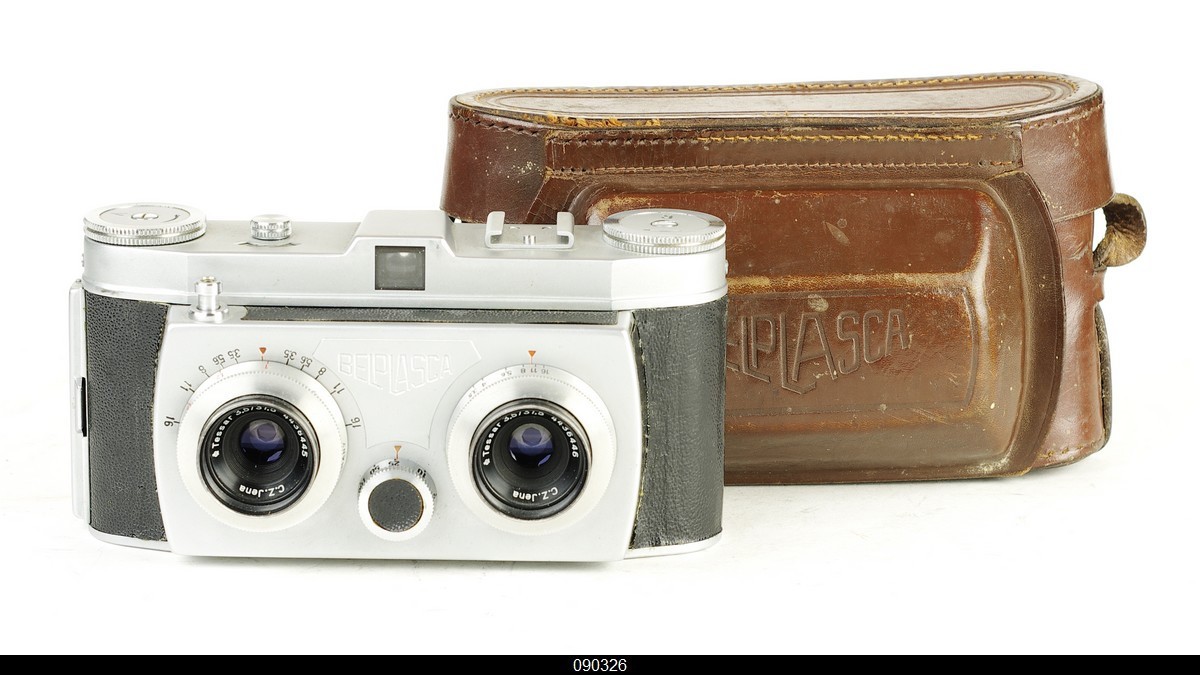
The Belca Belplasca isn’t a camera that announces itself with flash or fanfare—it’s a product of necessity, precision, and a city rebuilding itself from rubble. Born in the uncertain years following World War II, it emerged from Belca-Werk, a manufacturer stitched together from the remnants of Dresden’s devastated optical industry under Soviet occupation. This was a time when cameras weren’t just tools for photography but symbols of technical resilience, and the Belplasca fits squarely within that narrative. It’s a 35mm stereo camera, designed to capture dual images side by side on standard film, creating a three-dimensional effect when viewed through a compatible viewer. Its very existence speaks to a moment when East German engineers, working with limited resources, still aimed for optical excellence.
The Belplasca shares its DNA with the Beltica Model II, effectively serving as its stereo counterpart—a clever repurposing of existing design language to enter a niche but growing market for 3D photography in the mid-1950s. While stereo cameras were not uncommon at the time, few carried the pedigree of a Carl Zeiss Jena Tessar lens, and the Belplasca mounts two of them: matched 37.5mm f/3.5 optics, each aligned to capture a slightly offset perspective. These are not afterthoughts or budget glass—they’re serious lenses, the kind that made Saxon optics legendary.
Production dates remain slightly ambiguous, with auction records citing both 1954 and "c.1956" as possible years. This overlap likely reflects either a multi-year production run or inconsistencies in later cataloging. Either way, the Belplasca’s time in the spotlight was brief. By the mid-1950s, the East German government began consolidating its scattered camera makers into VEB Pentacon, a move that absorbed Belca-Werk and quietly retired its brand. The Belplasca, along with other Belca models like the Belfoca II, Beltica, and Belmira, became relics of a short-lived era of decentralized postwar innovation.
Specifications
| Manufacturer | Belca |
| Product type | Stereo camera; 35mm stereo camera |
| Film format | 35mm |
| Lens | Carl Zeiss Jena Tessar 3.5/37.5 |
| Lens focal length | 37.5mm |
| Lens maximum aperture | 3.5 |
Historical Context
The Belplasca was developed as the stereo version of the Beltica Model II, leveraging an existing platform to enter the 3D photography market. Belca-Werk arose in the aftermath of World War II, when Soviet authorities reorganized the fragmented optical workshops of Dresden into a functioning enterprise. The company produced several camera models through the late 1940s and 1950s, but its independence was short-lived. By the mid-1950s, the East German state consolidated its camera industry under VEB Pentacon, absorbing Belca-Werk and retiring its brand. Other notable models from Belca include the Belfoca II, Beltica, and Belmira.
Collectibility & Value
The Belplasca is scarce on the secondary market, appearing primarily in European auctions and specialty vintage camera sales. Recent listings suggest a valuation range between €350 and €500, depending on condition and provenance. One auction listed a starting price of €180, while another began at €200, indicating dealer confidence in its mid-tier collectible status. Units have sold for as much as $350.00 in online marketplaces. Condition reports from auction houses describe examples as "B/A," "B+," and "in very fine and working condition," with at least one confirmed as fully functional. No data exists on original retail pricing, production volume, or common mechanical failures.
eBay Listings
As an eBay Partner, we earn from qualifying purchases. This helps support our independent vintage technology research.