Beaulieu 5008 S (1974–1977)
The moment you flip the power switch and that mirror shutter snaps into action, you’re not just filming—you’re commanding a precision French-engineered machine built for real work.
Overview
The Beaulieu 5008 S isn’t just another Super 8 camera—it’s the one that brought professional-grade control, interchangeable C-mount lenses, and magnetic sound recording into a single all-metal body forged in France during the format’s golden age. Introduced in February 1974, it arrived when Super 8 was peaking as a serious tool for independent filmmakers, and Beaulieu wasn’t messing around. This was the first model in their lineup to feature built-in magnetic sound recording, a move that positioned it squarely between enthusiast gear and broadcast-capable rigs. At roughly $1,600 to $1,700 in 1974 dollars, it wasn’t cheap, but what you got was a dual-speed (18 and 24 fps), single-frame capable, SLR-equipped powerhouse that could handle everything from vérité documentaries to polished shorts.
Weighing in at 2.57 kg with the standard Schneider-Kreuznach 6–66 mm f/1.8 Macro lens, the 5008 S feels like a tool, not a toy. Its 34 cm × 10 cm × 21 cm chassis is packed with features that were cutting-edge at the time: TTL auto exposure via a CdS cell, manual ASA selection from 25 to 400, electric zoom control with speeds adjustable between 4 and 12 seconds, and even an interval timer for time-lapse work. The inclusion of lap dissolves (up to 100 frames) and manual fade-in/fade-out functions meant you could shoot and edit in-camera with surprising sophistication. And unlike many Super 8 cameras that used fixed lenses or clumsy viewfinders, the 5008 S featured a true single-lens reflex system with a vertical 45° mirror shutter—meaning what you saw through the viewfinder was exactly what the lens saw, with no parallax error.
It wasn’t perfect. The complexity that made it powerful also made servicing it today a challenge. The custom 7.2 V rechargeable battery (500 mA) is long out of production, and replacements often need to be sourced or rebuilt. But owners report that when it works, it works beautifully—especially with the optional Angénieux 6–80 mm f/1.2–1.4 Macro lens, a beast of a zoom that gives stunning low-light performance and smooth, cinema-grade focus throws. The fact that it accepted standard 50 ft (15 m) Kodapak cartridges meant compatibility with off-the-shelf film, but the lack of a movie light socket meant you had to bring your own lighting—another nod to its pro-targeted design.
Specifications
| Manufacturer | Beaulieu |
| Format | Super 8 |
| Lens mount | Interchangeable C-mount |
| Lens (example 1) | Angénieux 6–80 mm f/1.2-1.4 Macro |
| Lens (example 2) | Schneider-Kreuznach Optivaron 6–66 mm f/1.8 Macro |
| Zooming ratio | 11.6x |
| Focusing | Manual |
| Macro focusing | Yes |
| Minimum focusing distance with Schneider Kreuznach | From 0 to 1500 mm (just under 5 ft) |
| Zooming | Electric speed from 4 to 12 seconds or manual |
| Filter | Built-in Wratten filter 85 |
| Viewfinder | Single-lens reflex with tilting matte screen and adjustable eyepiece (+/- 2 diopters) |
| Viewfinder information | Film-advance indicator |
| Rangefinder | Ground glass |
| Exposure metering | TTL EE, CdS cell; auto and manual exposure control |
| Exposure meter sensitivity | Built-in CdS exposure meter sensitive to 40-400 ASA films. |
| Film speed selection | Manual selection for 40, 50, 100, 200, 400 ASA |
| ASA setting range | 25-400. |
| Shutter | Guillotine type, 1/40 sec (18 fps) or 1/60 sec (24 fps) |
| Shutter opening angle | <180 degrees |
| Fading | Manual fade-in/fade-out |
| Lap dissolve | 100 frames |
| Filming speed | 18, 24 fps, single frame |
| Interval timer | Yes |
| Sound | Single-system, magnetic recording on super 8 film |
| Recording level control | Auto and manual |
| Sound frequency response | 50 to 12 kHz +/- 1.5 dB (24 fps) and 50 to 9.5 kHz +/- 1.5 dB (18 fps) |
| Signal/noise | 57 dB |
| Earphone impedance | Z > 1.5 KΩ |
| Microphone input | DIN 5 pins, with 3 sensitivities: 0.15mV to 20mV Z = 5KΩ, 3mV to 15mV Z = 100KΩ and 30mV to 1.2V Z = 500KΩ |
| Capstan instability (Wow and flutter) | < 0.4 % |
| Remote control | Electrical remote control socket |
| Cable release socket | Yes |
| Movie light socket | No |
| Synchronized sound socket | Yes |
| Handle | Chamber for battery |
| Battery check button | Yes |
| Film drive motor | DC micromotor |
| Power supply | Rechargeable custom Beaulieu battery, 7.2 V |
| Battery capacity | 500 mA/7.2 V. |
| External power jack | Yes |
| Film cartridge | 50 ft (15 m) Kodapak cartridge. |
| Tripod socket | 1/4" |
| Country of manufacture | France |
| Dimensions | 34 cm (l) x 10 cm (w) x 21 cm (h) |
| Weight | 2.57 kg with standard Schneider 6-66 mm lens |
Key Features
SLR Viewfinder with Dual Viewing Modes
The heart of the 5008 S is its single-lens reflex system, a rarity in Super 8 cameras. Using a mirror on the shutter, it directs light to the viewfinder when the shutter is closed—giving a true through-the-lens image. The tilting matte screen and +/-2 diopter adjustment make it usable for most vision types, while the retractable ground-glass offers two viewing options: with the ultra-luminous ground glass for precise manual focusing, or without it for brighter, general scene composition. This flexibility was a godsend for run-and-gun shooting, especially in low light.
Interchangeable C-Mount Lenses
Few Super 8 cameras offered interchangeable lenses, but the 5008 S did—via a C-mount. This opened the door to high-end glass like the Angénieux 6–80 mm f/1.2–1.4 Macro and the Schneider-Kreuznach 6–66 mm f/1.8 Macro. The Angénieux, in particular, was a monster: an 11.6x zoom with a T-stop as low as T1.4, capable of pulling focus from infinity down to 0 mm (with macro attachment). The electric zoom could be set to run between 4 and 12 seconds, or switched to manual for whip-zooms or precise control. Owners still rave about the cinematic quality these lenses delivered—especially when paired with Kodak’s finest stocks.
Professional Sound Recording
As the first Beaulieu with magnetic sound recording on Super 8 film, the 5008 S was a game-changer. It supported single-system audio with auto and manual recording level control, a DIN 5-pin mic input with three sensitivity settings, and a headphone output (Z > 1.5 KΩ) for monitoring. The frequency response hits 12 kHz at 24 fps—remarkable for magnetic stripes on 8mm film—and wow and flutter is kept below 0.4%. The inclusion of a synchronized sound socket and remote control options made it viable for sync-sound interviews and narrative work, not just voice-over docs.
Exposure and Shutter Control
The TTL EE system, powered by a CdS cell, gave reliable auto exposure across 40–400 ASA films (with manual selection), though the full ASA range extends down to 25. The guillotine shutter offered 1/40 sec at 18 fps and 1/60 sec at 24 fps—shorter than many competitors thanks to the reflex design. The <180° shutter angle contributed to a slightly staccato motion, but also gave that crisp, filmic look. Manual exposure was available for full control, and the built-in Wratten 85 filter helped balance color under tungsten lighting.
Historical Context
Launched in February 1974, the Beaulieu 5008 S arrived at the peak of Super 8’s credibility as a filmmaking medium. It followed the 5000S Super 8 Sound camera introduced in 1973 and built on that foundation by refining ergonomics, adding dual-speed filming, and improving optical performance. Designed for both serious amateurs and professionals, it was used extensively in documentary and short film production—valued for its portability, synchronization capabilities, and robust all-metal French construction. The multispeed variant, the 5008 S MS, arrived in 1976 with expanded frame rates (including 8 and 45 fps), but the original 5008 S remained the standard for two-year. Production ended in 1977 as video technology began to eclipse film, and the Super 8 industry collapsed by 1980.
Collectibility & Value
The Beaulieu 5008 S remains a sought-after piece among analog film collectors and working filmmakers who still shoot on Super 8. Well-preserved, functional units regularly sell for $500 to $2,000 as of 2024, with prices climbing based on condition, included lenses, and operational status. The multispeed variants (5008 S MS) command a 20–50% premium. Units with the rare golden Beaulieu logo from a special production run are particularly prized. While the camera is considered easily repairable and has good parts availability, its complexity can deter modern technicians. The most common issue is the obsolete 7.2 V battery—though replacement packs and chargers are available. An external heavy-duty battery option exists for the 5008 S and other Beaulieu models, which helps extend runtime. Instruction manuals are accessible online, making DIY maintenance more feasible. Despite its age, the 5008 S is still valued for its optical precision and its role in preserving the tactile, hands-on craft of analog filmmaking.
eBay Listings

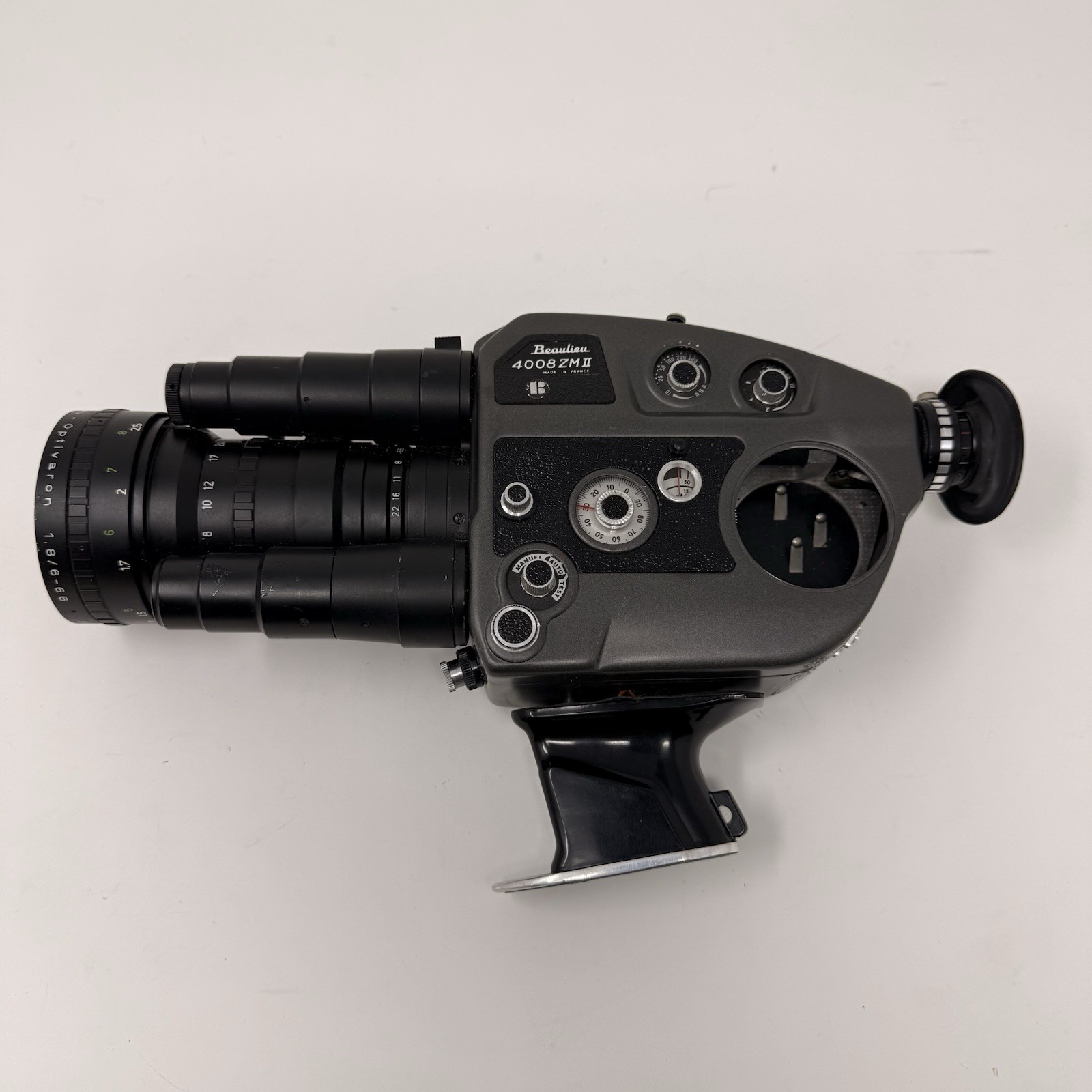

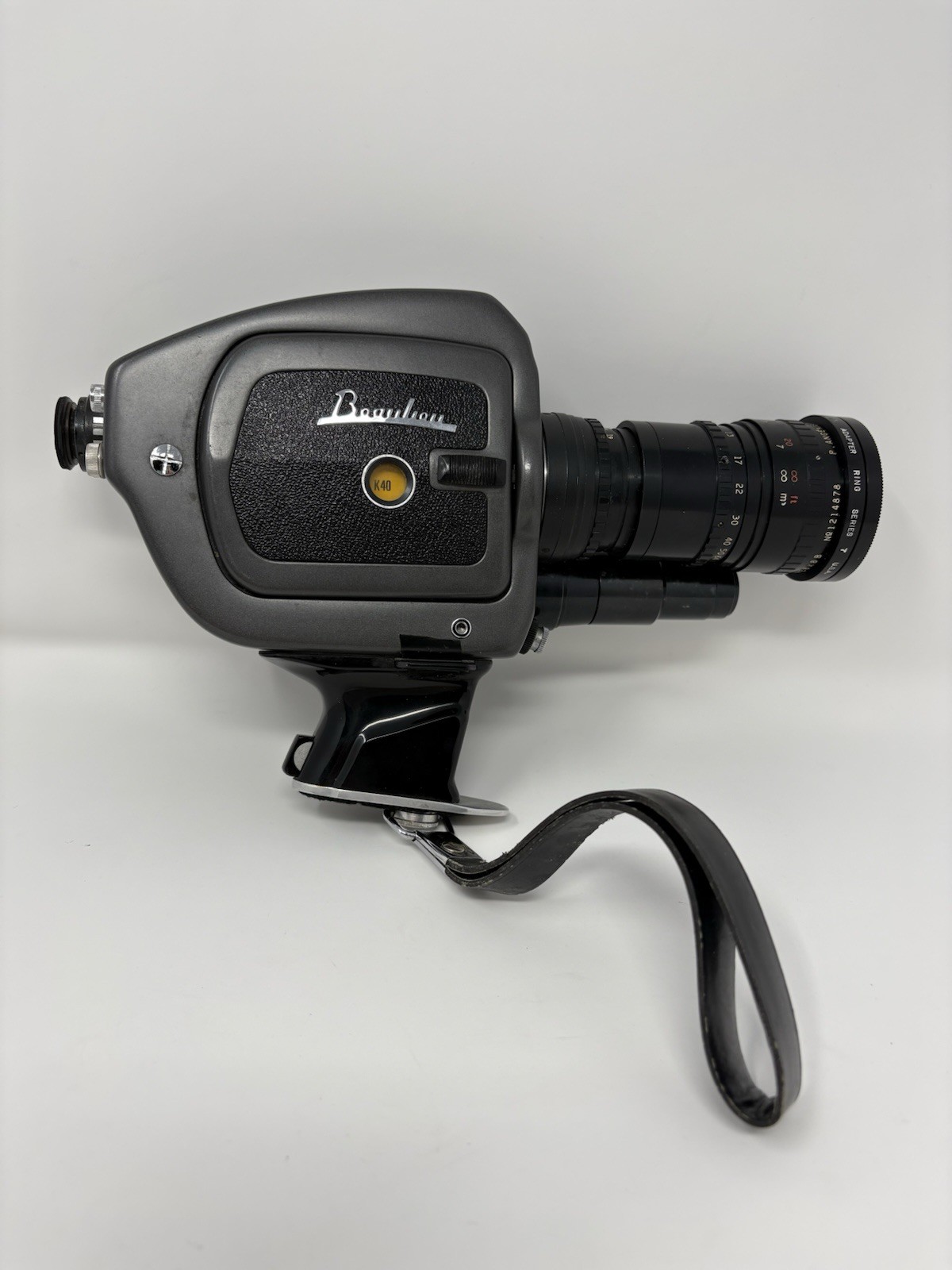
As an eBay Partner, we earn from qualifying purchases. This helps support our independent vintage technology research.
Service Manuals, Schematics & Catalogs
- Owner's Manual — archive.org
Related Models
- Beaulieu 4008 ZM II (1977)
- Arriflex 16 BL (1965)
- Arriflex 16 SR (1975)
- Arriflex 16 ST (1952)
- Arriflex 35 BL (1972)
- Arriflex 35 IIC (1964)
- Bell & Howell 134 (1940)
- Bell & Howell 2709 (1912)
- Bolex H16 Reflex (1956)
- Bolex H16 RX-5 (1966)