Beaulieu 4008 ZM II (1971–1976)
The moment you flip the switch and that reflex viewfinder snaps to life—bright, flickering, alive—you know this isn’t just another Super 8 box.
Overview
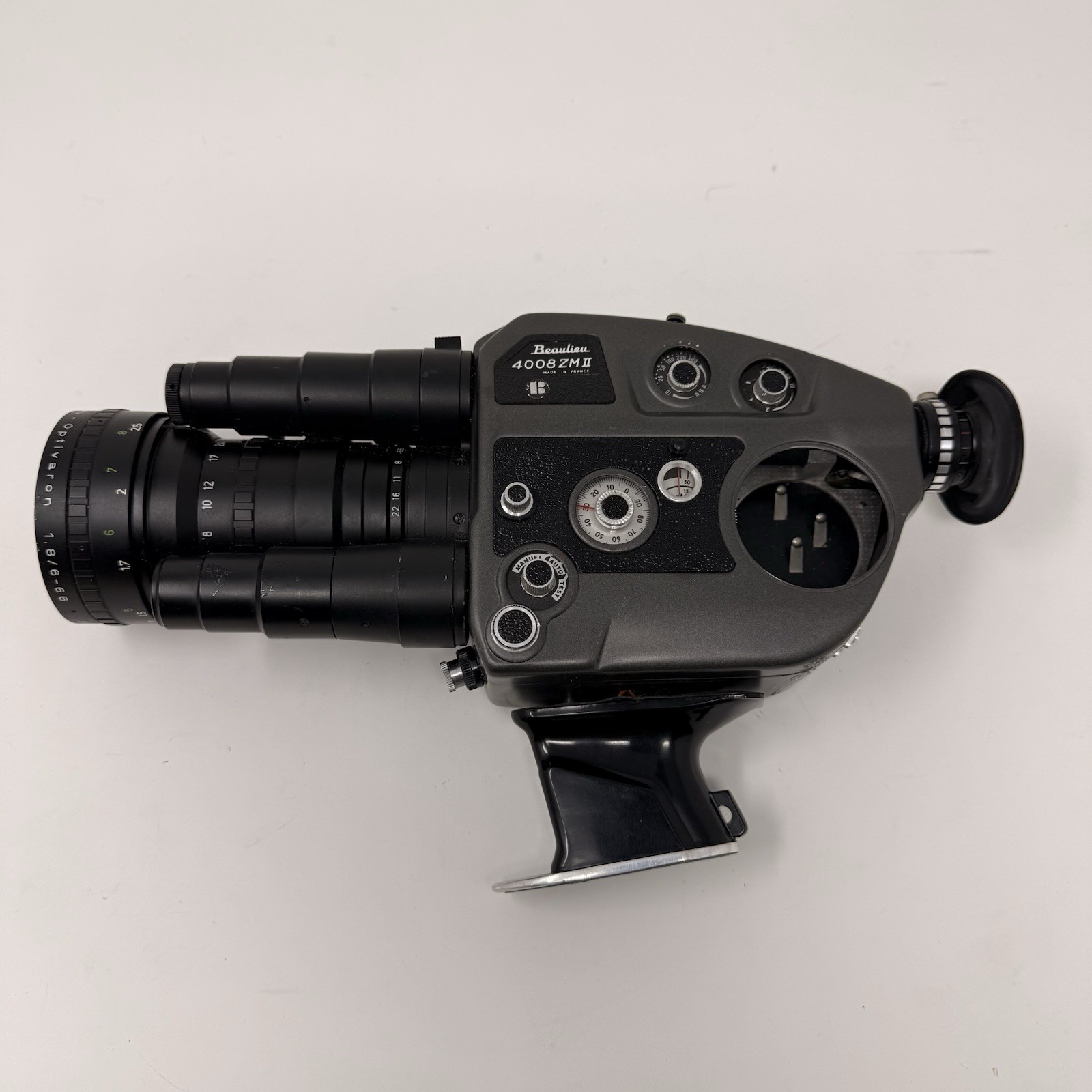
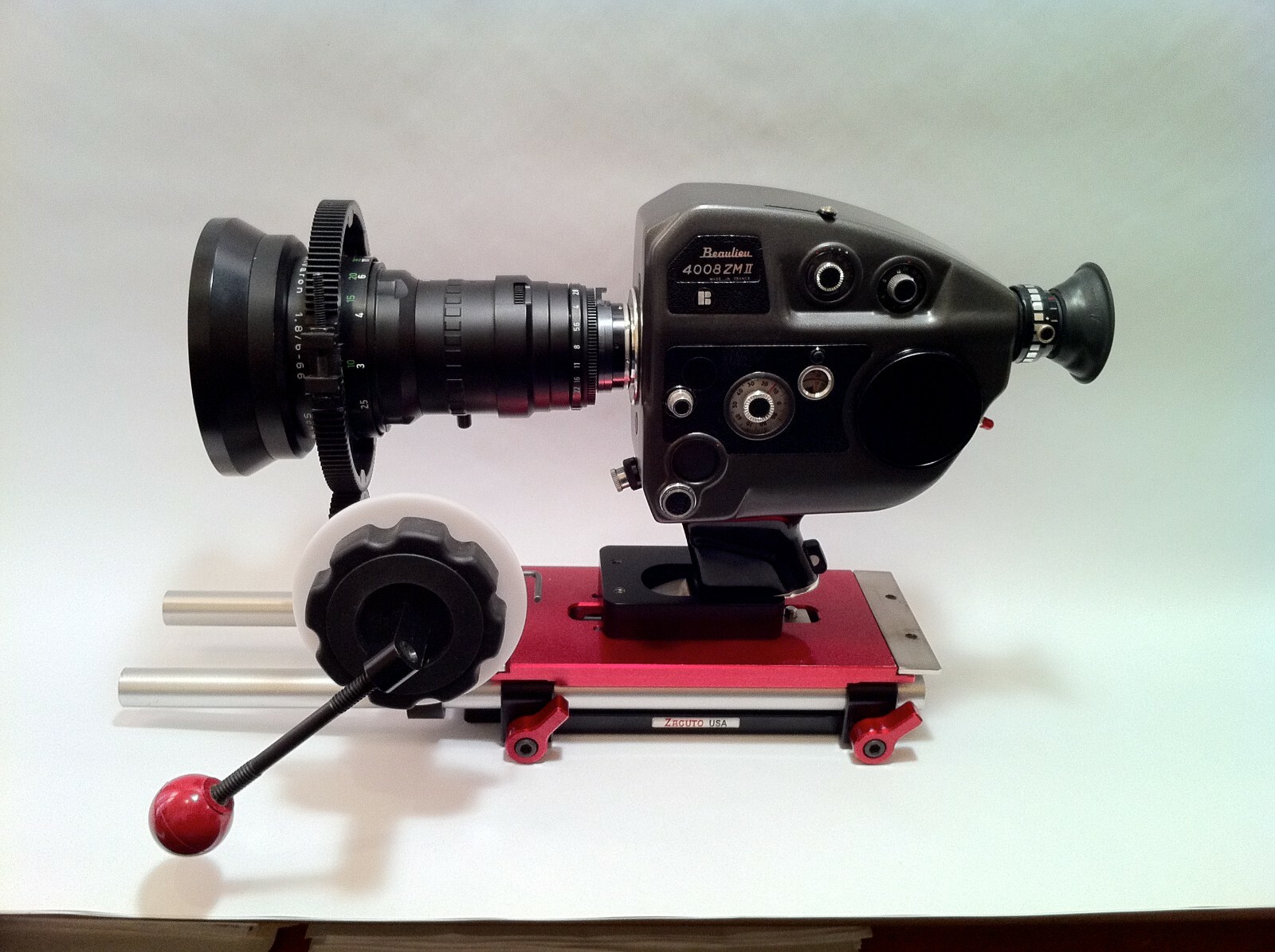
The Beaulieu 4008 ZM II isn’t just a camera; it’s a statement. Built in France between 1971 and 1976, it arrived when Super 8 was shedding its toy-like reputation and becoming a serious tool for amateur filmmakers who wanted control, clarity, and craftsmanship. This wasn’t a point-and-shoot gadget—it was engineered for people who cared about exposure, framing, and frame rate. And if you’ve ever cradled one in your hands, you know: it feels like a precision instrument. The weight, the layout, the way the zoom rocker glides—everything says this was made to be used, not just displayed.
It’s a silent Super 8 camera, meaning no onboard sound recording, but don’t let that fool you. Beaulieu wired it for serious double-system sound, with dedicated sockets to sync an external tape recorder. That alone set it apart from most consumer models. You could run a Nagra or a Revox alongside it and walk away with broadcast-grade sync—if you had the patience. And patience was part of the deal. This camera doesn’t rush you. It demands attention: manual focus, manual film speed selection from 12 to 400 ASA, and a TTL exposure meter you can trust—or override. The exposure system is “automatique débrayable,” meaning auto or manual, with a CdS cell measuring light through the lens. You get a needle in the viewfinder telling you when you’re spot-on. It’s elegant, simple, and effective.
What really defines the 4008 ZM II is its reflex viewfinder. Unlike cheaper Super 8s that used a separate optical path, this one shows you *exactly* what’s hitting the film, thanks to a mirror on the shutter that flips the image up when the shutter’s closed. The trade-off? It flickers. But that flicker means you can use shorter shutter speeds—down to 1/490 sec at 70 fps—without black frames. And yes, it does 70 fps, which was wild for its time. You can shoot slow motion, single frame, or anything in between: 2, 4, 8, 18, 24, 36, 50, 70. The shutter angle is variable, under 180 degrees, giving you control over motion blur. This wasn’t just for home movies. People shot experimental films, documentaries, even industrial shorts with this thing.
And then there’s the lens. Early units came with the Zoom Angenieux 1:1.9 f=8-64mm, a smooth, buttery zoom with a macro setting that lets you film from just 1 millimeter away. After the first year, Beaulieu switched to the Beaulieu-Optivaron—a Schneider-Kreuznach design—with a wider f/1.8 aperture and a broader 6-66mm range. That’s a real upgrade: more light, more reach, better optics. Both are C-mount, so you could technically swap them, though most owners just kept the factory glass. The zoom itself is electric, 8x, with variable speed (2 to 12 seconds for a full zoom) or manual override. It’s not silent, but it’s consistent.
The body? Anthracite gray lacquered sheet metal with black faux-leather sides. It’s compact but dense—1.85 kg with lens, or 1.5 kg for body plus lens depending on configuration. Dimensions are 70 x 170 x 260 mm, and it balances well on a tripod via the standard 1/4" socket. There’s a fixed handle, no movie light socket (so no hotshoe lighting), but it does have a flash sync contact. You’ve got a cable release socket, remote control socket, and a battery check button—small touches that matter when you’re rolling.
It runs on a 7.2V, 250 mA nickel-cadmium accumulator, charged via an external DC transformer (which only charges—doesn’t power the camera directly). That battery is a known weak point today. As one owner put it: “Very rarely are 4008s sold with good batteries. They almost always need to be recelled.” And given that the motor, zoom, meter, and counter all depend on it, a dead cell means a paperweight.
Specifications
| Manufacturer | Beaulieu |
| Format | Super 8 |
| Film system/length | Cassette Super 8, 15m |
| Drive | Electric (7.5v) |
| Filming speeds | 2, 4, 8, 18, 24, 36, 50, 70 fps, single frame |
| Lens mount | Interchangeable lenses C-mount type |
| Lenses | Zoom Angenieux 1:1.9 f=8-64 puis Beaulieu-Optivaron 1:1.8 f=6-66 |
| Zooming ratio | 8x |
| Zooming | auto with variable speed (2 to 12 sec) and manual |
| Focusing | manual |
| Macro focusing | yes |
| Viewfinder | Reflex, single-lens reflex type with adjustable eyepiece |
| Viewfinder information | pointer needle of the exposure meter |
| Rangefinder | ground glass |
| Exposure meter/control | Automatique débrayable (Auto and manual, TTL EE, CdS cell) |
| Film speed selection | manual selection between 12 and 400 ASA |
| CCA filter | built-in 85A filter, with filter control key |
| Shutter opening angle | <180 degrees, variable |
| Shutter speeds | 2 fps = 1/7 - 1/14 sec; 4 fps = 1/15 - 1/30 sec; 8 fps = 1/30 - 1/60 sec; 18 fps = 1/65 - 1/130 sec; 25 fps = 1/87 - 1/175 sec; 36 fps = 1/130 - 1/260 sec; 50 fps = 1/175 - 1/350 sec; 70 fps = 1/245 - 1/490 sec |
| Fading | manual fade-in/fade-out |
| Film rewinding | available with a reverse wind device |
| Double exposure | superimpositions, manual lap dissolve |
| Counter | En mètres et en pieds, Compteur d'images (1-15 m, 1-100 frames) |
| Sound | double-system, sound recording with synchronized tape-recorder |
| Sound sockets | 2 sockets for tape-recorder start/stop socket and 1 socket for synchro pilot |
| Remote control socket | yes |
| Cable release socket | yes |
| Movie light socket | no |
| Flash synchronization contact | yes |
| Battery check button | yes |
| Film drive motor | DC micromotor |
| Power source | 250 mA/7.2 V accumulator |
| External power jack | with DC transformer, only for charging the battery |
| Dimensions (LxPxH) | 6 (10) x 11 (17) x 14,5 (30) cm / 70 x 170 x 260 mm |
| Weight | 1.850 kg with objective / 1500 g (body + lens) |
| Tripod socket | 1/4" |
Key Features
Reflex Viewfinder with Dual Viewing Modes
The reflex viewfinder isn’t just a gimmick—it’s the core of the 4008 ZM II’s precision. Thanks to a mirror on the shutter, you see exactly what’s being exposed, eliminating parallax error. The viewfinder was upgraded to model X27, and it includes a retractable ground-glass screen. Pull it out, and you get an ultra-bright image perfect for critical focus. Flip it away, and you’re viewing directly through the lens path—dimmer, but stable for general shooting. It’s a thoughtful design that lets you adapt to the scene, not the other way around.
Sound Sync and Reverse Wind for Dissolves
Even though it’s a silent camera, the 4008 ZM II takes sound seriously. It has two systems: one socket to start/stop a tape recorder, and another for a synchro pilot signal. But here’s the clever bit: that synchro socket can also accept a special knob that, when pressed with a button near the footage counter, reverses the film wind. That means you can manually create lap dissolves—fade out by rewinding a few frames, then fade in on the next pass. It’s a mechanical trick few Super 8s offered, and it turns the camera into a mini film lab.
60-Meter Magazines and Top-Loading Design
Standard cassettes are 15 meters, but Beaulieu supported 60-meter (200 ft) magazines that mounted on top. The take-up motor in the magazine draws power from the camera via contact points, so no extra batteries. It’s a slick system that lets you shoot longer takes without reloading—rare in Super 8, and a nod to professional workflows.
Manual Exposure with TTL Metering
You can run it in auto exposure mode if you’ve got a Reglomatic-type lens, but most owners prefer manual. The TTL CdS meter gives you a needle in the viewfinder—just line it up with the mark, and you’re exposed. It’s fast, accurate, and doesn’t require stopping to check a separate meter. And since you can set shutter speed and aperture independently, you’re in full control. Want shallow depth of field at 24 fps? Crank open that f/1.8 Optivaron and go.
Robust Build and Serviceability
This is a camera built to last. The metal body, mechanical controls, and modular design mean it can be repaired—not just replaced. And the good news? Both parts and servicing are still available from Beaulieu. That’s almost unheard of for a company from this era. But it does need care: the manual recommends a full overhaul every three years by an authorized dealer. Even today, technicians can recell the battery, clean the film gate (recommended every 3–4 films), replace the internal UV filter, and recalibrate the exposure system.
Historical Context
Beaulieu didn’t just enter the Super 8 market—they dominated it. By 1969, the 4008 ZM had already made them the world leader in Super 8 cameras. The 4008 ZM II, introduced in 1971 (initially called the 4008 ZM 2), refined that legacy. It inherited the Angenieux lens from its predecessor, then upgraded to the Schneider-Kreuznach–made Optivaron after the first year. That lens switch wasn’t just cosmetic—it gave users wider aperture and focal range, a real step up in low-light performance and framing flexibility.
This was part of a clear lineage: the 2008 S (1965) led to the 4008 ZM, then the ZM II, followed by the 4008 M3 (an economical version launched in 1974), and finally the ZM4 in 1976. The ZM II sat right in the sweet spot—more advanced than the base models, but not as rare or expensive as the later crystal-sync variants. It was designed for serious amateurs, the kind who read film magazines, understood exposure, and wanted something that felt like a real movie camera.
But by 1980, the Super 8 industry collapsed. Beaulieu’s business crashed with it. That makes the 4008 ZM II a late peak—a high-water mark just before the tide went out.
Collectibility & Value
The 4008 ZM II is one of the most sought-after silent Super 8 cameras on the market. Auction records from 2019 to 2023 show prices all over the map: as low as €45, as high as €331. Most cluster between €100 and €200, but condition is everything. A unit listed on eBay in March 2026 was priced at $285.57 (or Best Offer), but explicitly sold AS-IS for parts or repair—untested, possibly non-functional, missing components. That tells you something: working, clean examples are worth significantly more.
Forum listings suggest higher valuations: $175 for a unit with case and manual (Reddit), $1,250 for one with crystal sync mod and Pelican case (DVXuser). But those are outliers. The reality is, most surviving units need work. The nickel-cadmium battery is almost certainly dead. The film gate may be scratched. The mechanics may be gummed up. And while servicing is still available, it’s not cheap.
Still, if you find a clean, tested 4008 ZM II with the Optivaron lens, you’ve got a gem. It’s not just nostalgia—it’s a tool. People still shoot with these. They mod them for crystal sync, clean the prism, replace the eyecup. Because when it works, it works beautifully.
eBay Listings


As an eBay Partner, we earn from qualifying purchases. This helps support our independent vintage technology research.
Service Manuals, Schematics & Catalogs
- Owner's Manual — archive.org
Related Models
- Beaulieu 5008 S (1976)
- Arriflex 16 BL (1965)
- Arriflex 16 SR (1975)
- Arriflex 16 ST (1952)
- Arriflex 35 BL (1972)
- Arriflex 35 IIC (1964)
- Bell & Howell 134 (1940)
- Bell & Howell 2709 (1912)
- Bolex H16 Reflex (1956)
- Bolex H16 RX-5 (1966)