BALDA SUPER BALDAMATIC
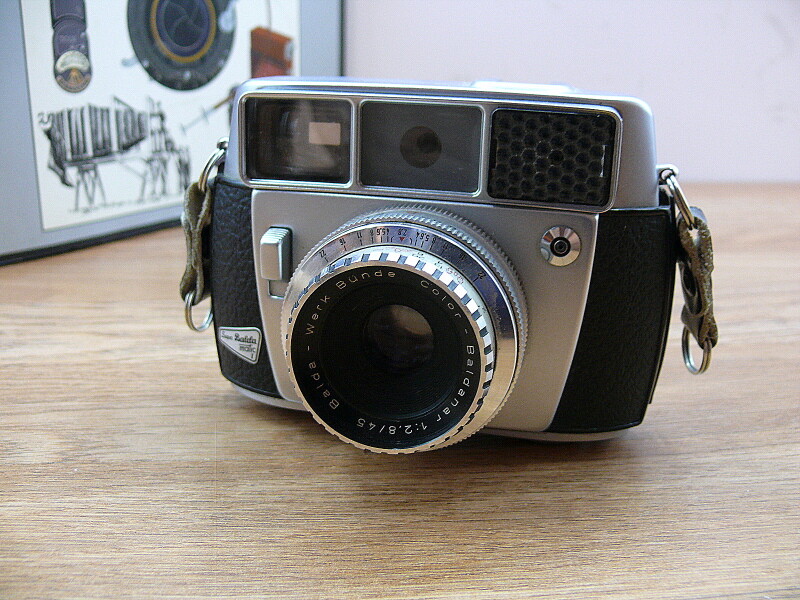
The Balda Super Baldamatic is a compact 35mm viewfinder camera produced in West Germany during the early 1960s. It is notable for being one of the earliest consumer-level 35mm cameras to feature shutter-priority automatic exposure, marking a significant step in the democratization of automated photography.
Overview
Manufactured by Balda Werke of Hamburg between 1960 and 1965, the Super Baldamatic was positioned as a premium compact camera for amateur photographers seeking ease of use without sacrificing optical quality. It succeeded earlier Baldamatic models and represented Balda’s push into the growing market for automated, point-and-shoot 35mm cameras. Unlike many of its contemporaries that relied on manual exposure settings, the Super Baldamatic introduced shutter-priority automatic exposure—a rarity in compact cameras at the time—making it a forward-thinking design for the early 1960s.
The camera features a fixed, high-quality Carl Zeiss Tessar 45mm f/2.8 lens, renowned for its sharpness and contrast. Focusing is achieved via a coupled rangefinder system, allowing precise manual focus through a bright, superimposed image in the viewfinder. The Super Baldamatic’s construction is primarily die-cast metal with a leatherette covering, reflecting the high build standards typical of German camera manufacturing in this era. Its top plate includes a large shutter speed dial, film advance lever, and accessory shoe, while the front houses a selenium light meter cell surrounding the lens—eliminating the need for batteries.
The Super Baldamatic was marketed as a sophisticated yet user-friendly alternative to larger rangefinder systems like the Leica or Contax, targeting affluent amateurs and traveling photographers. It fits within Balda’s broader lineup as the flagship of their Baldamatic series, which included simpler, fully manual variants. While Balda was not as widely exported as Leica or Kodak, the Super Baldamatic enjoyed a solid reputation in Europe and among specialist camera retailers in North America.
Specifications
| Specification | Value |
| Type | Rangefinder |
| Film Format | 35mm |
| Years Produced | 1960–1965 |
| Lens Mount | Fixed lens (non-interchangeable) |
| Shutter | Compur-Rapid shutter, speeds 1–1/300 sec + B; shutter-priority auto mode |
| Metering | Selenium cell meter (center-weighted) |
| Exposure Modes | Shutter-priority automatic, manual |
| Viewfinder | Combined viewfinder and rangefinder with parallax correction |
| Dimensions | Approx. 140 x 80 x 55 mm; weight ~580 g (with film) |
Key Features
- Shutter-priority automatic exposure: One of the first 35mm rangefinders to offer automatic exposure, with the user selecting aperture and the camera selecting shutter speed via selenium meter.
- Carl Zeiss Tessar 45mm f/2.8 lens: A high-performance, fixed prime lens known for excellent sharpness and low distortion.
- Integrated selenium light meter: No batteries required; meter cell surrounds the lens and powers exposure automation directly.
- Coupled rangefinder focusing: Ensures accurate manual focus with a bright, easy-to-use patch in the viewfinder.
- Compact metal body with ergonomic controls: Designed for portability and intuitive handling, with a film advance lever and rewind knob on the top plate.
Historical Context
The Super Baldamatic was introduced at a pivotal moment in camera history—the transition from fully manual to automated exposure systems. In the late 1950s and early 1960s, camera manufacturers began integrating light meters and automatic exposure mechanisms into consumer models. The Super Baldamatic entered the market shortly after the launch of the Zeiss Ikon Contaflex Super B (1959), one of the first SLRs with through-the-lens metering, and competed indirectly with the Kodak Retina IIIc and IVc, which offered similar lens quality but required full manual exposure.
Balda, though a smaller manufacturer compared to giants like Zeiss Ikon or Leitz, had a reputation for innovative design and solid engineering. The Super Baldamatic exemplified this by combining automation with rangefinder precision at a time when most automated cameras were simple box models. Its shutter-priority system was particularly advanced—users set the aperture, and the camera automatically selected a shutter speed between 1/30 and 1/300 sec based on scene brightness. In low light, the shutter could extend to 1 second in manual mode.
Despite its sophistication, the Super Baldamatic remained a niche product due to its relatively high price and limited international distribution. It was primarily sold in Western Europe and through specialty importers in the United States. While it did not achieve mass-market success, it was well-received by photography enthusiasts for its blend of automation and optical excellence.
Collectibility & Value
Today, the Balda Super Baldamatic is a sought-after collectible among vintage camera enthusiasts, particularly those interested in the evolution of exposure automation and German engineering. Its combination of a Zeiss lens, rangefinder, and early auto-exposure system makes it a unique hybrid of classic and modern (for its time) design. Units in good working condition typically sell for $400–$700 USD, with mint examples or those including original cases and documentation reaching higher prices.
Rarity contributes to its value—production numbers were modest compared to mass-market models like the Olympus Pen or Canonet. When purchasing a Super Baldamatic, collectors should verify the functionality of the selenium meter, as these cells can degrade over time, leading to inaccurate exposure readings or complete failure. The shutter mechanism, while robust, should also be tested for consistency across all speeds. Common issues include stiff film advance levers and worn rangefinder alignment, which may require professional servicing.
Due to its all-mechanical design and lack of reliance on modern electronics or batteries, the Super Baldamatic remains a functional camera for film photography. However, finding a technician experienced with Compur shutters and selenium meters can be challenging, increasing the importance of purchasing a well-maintained example.
Similar Cameras
- Kodak Retina IIIc (1951–1960): German-built 35mm rangefinder with interchangeable lenses and high-quality optics, though fully manual exposure.
- Canonet QL17 GIII (1972–1982): Later Japanese rangefinder with aperture-priority AE and excellent 40mm f/1.7 lens, more automated but less compact.
- Yashica Electro 35 (1966–1976): Compact 35mm rangefinder with aperture-priority AE, battery-dependent CdS meter, and mass-market appeal.
- Zeiss Ikon Contessa 126 (1964–1972): Simpler, fixed-lens 35mm camera with auto-exposure, targeting a similar user base but with lower optical performance.
- Alpa 104 (1964–1967): Swiss-made compact rangefinder with modular design and high-end build, overlapping in quality but significantly more expensive.
Repair & Maintenance
The Super Baldamatic requires no batteries, as its selenium light meter generates power directly from ambient light. This eliminates battery corrosion issues common in later CdS-metered cameras but introduces the risk of meter degradation—over decades, the selenium cells can lose sensitivity, resulting in underexposure. While the meter cannot be easily replaced, the camera remains fully usable in manual mode with an external light meter.
The Compur-Rapid shutter is generally reliable but may require cleaning or lubrication after decades of inactivity. Common issues include inconsistent speeds, especially at the extremes (1 sec and 1/300 sec), and sticking blades. Shutter servicing should be performed by a technician experienced with leaf shutters. The rangefinder mechanism may also require calibration if the superimposed image appears misaligned.
Routine maintenance includes cleaning the lens and viewfinder optics, ensuring the film advance and rewind mechanisms operate smoothly, and checking for light leaks in the film chamber. Given the camera’s age, original leatherette may be cracked or peeling—replacement is possible but should be done carefully to preserve collector value. Overall, the Super Baldamatic is a durable, repairable camera that, when properly maintained, remains a functional and historically significant tool for film photography.
eBay Listings


As an eBay Partner, we earn from qualifying purchases. This helps support our independent vintage technology research.