BALDA BALDINA
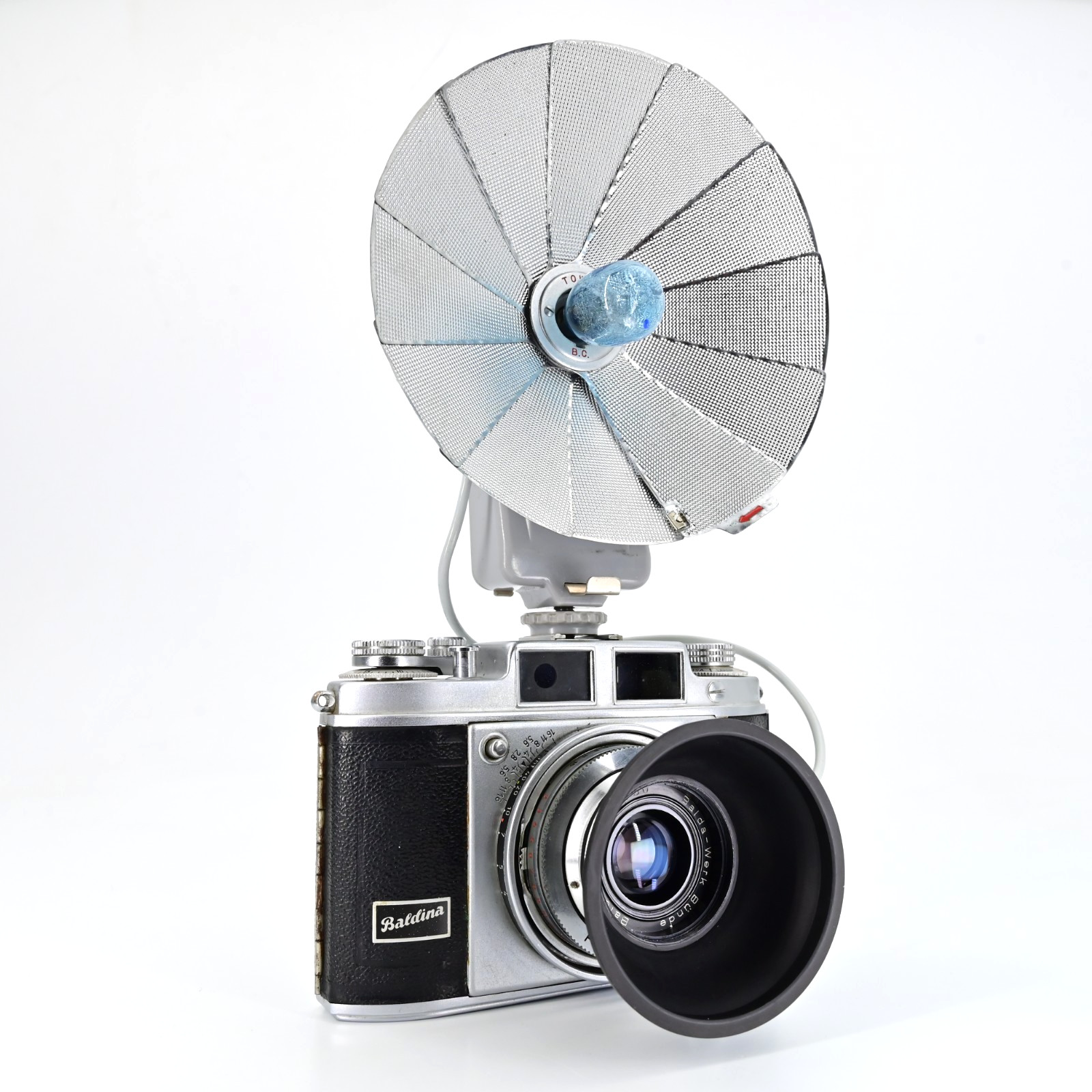
Designed as a portable, high-quality folder for amateur and enthusiast photographers, it features a precision Compur shutter and a fixed high-grade lens, reflecting the engineering excellence typical of pre-war German camera manufacturing.
Overview
Introduced during a period of rapid innovation in 35mm camera design, the Baldina was part of Balda’s early push into the consumer-oriented folding camera market. At a time when 35mm film was gaining popularity due to its convenience and compact form factor, Balda positioned the Baldina as a premium yet accessible option for photographers seeking portability without sacrificing optical performance. The camera was manufactured in Dresden, Germany, a hub of optical engineering, and built with the meticulous craftsmanship associated with German camera makers of the era.
The Baldina is a compact folder with a collapsible front standard that retracts into the body when not in use, making it highly portable. It uses standard 135 film cassettes and produces 24mm × 36mm full-frame exposures on 35mm film, typically yielding 36 exposures per roll. It features a fixed lens—most commonly a 45mm f/3.5 or f/2.8 Triplet or Tessar-type design—mounted in a Compur-Rapid shutter assembly. The camera lacks built-in metering or automatic exposure functions, requiring manual settings for aperture and shutter speed, consistent with the fully mechanical design philosophy of the time.
Within Balda’s product lineup, the Baldina occupied a mid-to-upper tier position, above simpler box cameras but below more advanced models like the Baldax or later Baldatessa. It exemplifies the transition from large plate cameras to compact, roll-film-based systems, catering to a growing class of amateur photographers who valued both image quality and portability. Its construction—featuring leatherette-covered metal body, metal folding struts, and precision-machined shutter—reflects the high standards of German engineering in the interwar period.
Specifications
| Specification | Value |
| Type | Folding viewfinder camera |
| Film Format | |
| Years Produced | 1935–1940 |
| Lens Mount | Fixed lens (non-interchangeable) |
| Lens | |
| Shutter | |
| Aperture Range | f/3.5 to f/16 (varies by lens version) |
| Metering | None (manual exposure) |
| Exposure Modes | Manual only |
| Viewfinder | Optical frame viewfinder with parallax correction |
| Focusing | Scale focusing (fixed focus at hyperfocal distance on some variants) |
| Dimensions | Approx. 100 × 60 × 35 mm (folded); ~130 mm front extension |
| Weight | ~400 g (depending on lens/shutter configuration) |
Key Features
- Compur-Rapid Shutter: Offers shutter speeds from 1 second to 1/400 second plus Bulb mode, providing versatility in various lighting conditions.
- Compact Folding Design: Collapses into a pocketable size, ideal for travel and street photography.
- High-Quality Fixed Lens: Equipped with a 45mm lens of Tessar or Triplet optical design, delivering sharp, contrast-rich images for its era.
- Precision Build Quality: German-engineered construction with metal body, leather bellows, and reliable mechanical components.
- Frame Counter: Manual film advance with red window on the back for frame counting (later models may feature automatic coupling).
Historical Context
Unlike the rangefinder-based Leica, the Baldina was a simpler viewfinder camera aimed at photographers who wanted quality optics and mechanical reliability without the high cost of a system camera.
Balda, founded in 1919, had established a reputation for well-built, innovative cameras by the 1930s. The Baldina capitalized on the growing demand for compact, easy-to-use cameras that still delivered professional-grade results. Its use of the Compur shutter—a hallmark of premium German cameras—signaled its positioning in the upper tier of non-professional cameras. Production ceased around 1940 due to World War II, which disrupted German manufacturing and shifted industrial focus to military needs. As a result, surviving Baldinas are relatively rare, especially in working condition.
Collectibility & Value
The Balda Baldina is a sought-after collector’s item among vintage camera enthusiasts, particularly those interested in pre-war German engineering. Condition is critical: intact leatherette, uncracked bellows, smooth shutter operation, and clean optics significantly affect value.
When purchasing a Baldina, collectors should inspect the Compur shutter at all speeds, as oil drying or gumming is common after decades of disuse. The red window should be clear and free of mold, and the film advance mechanism must operate smoothly. Bellows are prone to pinholes or brittleness, which can cause light leaks. While repair parts are scarce, skilled technicians familiar with vintage shutters can often restore functionality. Due to its age and mechanical complexity, the Baldina is not recommended for beginners but is a rewarding project for experienced restorers.
Similar Cameras
- Kodak Retina I (Type 117) – A contemporaneous 35mm folding camera with similar portability and quality, though with a proprietary film loading system.
- Wirgin Edinex – German-made 35mm folder with interchangeable lenses and Compur shutter options.
- Zephyr 35 – British 35mm folder with similar form factor and manual operation.
- Gomz-1 (USSR) – Post-war Soviet copy of pre-war German 35mm folders, inspired by designs like the Baldina.
- Rollei 35 – Though produced much later (1966), it shares the Baldina’s philosophy of compact, high-quality 35mm photography.
Repair & Maintenance
The Baldina requires no batteries, operating entirely mechanically. The Compur-Rapid shutter is the most critical component and may require cleaning, lubrication, and speed recalibration if it has been dormant for years. Shutter speeds below 1/30 sec are especially prone to inconsistency due to dried lubricants. The lens should be checked for fungus, haze, or separation, though many Baldina lenses remain in excellent condition due to high-quality glass and coatings of the period. The folding struts and hinge mechanisms should move smoothly; stiff action may indicate dried grease or misalignment. Regular use, proper storage in a dry environment, and periodic servicing by a specialist in vintage shutters are recommended to maintain functionality.
eBay Listings


As an eBay Partner, we earn from qualifying purchases. This helps support our independent vintage technology research.